

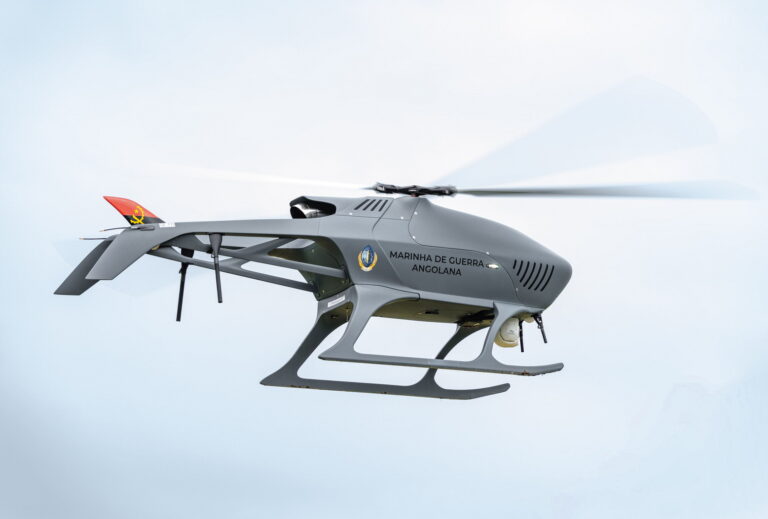
The United Arab Emirates’ EDGE Group has delivered six ANAVIA HT-100 NAVAL unmanned aerial vehicles (UAVs) to the Angolan Navy, completing a milestone in the broader one billion euro programme to build three BR71 Mk II Combattante corvettes for the African nation. EDGE announced the delivery on 10 September, following Factory Acceptance Trials (FAT) conducted from 24 to 28 August at ANAVIA’s facility in Bilten, Switzerland, attended by a delegation from the Angolan Navy and Simportex, the state enterprise responsible for importing equipment and services for Angola’s defence sector.
The delivery follows directly from Military Africa’s coverage in March 2026, when the outlet first reported that each corvette would carry two HT-100 systems, shortly after the programme’s first vessel, the NRA Ekuikui II, was launched in Cherbourg. What was then an announced allocation has now become a physically delivered capability, with the drones set to be integrated onto the corvettes ahead of sea trials in Angola.
What the HT-100 Actually Is
The HT-100 is a compact unmanned helicopter measuring 2.8 metres in length and 1 metre in height, with a 3.75-metre rotor diameter. Its most distinctive engineering feature is a pair of intermeshing main rotors that eliminate the need for a tail rotor entirely, a configuration sometimes called a synchropter, which ANAVIA says makes the aircraft roughly 30 percent more efficient than a helicopter using a conventional single main rotor and tail rotor layout, since no power is diverted to counteracting torque through a separate tail rotor.
Power comes from a 15-kilowatt turbine engine burning Jet A1 fuel at nine litres per hour, giving the aircraft a maximum range of 600 kilometres, extendable to effectively unlimited range through a satellite data link rather than a line-of-sight radio connection alone. Cruise speed is 100 kilometres per hour, with a maximum of 120 kilometres per hour. Endurance depends heavily on payload: carrying a 51-kilogram payload limits flight time to one hour, while dropping to a lighter 14-kilogram payload extends endurance to six hours, a trade-off typical of small rotary-wing UAVs where lift capacity and fuel-carrying time compete directly against each other. The carbon-fibre airframe weighs just 58 kilograms empty, which ANAVIA describes as the lightest in its payload class, against a maximum take-off weight of 120 kilograms and a maximum payload of 60 kilograms, with 60 litres of fuel capacity. Compatible payloads span electro-optical and infrared surveillance cameras offering 67 times optical zoom and cooled mid-wave infrared thermal imaging, wide-area search sensors, LiDAR mapping equipment, hyperspectral and multispectral imagers, emissions detection systems, communications intelligence equipment, high-resolution 100-megapixel cameras, and cargo boxes capable of carrying up to 50 kilograms across 90 litres of volume.
More Than a Subcontractor Relationship
EDGE’s own announcement describes the delivery as the product of “close collaboration across EDGE, ADSB, and ANAVIA,” language that understates how tightly integrated these three organisations actually are. Abu Dhabi Ship Building (ADSB) is EDGE’s own naval subsidiary, and EDGE acquired a 52 percent majority stake in ANAVIA in late 2023, meaning the Swiss manufacturer has been substantially an EDGE Group asset for nearly two years rather than an independent supplier EDGE simply contracted for this programme. That ownership structure matters for how the Angola deal should be read: rather than three separate companies coordinating a joint delivery, this is largely a single corporate group delivering an integrated naval package across its own subsidiaries, from the corvette hull design through to the embarked unmanned aircraft.
Two HT-100 NAVAL systems will be assigned to each of the three corvettes, fully integrated with the vessels’ combat management systems so that the drones’ data feed appears directly on the ship’s bridge rather than requiring a separate control station, extending each vessel’s surveillance and reconnaissance reach well beyond its own radar horizon. Khaled Al Zaabi, President of Platforms and Systems at EDGE Group, called the completed trials “an important milestone in the delivery of this advanced capability,” while ANAVIA Co-Chief Executive Officer and founder Ishan Sahgal described the programme as demonstrating the company’s ability to deliver a complete, fully autonomous shipborne system tailored to a specific customer’s operational requirements, a characterisation that reflects the companies’ own assessment of the programme rather than independently verified performance data, since the systems have not yet undergone integrated sea trials aboard the corvettes themselves.
The Corvettes They Will Fly From
The BR71 Mk II Combattante is a 900-tonne light corvette, measuring roughly 70 to 71 metres in length with an 11-metre beam depending on the source consulted, developed by French shipbuilder CMN Naval, part of the Privinvest Shipbuilding Group, as an upgraded evolution of the Baynunah-class corvette already in service with the UAE Navy since the mid-2000s. That lineage gives the design a proven operational pedigree rather than an unproven concept, since the original Baynunah class has patrolled UAE waters for close to two decades. The Angolan variant carries a steel hull and aluminium superstructure engineered to reduce radar cross-section, propelled by four MTU diesel engines driving four Kongsberg waterjets to a top speed of 30 knots, with a range of 2,500 nautical miles at a 12-knot cruising speed and a crew of roughly 50.
Angola opted for a notably heavy armament package for a vessel of this size, comprising eight Exocet MM40 Block 3C anti-ship missiles, an eight-cell VL MICA vertical-launch surface-to-air missile system, a Simbad-RC short-range air defence system, a 76-millimetre main gun supplied by Italy’s Leonardo, and two 20-millimetre Lionfish remote weapon stations. Italian firm Elettronica is supplying the electronic warfare suite, and French company Lacroix is providing anti-missile decoy systems, while a rear deck can accommodate a helicopter of up to five tonnes alongside two six-metre rigid-hull inflatable boats.
The contract itself, worth one billion euros, was signed in February 2023 at the IDEX defence exhibition, described at the time as the largest export deal in ADSB’s history. CMN Naval is building the first and third corvettes in Cherbourg, France, while ADSB is constructing the second in Abu Dhabi, an arrangement that includes technology transfer to Angola. Keel-laying for the programme’s C200 hull blocks took place simultaneously in both cities in October 2024, and the lead vessel, NRA Ekuikui II, was launched in Cherbourg on 4 March 2026, with delivery expected around October 2026 and all three vessels anticipated to be in Angolan Navy service by 2027.
Part of a Wider Fleet Renewal
The corvette and drone programme sits inside a considerably larger renewal of Angola’s naval forces, the Marinha de Guerra Angolana. CMN has separately delivered two 70-metre LCT-200-type tank landing craft, the first arriving in 2023, three 43-metre Ocean Eagle patrol boats, and two tugboats, while ADSB has delivered a further seven high-speed interceptor craft, six measuring 12 metres and one measuring 16 metres, described by the company as supporting the Angolan Navy’s maritime surveillance and national security objectives. Angola has also begun building domestic capacity through the Lobinave shipyard, launched in January 2026 in partnership with CMN, which is intended to eventually produce DV15 interceptor vessels and support stealth assault and special operations craft locally, alongside future frigates and corvettes.
The naval build-out reflects a broader Angola-UAE security relationship that extends beyond ships and drones. EDGE separately signed a letter of intent with Angola’s Ministry of Interior in October 2025 to deploy a comprehensive border security solution, indicating the UAE conglomerate’s ambitions in Angola now span both naval defence and domestic security infrastructure. For a country with roughly 1,600 kilometres of Atlantic coastline to secure, the HT-100 delivery represents a comparatively small but operationally significant piece of a naval modernisation programme that, once complete, will give Angola one of the more capable and heavily armed corvette fleets among African navies of comparable size.