


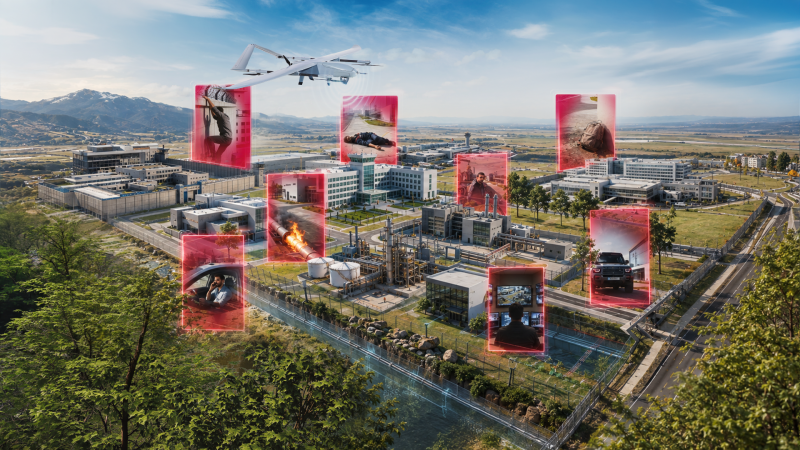
Across Africa, critical infrastructure, from military facilities and ports to energy and mining sites and airports operates in diverse environments and faces different threat profiles. HAVELSAN’s Critical Infrastructure Security Concept addresses this diversity not with a standard package of systems, but with a security architecture that preserves existing investments, allows new capabilities to be integrated as requirements evolve, and brings information from multiple sources into a common operational picture.
Critical infrastructure security in Africa cannot be addressed through a single threat model. The security requirements of a remote military facility are fundamentally different from those of a busy port, just as protecting an energy pipeline stretching across hundreds of kilometres requires a different approach from securing an air base. Location, surrounding activity, accessibility and existing security infrastructure all influence how the security architecture should be designed.
The changing threat environment adds another dimension. Unmanned aerial vehicles can be used for reconnaissance, surveillance or attack; facilities may face sabotage and unauthorised access attempts; large areas require persistent surveillance; coastal sites need to monitor approaches from the sea; and CBRN risks introduce an entirely different set of operational requirements. Security can therefore no longer be confined to the physical perimeter of a facility.
For energy and mining sites spread across large geographical areas, early detection and long-range surveillance may take priority. Ports and coastal facilities may require activity across the land, air and maritime domains to be assessed together. At remote facilities, meanwhile, the effective use of personnel and response assets becomes particularly important.
Modern critical facilities rely on interconnected networks, command and control systems, surveillance technologies, access control systems and operational infrastructure. A successful cyberattack can compromise not only sensitive information but also physical security, operational continuity, and mission-critical capabilities. Protecting a critical facility requires a comprehensive approach that integrates both physical and cyber security. Therefore, our security approach considers cybersecurity from the very beginning as a core element of the overall security architecture.
This environment demonstrates why simply deploying more sensors or platforms does not necessarily provide better security. The real requirement is to bring information from existing and newly introduced systems together, detect potential threats as early as possible, assess them through different assets and, when necessary, coordinate the appropriate response within the same operational structure.
HAVELSAN’s Critical Infrastructure Security Concept is therefore designed not as a fixed product package, but as a security architecture that can be configured according to the existing infrastructure, geographical conditions and threat profile of the facility being protected.
Existing Infrastructure New Capabilities
Improving critical infrastructure security does not always require replacing what is already in place. Many military facilities, airports, ports and industrial sites already operate camera networks, perimeter sensors, access-control infrastructure and security systems supplied by different manufacturers.
The first question, therefore, is not which systems should be replaced, but how much of the existing investment can be retained and how missing capabilities can be integrated into that environment.
At a large facility equipped with hundreds of cameras, for example, adding more cameras may not deliver a proportional improvement in security. As the volume of video increases, it becomes increasingly difficult for operators to continuously monitor every feed. The requirement shifts from generating more imagery to identifying security relevant events within the available imagery in time to act.
HAVELSAN’s EYEMINER Video Analytics Platform adds this capability by applying analytical methods to video generated by existing camera infrastructure. Modernisation can therefore begin by making more effective use of existing video feeds rather than replacing the camera network itself.
This also allows critical infrastructure security to be approached not as a one time investment, but as an architecture that can evolve as threats and operational requirements change.
Looking Beyond the Perimeter
Fixed security systems may not provide sufficient coverage for every facility. Large sites, extended perimeter lines, distant approach routes and difficult-to-access areas can require surveillance to extend well beyond the physical boundary.
HAVELSAN’s BAHA Autonomous Unmanned Aerial Vehicle can be incorporated into the security architecture where such a requirement exists, providing aerial observation beyond the coverage of fixed systems, supporting the assessment of activity around a facility and allowing surveillance capability to be directed towards a specific area when required.
The objective is not to add the same platform to every facility. Aerial surveillance becomes part of the architecture where geography, facility size and the threat assessment justify its use.
A similar requirement exists for critical infrastructure with access to the sea. For ports, naval bases and strategic coastal infrastructure, the security perimeter does not end at the shoreline. Maritime approaches need to be monitored, and activity at sea may need to be assessed together with the security picture on land.
The SANCAR Armed Autonomous Unmanned Surface Vehicle can provide an additional capability where the security area needs to extend into the maritime domain. This enables air, land and maritime approaches to be considered not as separate security environments, but as different dimensions of the protection of the same facility.
Keeping Personnel Away from Risk
Detection is only the first stage of critical infrastructure security. An alarm may need to be verified, a suspicious area inspected, a site examined following an attack or sabotage attempt, or a potentially hazardous location physically approached.
In such situations, unmanned systems can move beyond surveillance and provide security teams with additional options for assessing and responding to an incident.
HAVELSAN’s BARKAN Unmanned Ground Vehicle can support reconnaissance, surveillance and field operations within and around critical facilities with different mission payloads. In particular, it can help gather information before personnel are sent into an area where the level of risk has not yet been established, enabling the situation to be assessed and subsequent action to be planned on the basis of available information.
The role of autonomy here is not to replace personnel, but to provide more options for deciding when and where personnel should be deployed and what information should be available before they are sent into a potentially hazardous area.
This becomes even more important in CBRN incidents. Where chemical, biological, radiological or nuclear hazards may be present, the nature of the threat and the affected area need to be assessed as accurately as possible before security or response teams enter the site.
CBRN reconnaissance, detection and assessment capabilities within the concept allow these risks to be addressed as part of the wider security architecture rather than through an isolated process. When combined with unmanned systems, they can support information gathering from hazardous areas and allow subsequent response measures to be planned on the basis of the data collected.
From Sensors to a Common Operational Picture
Adding cameras, sensors, unmanned aerial vehicles, ground vehicles or maritime platforms can increase the technical capacity of a critical facility. But if each system introduces a separate screen, data stream and operational process, the fundamental information management challenge facing the decision-maker remains.
For this reason, the defining element of HAVELSAN’s approach is not simply the range of sensors and platforms available, but the ability to bring the information they generate together at the command-and-control level.
HAVELSAN’s experience in command and control lies at the centre of this approach. The DOOB Joint C4I System provides the structure through which information from different operational sources can be assessed in a common environment while supporting command-and-control processes.
The objective is not to add more screens to an operations centre, but to shorten the distance between detection and decision.
A suspicious activity identified through existing camera infrastructure or EYEMINER, for example, could be assessed from another angle using BAHA. BARKAN could then be directed towards a potentially hazardous location, while at a coastal facility, activity along a maritime approach could be monitored using an asset such as SANCAR. Assessing the information generated by these different sources as part of the same incident requires a fundamentally different operational structure from operating each security system independently.
Within such an architecture, the security chain extends from detection and verification to assessment and the coordination of response. Instead of working with isolated data generated by individual platforms, decision-makers can act on a common operational picture that provides a broader understanding of the incident.
This is where HAVELSAN’s value proposition becomes particularly relevant. The company’s approach is not based solely on having capabilities in video analytics or unmanned air, ground and maritime systems. It is built around the ability to bring existing systems and new capabilities into the same security architecture through command-and-control and software expertise.
No Single Configuration for Africa
Africa’s geographical and operational diversity makes a standard configuration for critical infrastructure security impractical.
At remote military facilities across large areas such as the Sahel, early detection of approaches beyond the perimeter, wide-area surveillance and the effective use of limited personnel may be priorities. At a major port or coastal facility in North Africa, the requirement may instead be to monitor activity across the land, air and maritime domains as part of the same security picture.
For energy and mining sites, large areas, remote locations and extended perimeter lines may shape the security architecture. At air bases, command centres and other high-security facilities, the coordination of information from multiple sensors with available response assets may become more important.
For this reason, the first question within HAVELSAN’s Critical Infrastructure Security Concept is not “Which product should be deployed?” but rather “What facility needs to be protected, under what conditions, and against which threats?”
Once these requirements have been assessed, usable elements of the existing security infrastructure can be retained, while video analytics, autonomous air, ground or maritime systems and CBRN capabilities can be integrated where needed. As the threat profile or operational requirement changes, the architecture can be expanded with additional capabilities rather than rebuilt from the ground up.
For critical infrastructure across Africa, the defining question is therefore no longer simply how many cameras, sensors or unmanned platforms are deployed, but how effectively those capabilities can work together when a threat emerges.
HAVELSAN’s Critical Infrastructure Security Concept is therefore not positioned as a standard security package made up of separate products. It is based on preserving existing infrastructure where possible, adding the capabilities required by the threat environment and transforming information from different sources into a common operational picture.
Across an architecture extending from video analytics and autonomous air, ground and maritime systems to CBRN capabilities and command and control, technology is not treated as an end in itself. It becomes part of a security chain extending from detection and assessment to the coordination of response.