

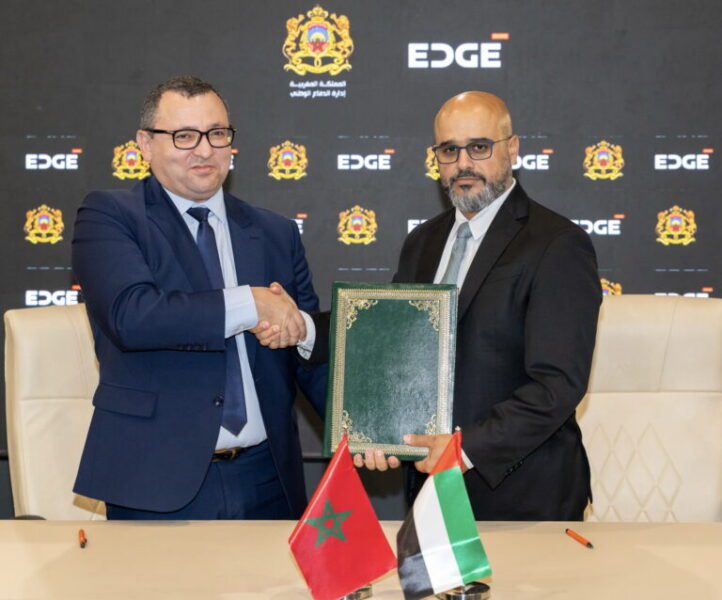
EDGE Group signed a contract to supply guided weapons to the Royal Moroccan Air Force on Friday, 9 October 2026, at the Marrakech Air Show. The company also signed a separate agreement to explore the local production of weapons in Morocco.
The Abu Dhabi-based defence group concluded both agreements with Morocco’s Administration of National Defence (ADN), the body responsible for procurement for the Royal Armed Forces. The weapons contract covers two systems: the DESERT STING 16 (DS-16), a guided glide bomb, and the THUNDER P-31, a precision-guidance kit designed for the MK 81 general-purpose bomb. Both systems are manufactured by HALCON, an EDGE subsidiary.
The agreement extends beyond a straightforward purchase. EDGE will also undertake integration work across Morocco’s fleet of unmanned combat aerial vehicles (UCAVs), including the aircraft modifications and software required to enable Moroccan drones to carry and deploy the munitions.
Saif Al Dahbashi, EDGE’s President of Missiles & Weapons, said the contract reflects the air force’s requirements. Each system comes with “assured supply and long-term sustainment,” he said, describing the agreement as a foundation for “an enduring relationship” with Morocco.
The two weapons serve distinct roles. The DS-16 weighs 23 kg, including a 12 kg warhead, and can strike targets up to 15 km away when released from an altitude of 30,000 feet. It is a complete glide weapon rather than an add-on kit. The THUNDER P-31 operates differently: it converts an existing MK 81 bomb into a precision weapon by adding a guidance kit. This extends its range to 10 km when launched from drones and up to 20 km from faster, higher-flying aircraft. Both systems rely on GNSS-assisted inertial navigation, which combines satellite positioning with onboard sensors, and can be equipped with an optional semi-active laser seeker for increased accuracy.
The pairing provides Moroccan drones with two distinct strike profiles: a lighter glide weapon for shorter-range precision operations and a modified general-purpose bomb for longer-range stand-off engagements. EDGE has prior experience integrating the DS-16 onto unmanned platforms. In January 2024, the company announced a programme to integrate the weapon onto the Bayraktar TB2, a drone already operated by Morocco, with further aircraft integrations planned thereafter.
The second agreement signed on Friday points in a different direction: manufacturing weapons in Morocco rather than importing them. The memorandum of understanding (MoU) tasks EDGE and the ADN with identifying opportunities for local production of small arms and aeronautical engines. This work would be conducted through partnerships with Moroccan companies rather than by EDGE alone.
Two EDGE business units are likely to play a central role in this effort. CARACAL designs and manufactures high-performance small arms and small-calibre ammunition. POWERTECH develops aero engines and propulsion systems for unmanned platforms. Both are part of EDGE’s wider manufacturing network in the UAE, which the group has been extending to partner countries seeking to develop their own defence industries.
Hamad Al Marar, EDGE’s Managing Director and CEO, presented the MoU as part of this broader approach. “Morocco is a key partner for EDGE in Africa, and this MoU puts our partnership-first approach into practice,” he said, describing a model based on “knowledge exchange, local production, and technology transfer.” He added that working with Moroccan companies on firearms and aero engines would help build “an industrial backbone” for the kingdom’s defence requirements.
Friday’s signings took place during EDGE’s second appearance at the Marrakech Air Show, where the company also displayed surveillance, counter-drone, navigation-protection and loitering-munition products. EDGE first exhibited at the show in 2024.
The contract is consistent with EDGE’s broader expansion across Africa. The company is currently delivering a €1 billion naval modernisation programme in Angola, which includes three Combattante corvettes and six naval unmanned helicopters. In 2025, it also signed a letter of intent with Angola’s interior ministry for a border-security programme. Further south, EDGE is reportedly in advanced discussions concerning a $300 million equipment deal with Nigeria, focused on the army’s ground forces and counter-terrorism units.
Morocco’s fighter procurement has progressed unevenly in recent years. In 2022, the UAE offered Rabat its entire fleet of Mirage 2000 jets, but a planned transfer of 30 Mirage 2000-9 aircraft was postponed this year. The decision was linked to regional instability, which has prompted the UAE to retain more of its combat aircraft in service. Arming the drone fleet instead gives Morocco a faster route to precision-strike capability while the fighter transfer remains unresolved.
For the Royal Moroccan Air Force, the agreement addresses a capability gap rather than establishing an entirely new capability. Morocco has operated armed drones for several years, but integrating a two-tier weapons set—a lighter glide bomb and a longer-range guided kit—broadens the range of targets its UCAVs can engage without requiring new airframes. The production MoU represents a longer-term commitment: if it leads to manufacturing agreements, it would mark a shift from purchasing finished weapons to producing components of Morocco’s own defence supply chain.