

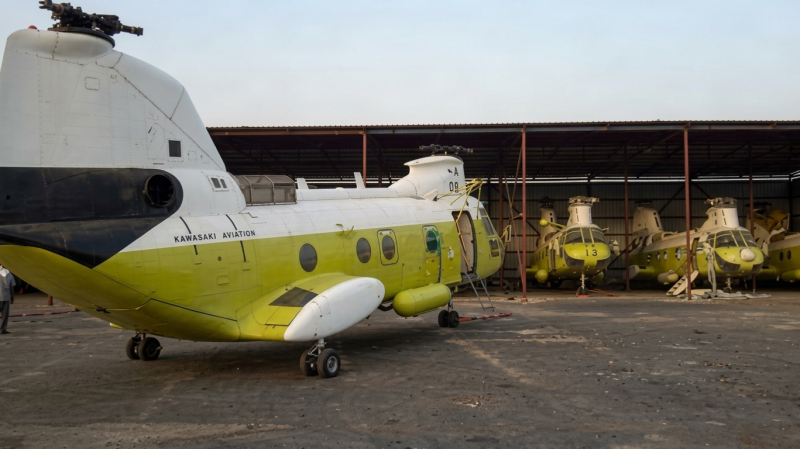
The twelve Kawasaki KV-107 helicopters that Nigeria was reported in January to be acquiring from Saudi Arabia are back on the market, according to a source familiar with the matter. Nefer Defence, described as the agency in charge of the procurement, would prefer to sell the fleet in bulk, together with what the source calls a plentiful supply of spare parts. Military Africa independently confirm the sale notice and identifed Nefer Defenceas the sole agency in charge of the sale. Although, the Nigerian Ministry of Defence, the Nigerian Air Force (NAF) or Saudi authorities have not publicly confirm the transfer or its cancellation in any material reviewed for this article. The end of the plan is therefore an inference drawn from the sale notice, not an announced decision.
What Is on Offer
The fleet is made up of twelve KV-107IIA helicopters in four configurations: five firefighting aircraft, three multi-purpose cargo, passenger and search and rescue (SAR) helicopters, two fitted for very important person (VIP) transport, and two air ambulances. Nefer Defence describes them as “naval-type helicopters manufactured between 1978 and 1984, all of which have undergone regular maintenance.” The notice by Nefer says it is a “naval-type.”
Open-source airframe records are broadly consistent with that profile. They list sixteen KV-107IIA-SM helicopters built between 1979 and 1984 for the General Civil Defence Agency of Saudi Arabia’s Ministry of Interior, two of which are recorded as written off, in 1987 and 2007. The sub-variants in that list cover firefighting, rescue, multi-purpose and air-ambulance roles, the same spread as the aircraft now being offered.
A Package That Looks Familiar
One detail complicates the idea that this fleet only recently came back to market. A classified listing on the Sky4buy website, bearing a March 2018 date stamp, advertised twelve KV-107IIA helicopters in an almost identical mix: five firefighting aircraft, three rescue and first-aid helicopters, two VIP transports and two ambulances. It also offered 27 spare engines, 20 gearboxes, 22 rotor hubs and 28 containers of spare parts. The seller described the aircraft as low-hour machines averaging about 5,000 flight hours and asked US$3 million each.
How the Deal Was Reported
The original account surfaced in early January 2026 through Honourable Aliyu Ibrahim Gebi, Special Adviser to the Chief of Defence Staff of the Armed Forces of Nigeria. He said the military was preparing for the arrival of twelve KV-107s from Saudi Arabia. Gebi did not explicitly confirm the transfer, but his record of accurately anticipating military acquisitions led analysts to treat the claim with weight.
When Military Africa reported the story on 29 January, official statements from the Ministry of Defence, the NAF and Saudi authorities were all still pending, leaving the delivery timeline and contractual details in “a state of informal anticipation.” In the eight months since, nothing on the public record has moved the matter forward.
The Aircraft
The KV-107 is a licence-built version of the Boeing Vertol Model 107, known in United States service as the CH-46 Sea Knight. Kawasaki Heavy Industries began production at Gifu in 1962. Its tandem-rotor layout, with two large rotors mounted one behind the other, removes the need for a tail rotor and gives the aircraft a wide centre-of-gravity envelope and stable handling in the hover and in crosswinds. The earlier Military Africa analysis judged those traits useful across the varied terrain of the Sahel and the Niger Delta. A rear loading ramp speeds the movement of palletised cargo and small vehicles, which shortens turnaround times on logistics sorties.
Published figures for the type show two CT58 turboshaft engines of 1,400 shaft horsepower each. The CT58 is a General Electric design built under licence in Japan by IHI. Empty weight is about 5,250 kilograms and maximum loaded weight about 9,700 kilograms, with a service ceiling near 5,180 metres and a range of about 1,097 kilometres on maximum fuel. The 270 kilometres per hour figure often quoted for the helicopter is its never-exceed speed. Sea-level maximum speed is closer to 254 kilometres per hour, with cruise around 240.
The January analysis put payload at roughly 4,000 kilograms, enough to move troops, equipment and supplies to remote areas. Simple subtraction shows the limits of that number. The gap between empty and loaded weight leaves about 4,450 kilograms for crew, fuel and payload combined, so a full 4,000-kilogram load cannot travel with full tanks. Data for the earlier KV-107/II-2 variant puts range at only about 175 kilometres when carrying a three-tonne payload with reserves. That figure may not match the IIA series exactly, but it illustrates the trade-off between load and distance. The type is also better described as medium-lift than heavy-lift, a point the January analysis itself acknowledged when it noted that a CH-47 Chinook offers greater capacity.
The Saudi Service Record
Saudi Arabia operated the KV-107 for decades, mainly under the Ministry of Interior for civil defence, security and SAR. The fleet included a firefighting version, a multi-purpose transport version and an air-ambulance version. The earlier analysis said the ambulance aircraft often carried advanced medical kit and could be configured for emergency surgical procedures. It added that the helicopters supported the Hajj pilgrimage and took part in high-stakes security operations, including rooftop assaults. Military Africa has not independently re-verified those operational claims.
Why Nigeria Was Interested, and What Was Left Open
The January analysis read the reported deal as a pragmatic answer to urgent logistical needs. Modern heavy-lift helicopters such as the CH-47 Chinook offer more capacity, but their cost and delivery schedules often put them out of reach for developing nations. Twelve airframes maintained for civil defence and SAR promised a considerable increase in lift at a lower cost per unit. The deal was also read as reinforcing defence ties between Abuja and Riyadh, a reading the sale notice now leaves without support.
The same analysis flagged the trade-offs. A licence-built type needs a steady supply of spare parts, particularly for the CT58 engines, and a robust support agreement, possibly involving third-party maintenance organisations familiar with Japanese-built airframes. The spares package in the sale notice speaks to that concern, though the 2018 listing suggests it may be an old offer rather than a new one.
Which service would fly the aircraft was never settled. The recently established Nigerian Army Aviation Corps has been building its fleet around MD 530F Cayuse Warrior scout helicopters and Bell UH-1 Huey utility helicopters, and the KV-107s would have given it its first dedicated heavy-lift capability and independent troop insertion without relying on NAF assets. The NAF, by contrast, has the established maintenance infrastructure and training programmes, which made it the more logical operator. Tandem-rotor helicopters demand type-specific pilot conversion and rotor-system maintenance skills, and whether the NAF’s existing infrastructure covers them was never established publicly.
What Nigeria Has Added Since January
The wider air-power programme the January analysis described has moved on while the KV-107 question stood still. Bell has begun building Nigeria’s first AH-1Z Viper attack helicopter, the first of twelve covered by a Foreign Military Sales case that the Defense Security Cooperation Agency valued at an estimated US$997 million when it notified Congress in April 2022. Businessday Nigeria notes that a separate US$455 million production contract awarded to Bell in 2024 covers manufacture of the aircraft, so the headline figure buys a capability rather than twelve bare airframes.
The NAF has taken delivery of its Turkish T-129 ATAK attack helicopters in batches, the first two in November 2023 and a second pair in October 2024, of an order for six. It completed factory acceptance testing on the first three of 24 M-346FA fighter-attack jets between 29 June and 9 July 2026. On 15 September it received three more AW109 Trekker B helicopters in Lagos, following two Airbus H125 utility helicopters, as part of a ten-aircraft order that brings planned Trekker holdings to sixteen.
None of those platforms supplies the medium or heavy troop and cargo lift that the KV-107 reports were meant to provide. The attack helicopters and the M-346FA add firepower, and the AW109 and H125 are light utility types. The January analysis described Nigeria’s acquisitions as part of the military’s “Golden Era” of fleet expansion. On the evidence so far, the lift gap sits outside that expansion.