

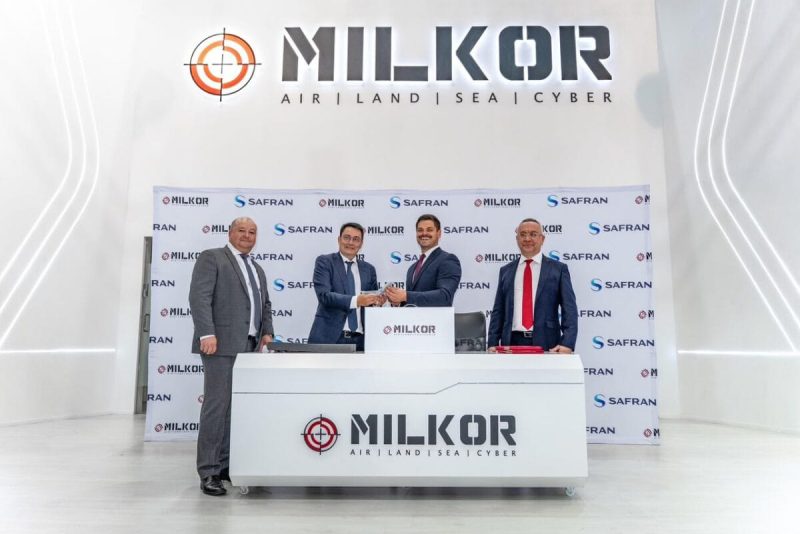
South African defense company Milkor Group and France’s Safran Electronics & Defense signed a memorandum of understanding (MoU) at the Africa Aerospace and Defence (AAD) exhibition in Pretoria, South Africa, to explore fitting Safran sensors and navigation gear to Milkor’s unmanned aircraft. The agreement was formalised at the Africa Aerospace and Defence Exhibition (AAD) 2026, in Pretoria, with Alexandre Ziegler, Director of the Defence Division at Safran Electronics & Defense, and Julian Coetzee, CEO of Milkor, signing on behalf of their companies. AAD 2026 runs from September 16 to 20 at Air Force Base Waterkloof in Centurion.
The MoU covers Safran’s airborne optronics (cameras and sensors that see in visible and infrared light), its position-navigation-timing (PNT) systems, and related equipment. The initial focus is the Milkor 380, a medium-altitude long-endurance (MALE) drone already in production. The deal also names the larger Milkor 780, a High-Altitude Long-Endurance (HALE) UAV strike-capable platform still under development, leaving room for cooperation as Milkor’s product line grows. The two firms are studying to integrate inertial navigation units, Global Navigation Satellite System (GNSS) receivers, and guided-weapons technology onto Milkor airframes.
Safran brings decades of experience building electro-optical sensors and navigation systems for military aircraft, ships, and munitions. In 2022, the firm acquired Orolia, a company known worldwide for PNT technology, and later that year it bought Cesson-Sevigne-based radio-navigation firm Syrlinks, moves that broadened its navigation portfolio well beyond its traditional optronics business. That track record gives Milkor a ready-made menu of sensor options.
Milkor designs and builds the 380 alongside armored vehicles and other defense equipment. The company has collaborated with outside partners. In 2025, it partnered with South Korea’s Hanwha Systems to widen the drone’s sensing and range, and in April 2026 it signed a separate MoU with South Korea’s LIG Nex1 D&A to co-develop unmanned systems. According to DefenceWeb, the Safran agreement extends that pattern into optronics and navigation, an area where Milkor previously relied largely on third-party gimbals such as the Hensoldt Argos 15 seen on the 380’s current production model.
The Milkor 380 has an 18.6-meter wingspan and a maximum take-off weight of 1,500 kilograms. It can stay aloft for roughly 30 to 35 hours at 10,000 feet, cruising around 60 knots, and has a range of over 4,000 kilometers. Line-of-sight radio links keep it in contact with ground control out to 250 kilometers, handing off to satellite communications for missions beyond that. Payload capacity ranges about 220 kilograms, split across 5 hardpoints: 2 outer wing stations rated at 80 kilograms each, 2 inner stations at 150 kilograms each, and an underbelly station cleared for 400 kilograms. A modular nose bay accepts different electro-optical, infrared, or radar payloads, which is exactly the kind of interface Safran’s sensors would plug into. At the AAD stand, the 380 on display also carried a synthetic aperture radar (SAR) pod, a larger satellite antenna, and FZ rocket launchers, hardware that points toward strike and all-weather surveillance roles rather than pure reconnaissance.

Milkor’s Cape Town plant currently turns out about 8 airframes a year, and the company has said it plans to double that output in 2026 to meet rising orders. Demand has been building steadily: talks since 2024 have covered a dozen Milkor 380s for the Democratic Republic of the Congo to support operations against M23 rebels, and in February 2024 Milkor secured a manufacturing permit for a local assembly line in Riyadh, Saudi Arabia, tied to the country’s Vision 2030 industrial program.
Safran, for its part, has been widening its own drone-integration footprint. It struck a similar optronics and navigation partnership with Turkish manufacturer Baykar in May 2026, aimed at the TB2 drone family, and in 2024 the Egyptian Navy chose Safran to fit optronic and navigation systems on 10 offshore patrol vessels. The Milkor MoU fits a broader company strategy of selling its sensor and navigation stack across as many export-oriented platforms as possible.
The Milkor 780 remains under development, and its final sensor suite is not yet finalized, which means Safran’s optronics and navigation lines could be defined into that aircraft at an earlier stage than they were for the 380.