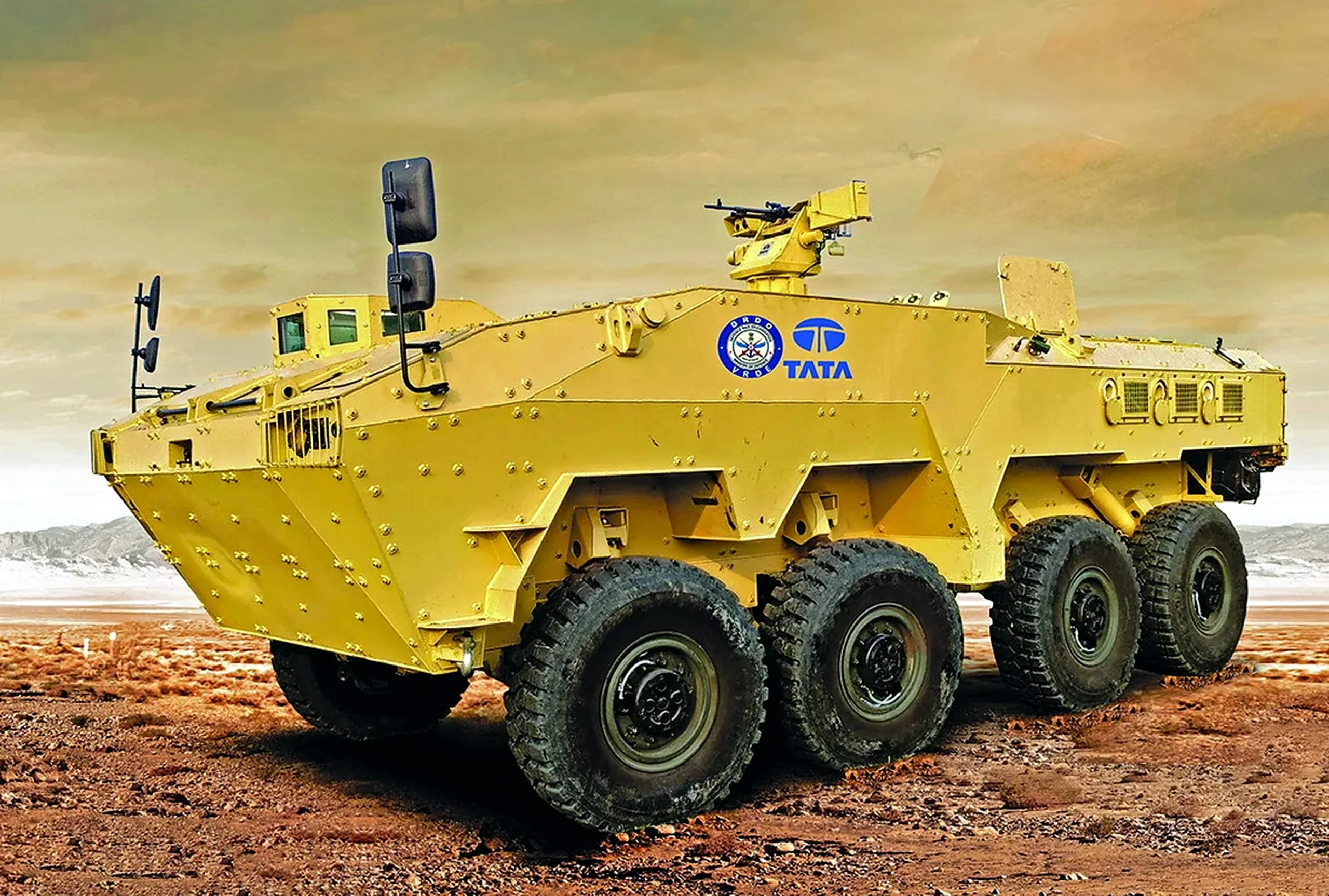
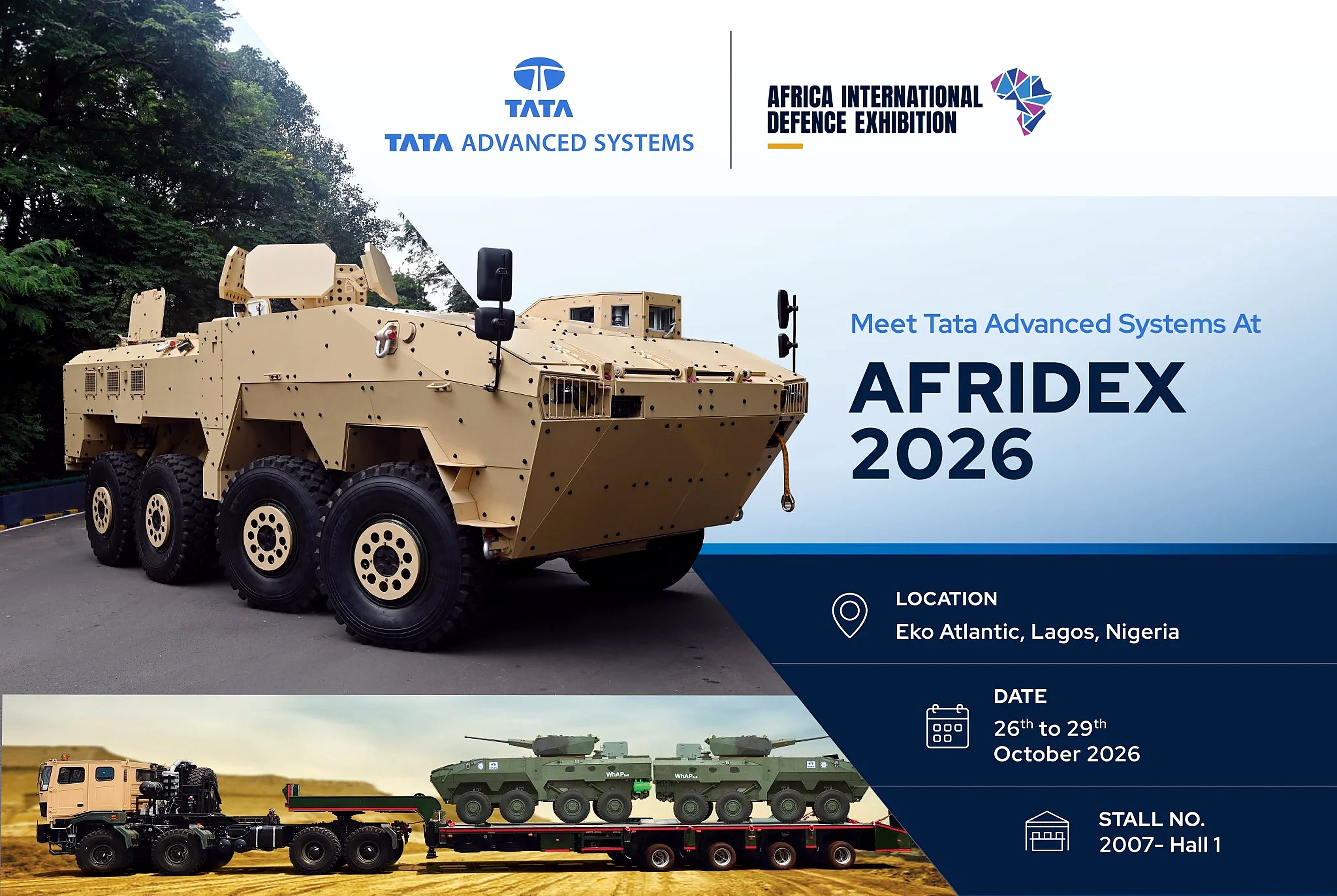
Tata Advanced Systems Limited (TASL), the Indian aerospace and defence arm of the Tata Group, showcased its 8×8 Wheeled Armoured Platform (WhAP) at the inaugural Africa International Defence Exhibition (AFRIDEX) in Lagos, Nigeria, held from 26 to 29 October 2026 at Eko Atlantic. The vehicle on display was built at TASL’s new factory in Morocco, the company’s first overseas defence manufacturing plant, DefenceWeb reported.
That plant sits in the industrial zone of Berrechid, near Casablanca. India’s defence minister, Rajnath Singh, and his Moroccan counterpart, Abdelatif Loudyi, jointly inaugurated the facility on 23 September 2025. The 20,000 square metre site had become operational three months ahead of schedule, according to TASL.
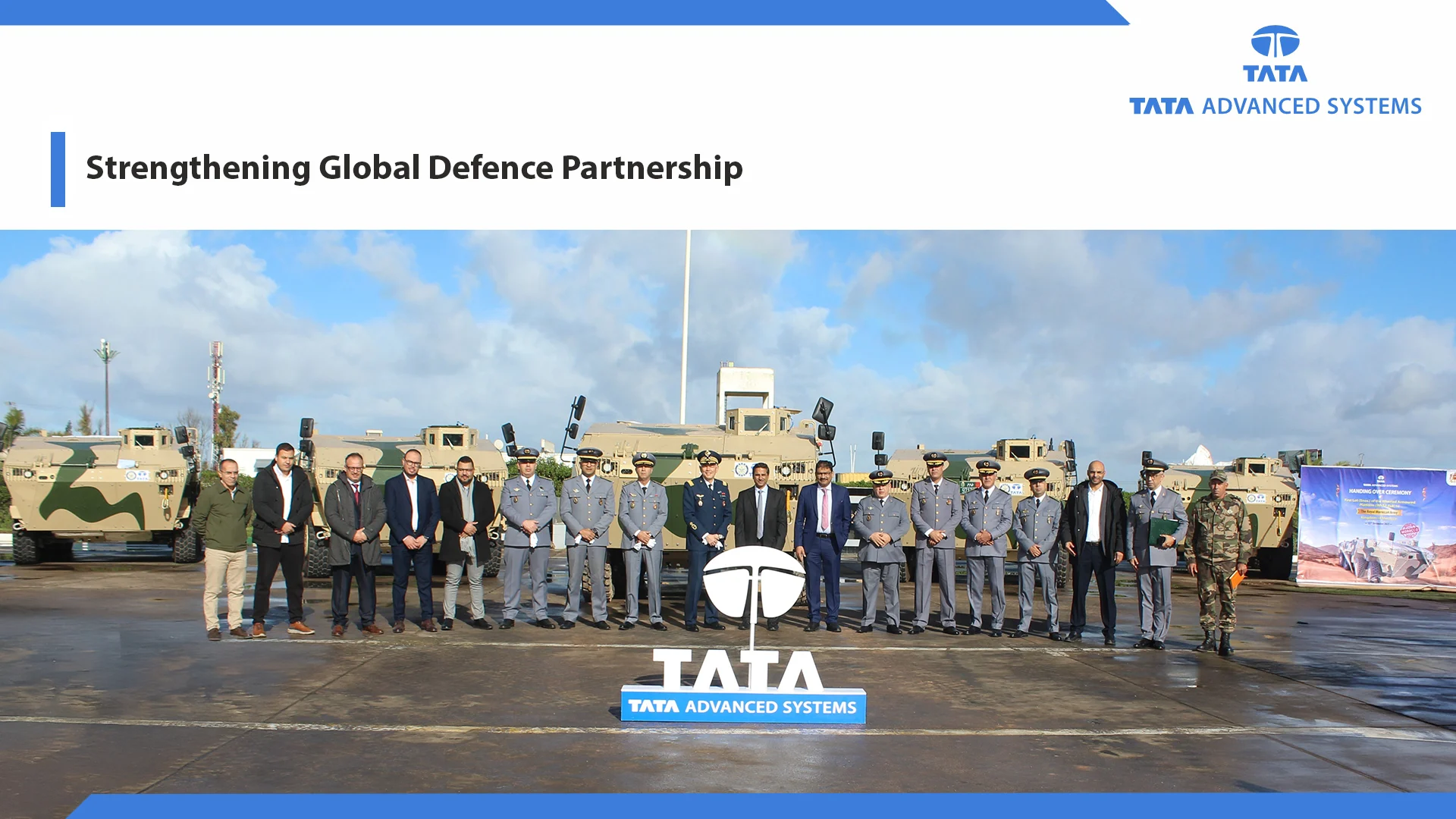
The project traces back to a deal signed on 30 September 2024, when TASL agreed with Morocco’s National Defence Administration to build the WhAP locally. Indian officials have said the contract covers 150 vehicles for the Royal Moroccan Army, delivered over three years. The Royal Moroccan Army received its first batch of Morocco-built WhAPs on 24 December 2025, a little over three months after the plant opened. Military Africa reported at the time that the first batch comprised five finished vehicles.
A Modular 8×8 Built With DRDO
The WhAP is India’s first amphibious infantry combat vehicle built in a wheeled configuration. It was developed jointly by TASL and India’s Defence Research and Development Organisation (DRDO), the state body that designs much of India’s indigenous military hardware. The Indian Army uses a version of the same vehicle under the name Infantry Protected Mobility Vehicle.
TASL describes the platform as modular, meaning the same hull can be reconfigured for different jobs rather than built as a single fixed design. Variants include a straightforward armoured personnel carrier, a reconnaissance vehicle, a command post, an ambulance, a light tank carrying a 105 mm gun, and a 120 mm self-propelled mortar. The base vehicle is reported to run on a 600 horsepower engine with a fully automatic transmission, and standard protection includes composite add-on armour, blast protection for the crew and a remote-controlled weapon station.
Earlier Military Africa reporting gives more detail. The vehicle weighs about 24 tonnes and uses a Cummins ISX engine with an Allison 4500SP automatic transmission, for a top road speed of 100 km/h. It carries a crew of three and nine infantry soldiers, and rear water jets drive it at up to 10 km/h afloat. DefenceWeb’s AFRIDEX report says the modular composite and steel armour meets STANAG 4569 Levels 1 to 4, the North Atlantic Treaty Organization (NATO) protection standard, with mine blast resistance rated at Level 3. Moroccan configurations can mount remote weapon stations with machine guns or 30 mm cannon.
Replacing Morocco’s Ageing Armour
That flexibility is part of the pitch to buyers like Morocco. The Royal Moroccan Army has been trying to replace an armoured vehicle fleet it considers too old for modern combat conditions since at least 2022, and much of that inventory is French-supplied equipment that has been in service for decades. A modular wheeled platform lets Rabat cover several roles, from troop transport to fire support, without running separate procurement programmes for each one. The same modernisation drive has touched Morocco’s logistics fleet, from new trucks to the Oshkosh tank transporters ordered this month.
For Morocco, the arrangement is about more than buying vehicles. Local production was always central to the deal. Morocco’s National Defence Administration said the Berrechid plant would initially source about 35 percent of its components from local suppliers, with that figure rising to 50 percent as Moroccan industry builds capacity. The government has framed the facility as a step toward a domestic defence-industrial base and a possible export hub for the wider region, though actual exports will depend on customer demand, export approvals and how quickly local suppliers mature. The plant employs about 90 people directly and supports some 250 indirect jobs, Military Africa reported in May.
India’s First Private Defence Factory Abroad
For India, the Moroccan plant marks its first privately operated defence factory outside the country and gives TASL a manufacturing foothold in North Africa, a region it had not previously supplied at scale. Tata’s defence and security division already makes artillery systems, rocket and missile launchers, air defence equipment, command and control systems, radars, optronics and cybersecurity products, so the WhAP is one piece of a broader portfolio the company is trying to sell into African and European markets. TASL’s chief executive, Sukaran Singh, called the Berrechid opening “a new chapter in the India-Morocco industrial partnership” at the time.
There is also a wider pattern. Tata Sons’ defence arm has been in talks to supply equipment to other African and European buyers as part of a broader Indian push to grow its arms exports, which have expanded steadily over the past decade as New Delhi tries to reduce its own dependence on imported weapons. A factory built abroad, staffed partly by local engineers and technicians, fits that strategy because it can serve as a base for regional sales without each customer having to buy directly from India. Other Indian firms are following: MKU plans an electro-optics and armour plant in Morocco, and at AFRIDEX itself India’s ADSL partnered Nigus Hercules on tank maintenance in Nigeria.
From Berrechid Hulls to New Orders
TASL has signalled it plans to expand the Berrechid site’s output beyond the WhAP. Plans are reportedly in place to add production of the company’s Light Armoured Multi-Role Vehicle (LAMV) at the same facility. Local subsidiary Metlonics Morocco confirmed in March 2026 that the plant had completed its first 20 hulls, suggesting serial output is now under way rather than limited to a handful of demonstration units. The plant is expected to reach up to 100 vehicles a year at full rate.
None of this guarantees TASL further orders elsewhere on the continent. Africa’s defence procurement market is fragmented, budgets are tight in most states, and established suppliers from Europe, Russia, China and Türkiye already compete hard for the same contracts. Nigeria’s own AFRIDEX exhibition, hosted under the patronage of the Nigerian government and organised with the country’s Defence Industries Corporation, is itself a sign that African governments want more leverage over who builds their hardware and where, not just another sales outlet for outside firms. President Bola Tinubu made the point when he told AFRIDEX that Africa must become more self-reliant in defence.
Can the Moroccan Template Travel to Lagos?
The Berrechid plant gives TASL a working template: design in India, produce in a partner country, build local supply chains, and use the resulting capacity as a selling point to third-party buyers. Whether that model travels beyond Morocco will depend on how the first full batches of Moroccan-built WhAPs perform in service, and on whether TASL can convert exhibition interest in Lagos into an actual contract with Nigeria or another African government.