The United States Air Force (USAF) is asking industry whether it can return up to four retired KC-10 Extender tankers to flying condition for an unnamed North African partner.
The Air Force Life Cycle Management Center (AFLCMC), the service’s acquisition and sustainment organisation, published the Request for Information (RFI) on 7 October 2026. The notice says it is issued “solely for information and planning purposes.”
The Air Force wants to identify companies that can handle regeneration, a one-time flight clearance, depot-level return to service, worldwide ferry delivery, in-country contractor logistics support (CLS) and operational and maintenance training. CLS means a company keeps the aircraft supplied and maintained after delivery. One report, from aviation site Migflug, cites a three-to-five-year sustainment package.
The tankers would move as Excess Defense Articles (EDA), a programme that passes surplus US equipment to allies at reduced cost or as a grant. The Defense Security Cooperation Agency says such equipment generally goes “as is, where is,” so the recipient pays for transport and refurbishment.
The Air Force does not name the country. TWZ, the online publication covering military technology, national security and geopolitics, The Aviationist and other defence outlets point to Egypt or Morocco.
What the Aircraft Offers
The KC-10 is a military version of the McDonnell Douglas DC-10-30CF, a convertible passenger-freighter airliner. The Air Force received 60, flew them from 1981, and sent the last one from Travis Air Force Base, California, to storage on 26 September 2024. The 309th Aerospace Maintenance and Regeneration Group (AMARG) at Davis-Monthan Air Force Base, Arizona, holds the stored fleet.
The KC-46 Pegasus replaced the Extender in USAF service. The retirement was controversial; TWZ notes the KC-10 carried more fuel than the KC-46.
The Air Force fact sheet lists a maximum fuel load of 356,000 lb (160,200 kg) and a cargo payload of up to 170,000 lb (76,560 kg) on 27 pallet positions. Range is 4,400 miles (7,080 km) with cargo and 11,500 miles (18,500 km) without. Three General Electric CF6-50C2 engines, each rated at 52,500 pounds-force of thrust, power the aircraft, and it can carry up to 75 people.
The KC-10 passes fuel two ways. A flying boom is a rigid pipe, steered by an operator, that locks into a receptacle on the receiving aircraft; it moves up to 1,100 US gallons a minute. A centreline hose-and-drogue, a flexible hose ending in a basket, delivers about 470 gallons a minute.
A KC-10 crew is four: pilot, co-pilot, flight engineer and boom operator. The training package in the notice therefore covers a new trade for an air force with no boom tanker experience, as well as maintenance.
Boom or Drogue in North Africa
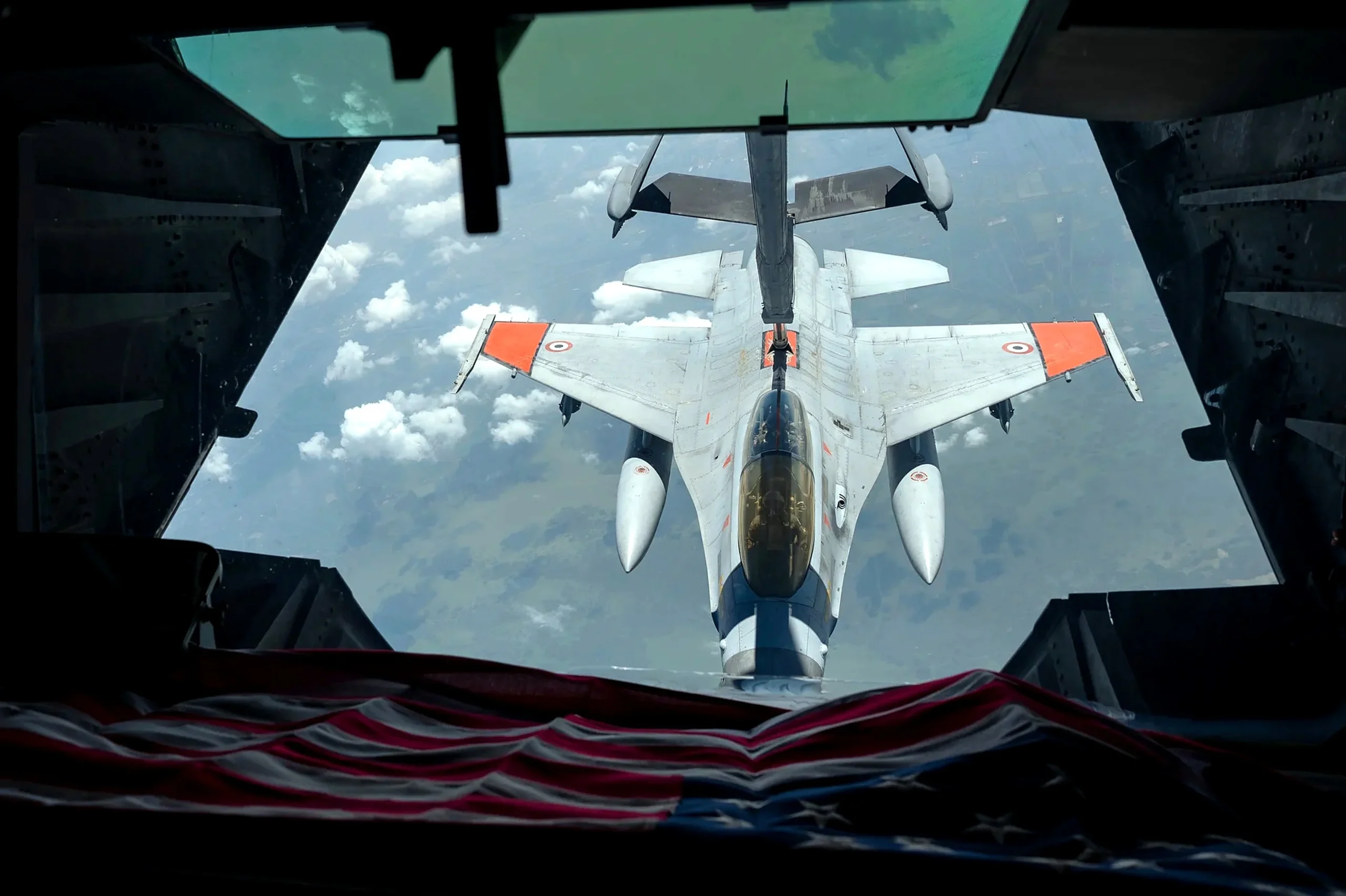
That mix matters in North Africa. The F-16 takes fuel only by boom, while fighters such as the Rafale and MiG-29M use a probe and drogue.
Egypt has no dedicated tankers, TWZ reports, and is buying two C-130J-30 transports that can serve as drogue tankers. In September, Chinese YY-20 tankers refuelled Egyptian MiG-29M and Rafale fighters during the Eagles of Civilization 2026 exercise, around the time Chinese aircraft made their overseas debuts at the El Alamein airshow. A YY-20 cannot serve Egypt’s F-16s.
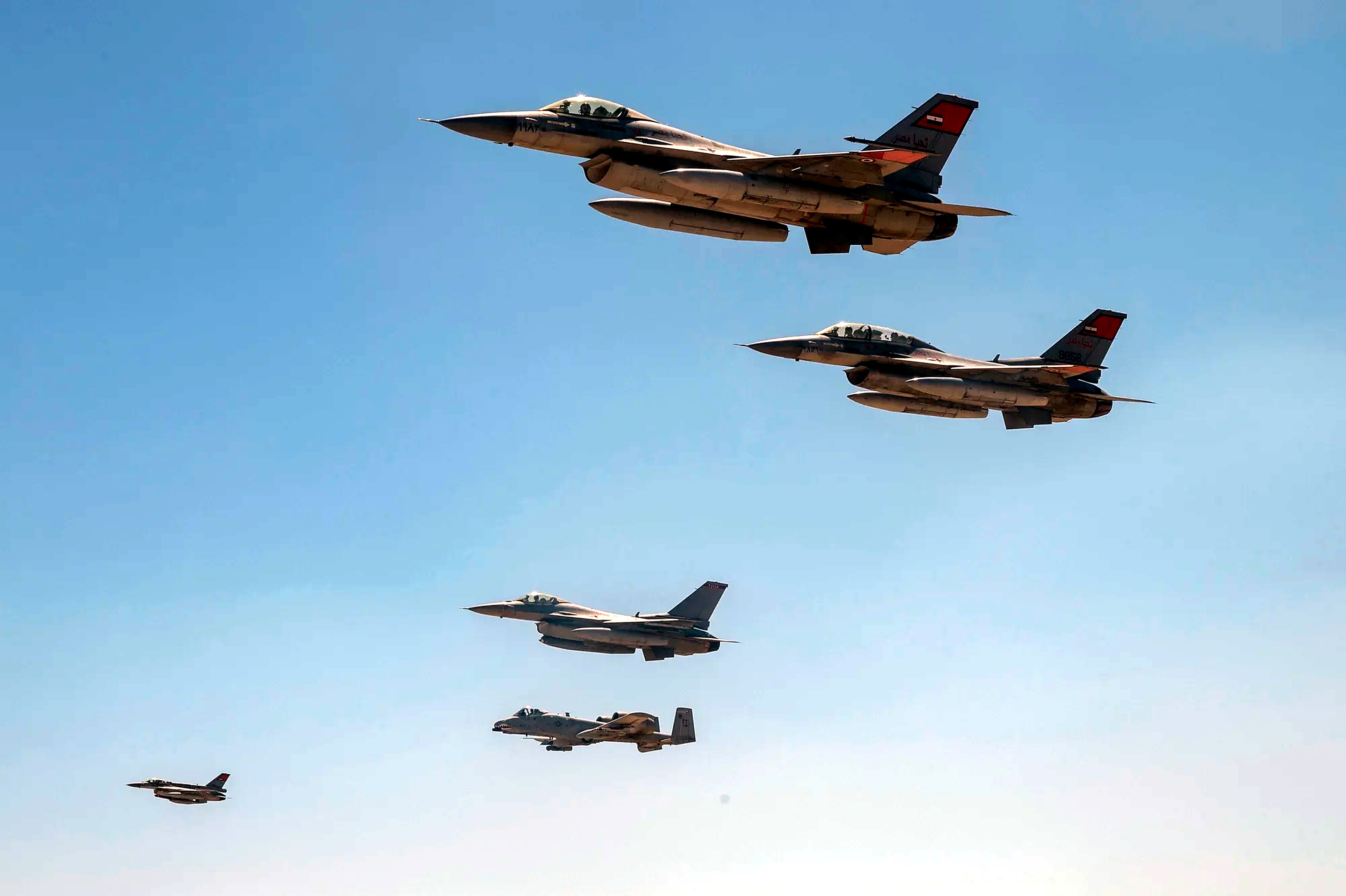
Egyptian pilots have flown with the KC-10 before. Egyptian F-16s formed up off the wing of a USAF Extender over Egypt during Exercise Bright Star on 14 September 2023, according to a US Air Force photo caption. Ten days earlier, on 4 September, an Egyptian F-16 practised taking fuel from a KC-10 of the 908th Expeditionary Air Refuelling Squadron, US Air Force imagery shows, so Egyptian crews already have some experience on the boom.
Morocco flies C-130s fitted for drogue refuelling, which leave its F-16s without a tanker of their own. Its first new-build F-16 Block 72 flew in early October. Rabat has also weighed the Embraer C-390 and Lockheed Martin C-130J for its transport fleet, both of which can be fitted as drogue tankers. The wider rivalry is set out in Military Africa’s analysis of North Africa’s air arms race.
Condition Is the Open Question
Congress’s fiscal 2026 defence authorisation act, signed in December 2025, told the Air Force to keep retired KC-10s “in the same storage condition” as of 30 September 2025. It left disposal open.
Outdoor desert storage, even with protective coatings, means engineers would expect to inspect structure, engines, wiring and hydraulics. They would also need a spare-parts chain for a type no longer in US service. Regenerating large military aircraft is costly and slow even when they sit in well-kept storage, TWZ says.
Ten earlier KC-10s were auctioned last year in non-flyable condition, each with one engine removed and booms stripped as spares for the fleet. TWZ says the private tanker operator Omega Air appears to have won them. Omega has shown the work is possible, and TWZ has reported a retired KC-10 flying again after storage.
The firm also flies two former Dutch KDC-10 tankers, a close relative of the KC-10, so at least one private operator already works on this family of aircraft.
A Record of US Aid to African Air Arms
The KC-10 notice follows earlier US aircraft transfers to African forces. In May 2016 the Air Force awarded North American Surveillance Systems and L3 Communications contracts worth about $40 million and $14.2 million to convert Cessna 208B turboprops into intelligence, surveillance and reconnaissance (ISR) aircraft. The work used US counter-terrorism partnership money.
Chad and Cameroon each received two of the aircraft in 2018. A US military photo showed a Chadian aircraft carrying an L3 Wescam MX-15 electro-optical and infrared sensor.
In September 2023, US Marine Corps General Michael Langley, then commander of US Africa Command (AFRICOM), announced an $80 million grant for four Bell 412EP helicopters for the Zambia Air Force. The grant also covers three years of service, parts and training. Major General Oscar Nyoni, deputy commander of the Zambia Air Force, said the helicopters would support domestic needs, regional security and United Nations peacekeeping.
Those aircraft were small and new or converted. The KC-10 would be a larger, older platform, and under normal EDA terms the recipient would bear refurbishment costs.
A Boom Tanker for North Africa’s Vipers
The EDA route keeps the purchase price low, but the cost sits in regeneration and support. TWZ argues that a low up-front price could still suit the right buyer, especially next to the cost of new-production tankers. For an air force that has never run a boom tanker, four KC-10s would add range for its F-16s without leaning on partner tankers.
The fit differs by country. Morocco’s new Block 72 F-16s would gain a boom tanker to match them. Egypt could serve its F-16s, Rafales and MiG-29Ms from one airframe type, rather than relying on foreign tankers during exercises.
TWZ notes the aircraft could instead be regenerated as cargo aircraft, though it judges that less likely. The KC-10 did both jobs for the Air Force, and a tanker can still carry freight.
Responses to the RFI were reportedly due on 28 October 2026, according to Migflug. No contract award or request for proposals had surfaced as of 14 November 2026, and the Air Force has not said how many firms responded or what the work might cost. The next marker is whether the Air Force issues that request for proposals, and whether a recipient government confirms its interest.