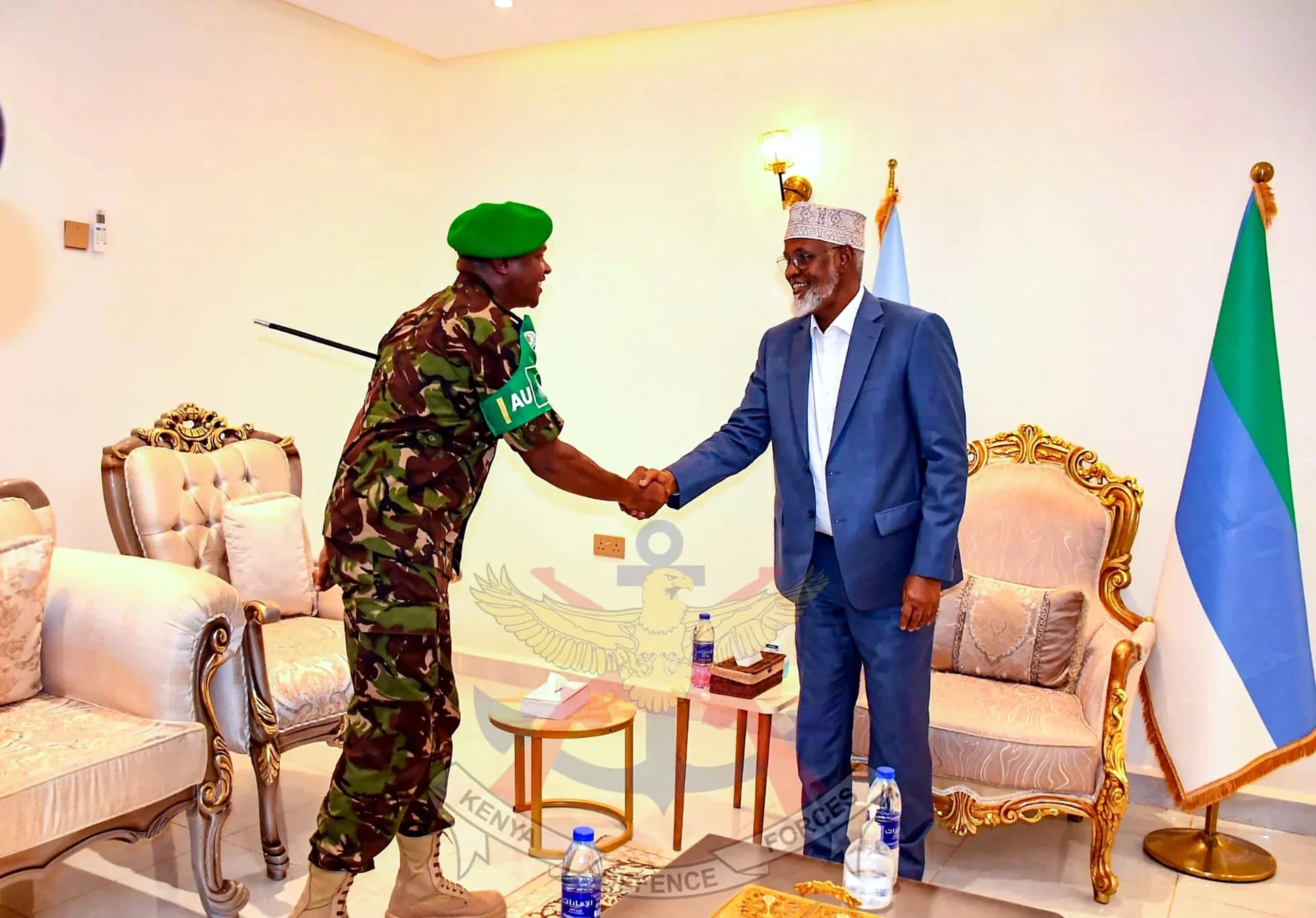
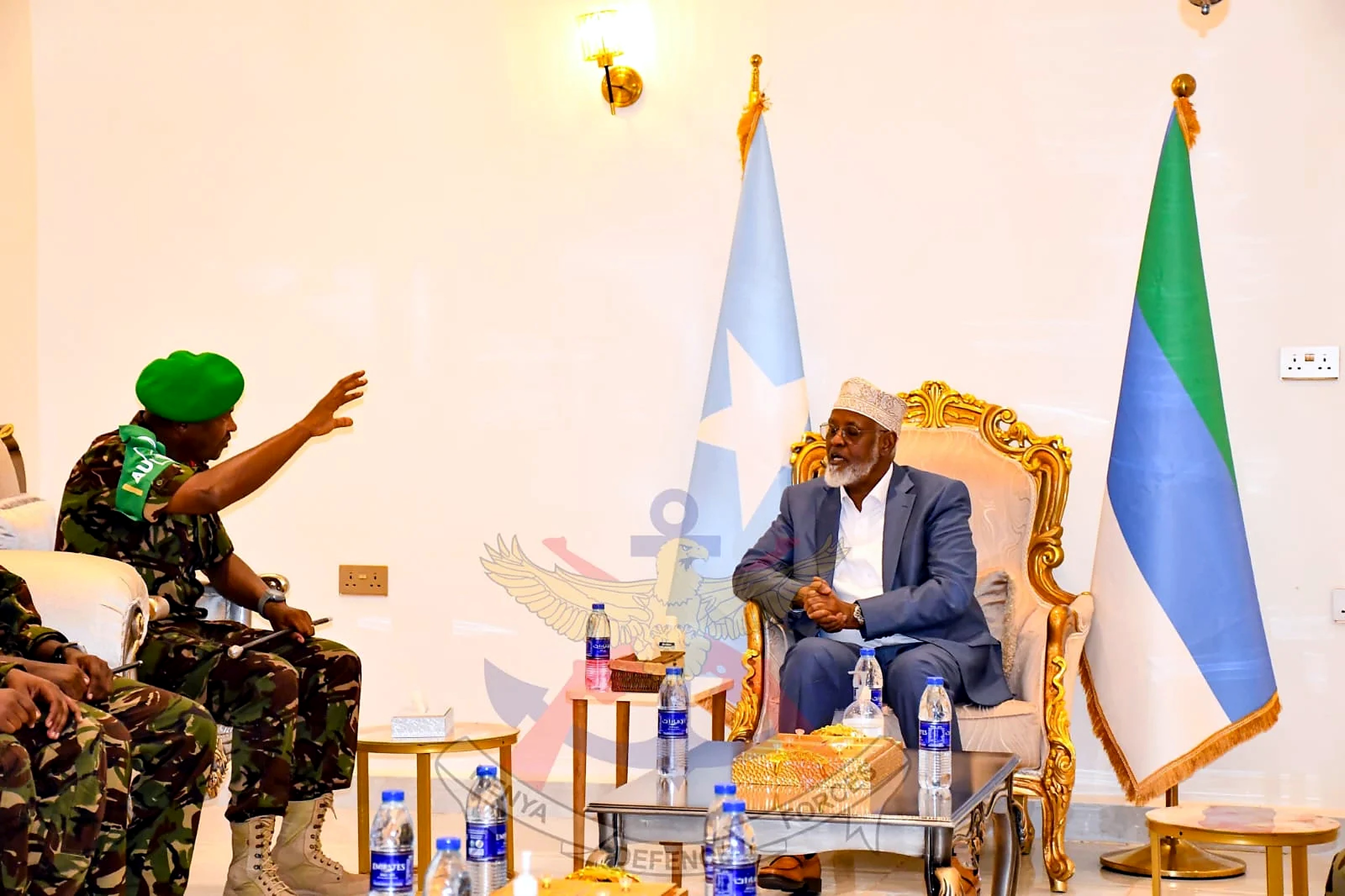
A senior Kenyan officer serving with the African Union Support and Stabilisation Mission in Somalia (AUSSOM) met Jubaland’s president in Kismayo this month to discuss security coordination. Colonel Daniel Musau, Deputy Commander of AUSSOM Sector II, paid a courtesy call on President Ahmed Mohamed Islam Madobe on Wednesday, 4 November 2026, according to the Kenya Defence Forces (KDF), which reported the meeting the following day.
Musau and Madobe discussed how Kenyan troops serving under AUSSOM can work more closely with the Jubaland State administration, along with the security challenges and stabilisation efforts in the region, Kenya’s Ministry of Defence said. Musau stressed the value of continued cooperation between military personnel and local leaders to advance shared security goals in the sector, Somali outlet Dawan reported, while Kaab TV quoted him as saying that “close engagement was necessary to achieve the security objectives assigned to Sector Two.”
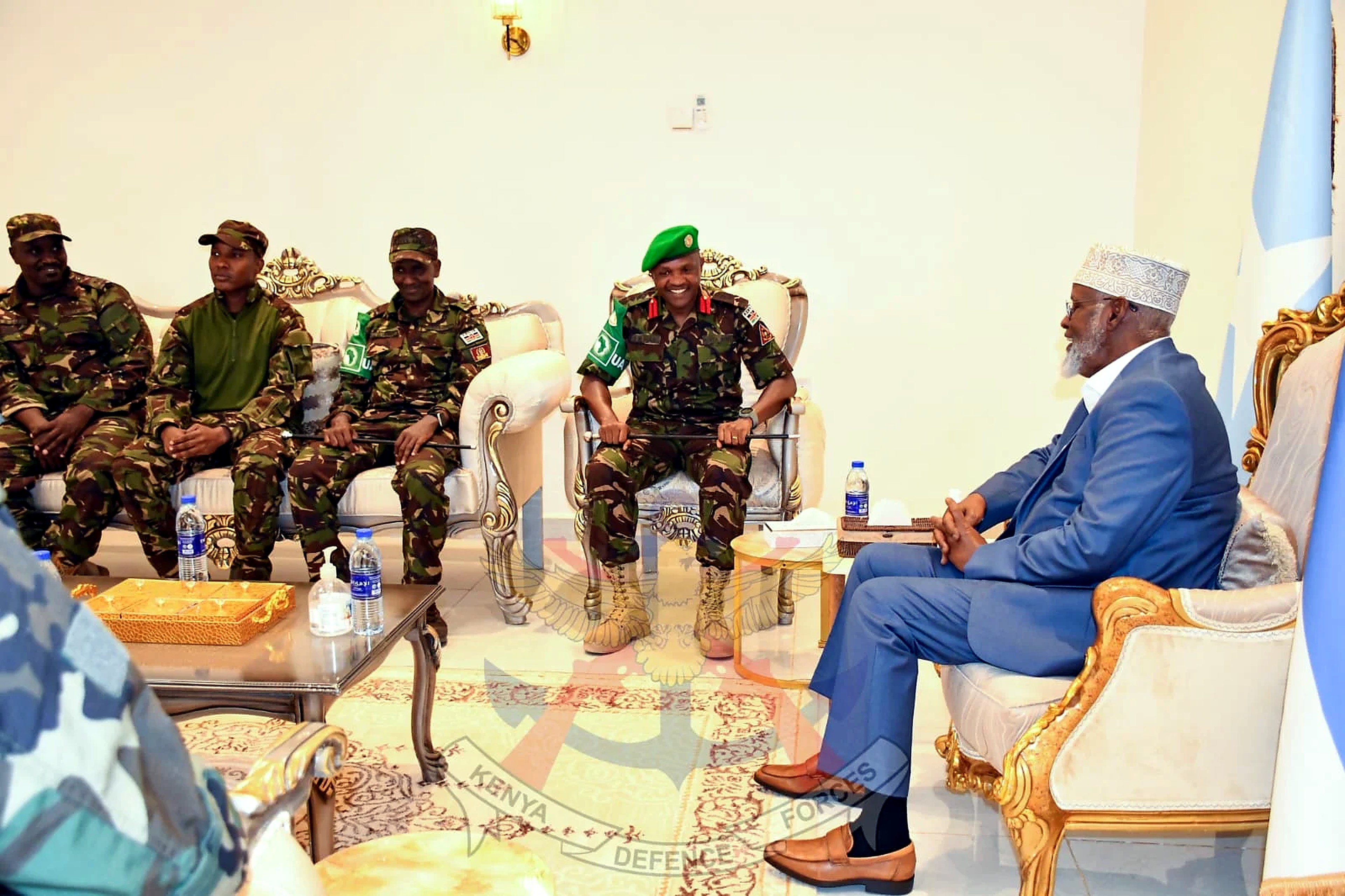
The KDF describes the visit as part of regular engagement between Sector II commanders and Jubaland stakeholders, and senior Kenyan officers have passed through Kismayo often in recent weeks. Major General Luka Kutto, General Officer Commanding the KDF’s Eastern Command, visited Kenyan troops in Kismayo around KDF Day on 14 October, when Musau received him on arrival. Kutto urged the troops to maintain “readiness, discipline and professionalism in the execution of assigned duties.”
A sector built around Kismayo
Sector II has its headquarters in Kismayo and covers Lower Juba, Middle Juba, Gedo and parts of Lower Shabelle, with Kenya as its main troop contributor. AUSSOM material in late 2025 named Brigadier Edward Banda as the sector commander; recent reports have not named his successor.
Jubaland matters to Nairobi because it shares a long border with Kenya and includes ground where al-Shabaab, the al-Qaeda-affiliated Somali militant group, still operates. Kenya first sent troops across that border in October 2011 under Operation Linda Nchi, and its forces later joined the AU mission. Cooperation with the regional administration helps with border security, tracking militant movements and supporting local forces, and it sits alongside Kenya’s wider security partnerships, from intelligence ties with the United Kingdom and United States at Manda Bay to its growing defence and trade relationship with France.
Training is one concrete form of that cooperation. In June 2026, AUSSOM staff in Kismayo trained Jubaland security personnel in weapons handling, counter-improvised explosive device (counter-IED) techniques, battle drills and tactical combat casualty care, the emergency medical treatment given under fire. Kaab TV put the graduating class at 100, while Somali outlet Axadle described it as “dozens”.
Politics in Kismayo and Mogadishu
The meeting takes place against a long dispute between Somalia’s federal government in Mogadishu and Jubaland. Tensions rose after Madobe’s re-election in November 2024: Mogadishu rejected the result, while Jubaland maintains that the vote was legitimate. The disagreement also covers electoral arrangements, constitutional amendments and how powers are shared between the centre and the federal member states.
That dispute affects a mission whose job is to hand security back to Somali institutions. AUSSOM took over from the African Union Transition Mission in Somalia (ATMIS) in January 2025 to support Somali forces against al-Shabaab, protect civilians and help the federal government assume full responsibility for security. The handovers are already under way: on 15 November, Ugandan troops handed five forward operating bases in Barawe to the Somali National Armed Forces.
In Mogadishu, Somalia’s Defence Minister Ahmed Moallim Fiqi met the United States chargé d’affaires, Ruth Anne Stevens-Klitz, in early November to discuss the mission’s mandate and future. The two sides said the transfer of security duties should be “a coordinated and carefully planned process” based on the capabilities and readiness of Somali forces, Dawan reported. Fiqi asked for continued US support in training, capacity building and operational assistance.
Funding is the weakest point
Money remains the mission’s biggest vulnerability. On 6 November, the African Union and European Union held their 17th annual consultative meeting in Addis Ababa, and their joint communiqué called for “predictable, adequate and sustainable financing for AUSSOM” and a Somali-led assessment of the expected reduction in logistics support. They named United Nations (UN) Security Council Resolution 2719, the AU Peace Fund and partner contributions as possible sources, Shabelle Media Network reported. Washington has also told Fiqi that its financial contribution to the mission is due to end in December.
Resolution 2719, adopted in 2023, allows AU-led peace operations to draw up to 75 per cent of their costs from UN assessed contributions. It has never been applied to AUSSOM because the United States opposed it, and in July Washington said it would also oppose UN funding for the UN Support Office in Somalia (UNSOS) beyond the current mandate, as Military Africa reported at the time. Reporting in 2025 put the mission’s five-year budget at $832.5 million, with $166.5 million a year for troop allowances alone.
Sector II depends heavily on UNSOS for logistics. In April 2025, Colonel Meshack Kishoyian, then a Sector II deputy commander, said: “We cannot survive without UNSOS.” The Security Council unanimously renewed AUSSOM’s authorisation in December 2025, through Resolution 2809 according to one analysis, but only until 31 December 2026, so a decision on the mission’s future is now weeks away.
Kenya’s stake in the Juba Valley
For Kenya, the Kismayo talks protect a working relationship that matters more than the political quarrel in Mogadishu. Kenyan troops need local goodwill to operate, share information and train partners, and Jubaland needs Kenyan support against al-Shabaab. Neither side gains from letting the federal dispute spill into the sector.
The harder problem is who pays, and for how long. A mission without stable funding struggles to plan rotations, pay allowances or keep supplies moving, and the risk grows as Somali units take on more of the work before they have the means to hold it. With Uganda already drawing down its forces, a handover that outruns the money and the forces behind it would give al-Shabaab room to return.