

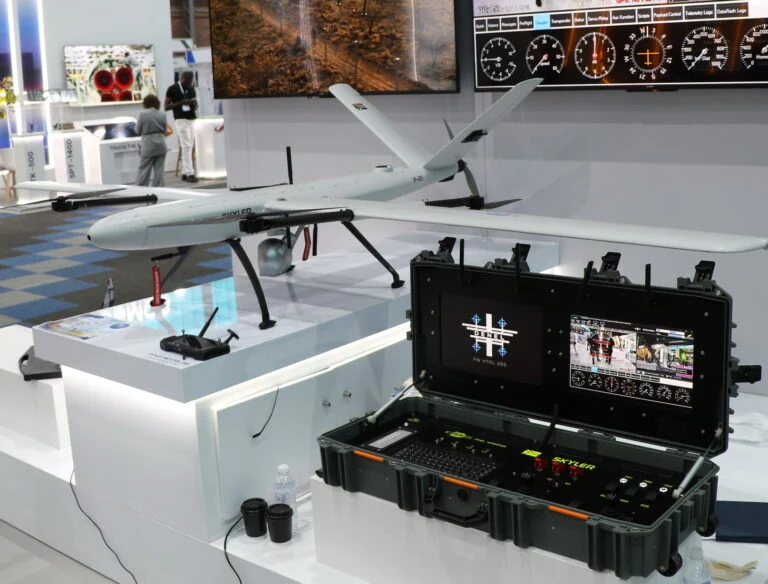
Denel showed its new Skyler unmanned aerial vehicle (UAV) in public for the first time at the Africa Aerospace and Defence (AAD) 2026 exhibition at Air Force Base Waterkloof, two weeks after presenting it to President Cyril Ramaphosa during an oversight tour of the company. According to Unmanned Africa report, The aircraft, developed until recently under the working name FW-VTOL (Fixed-Wing Vertical Take-Off and Landing), is a short-range reconnaissance drone that Denel says is now in flight testing and qualification. Two prototypes have been built and a third is planned.
The South African National Defence Force (SANDF) is in what Denel describes as advanced discussions about the system, and the company says it is helping the military prepare to receive it. No contract has been announced.
How the Aircraft Flies
Skyler takes off vertically on four small lift rotors, then switches to a rear-mounted pusher propeller for forward flight before landing vertically again. That hybrid layout combines the main advantage of a multicopter, the ability to launch and recover without a runway or catapult, with the efficiency of a fixed wing in cruise. Denel quotes an endurance of up to 150 minutes of low-noise forward flight and a maximum altitude of about 3,000 metres.
Dr Lindokuhle Mpanza, Divisional Executive Engineering and Continuing Airworthiness at Denel Aeronautics, told DefenceWeb that the first stage of testing is finished. “The first part of flight testing is proof of flight, that it can actually fly, that is, airworthy and controllable. That is completed,” he said. The team is now on what he called “expansion of the envelope,” testing the aircraft across flight modes, including the transition from hover to forward flight and back, to confirm it meets its design criteria within established safety limits. The transition phase is the most demanding part of any fixed-wing VTOL design, since the aircraft must hand control from the lift rotors to the wing without losing height or stability.
If the link between the ground control station and the aircraft is lost, Skyler is programmed to make an emergency landing either at its take-off point or at another safe landing point set before the mission.
Sensors and Tracking
The payload is a two-kilogram, three-axis stabilised gimbal, which holds the cameras steady in pitch, roll and yaw. It carries an electro-optical camera with 30 times optical magnification and a further 12 times digital zoom, a laser rangefinder rated by Denel to five kilometres, and an infrared thermal imager for night work. A separate forward-facing camera in the nose serves as the flight camera for the operator.
Denel has also fitted a locally developed artificial intelligence system that automatically identifies and tracks objects. Mpanza said the “auto tracker” can follow both vehicles and individual people. Denel describes Skyler as a reconnaissance aircraft that can also designate targets, meaning its rangefinder and tracking could guide fires or weapons carried by other platforms rather than by the drone itself.
A Layered Reconnaissance System
Denel calls Skyler a “first line of recon” asset, a close-range scout for the area immediately ahead of a deployed force. Mpanza described where it would sit in a military chain of reconnaissance: “Skyler is a close-range forward scout. If something of a threat is found you could send a Seeker, and if a Seeker finds something even bigger, you would send a Rooivalk.”
He was clear that the new aircraft is meant to complement the Seeker, not replace it. The Seeker 400 is a much larger tactical UAV with a quoted range of 250 kilometres and the ability to carry missiles. “We develop all our Denel systems in a layered function,” Mpanza said. “We don’t develop one system to replace another still functioning. If it does, we go through an upgrade programme, but if we introduce a new system, it is to complement the other systems.”
That philosophy matters for a defence force with a limited budget. A small, battery-powered drone costs far less to fly than a Seeker, so a commander can use it for routine local surveillance and save the larger aircraft, and ultimately the Rooivalk attack helicopter, for targets that justify them.
Mpanza said the Seeker is currently used by Defence Intelligence and the South African Air Force (SAAF), which is setting up a drone squadron. “The squadron will be receiving this one,” he said of Skyler. The SAAF’s last dedicated UAV unit, 10 Squadron, flew the original Seeker during the Border War before being disbanded in 1991, and the air force confirmed its reactivation in 2016. It is not clear from Mpanza’s remarks whether the new squadron is 10 Squadron or a separate unit. Military Africa has previously reported on a Seeker 400 belonging to the SANDF suffering a mishap in 2021.
Denel gave Skyler’s operating radius as 25 kilometres from base, while describing the “first line of recon” role as covering 25 to 50 kilometres. Both Skyler and the Seeker can extend their reach using forward ground relay stations or satellite communications.
Keeping an Aircraft Overhead
Skyler’s battery pack can be changed quickly. Mpanza outlined an operating concept in which aircraft work in pairs, one returning to swap batteries while a freshly charged aircraft takes its place, giving continuous coverage of an area despite the limited endurance of a single airframe.
Denel is also looking at a longer-term answer. It is investigating integration of a hydrogen fuel cell developed by the Council for Scientific and Industrial Research (CSIR), which it says could raise endurance to as much as 10 hours. The CSIR has worked on hydrogen propulsion for small drones for several years. Military Africa reported in 2022 that it was building a fixed-wing, multi-rotor VTOL test aircraft, and in February 2025 the CSIR demonstrated a hydrogen fuel cell-powered UAV at its laboratory, with plans to license the propulsion system to a local partner. Fuel cells offer more stored energy than batteries for the same weight and run quietly, though they add cost and require a hydrogen supply in the field.
Small Logistics Footprint
Mpanza said one of Skyler’s main selling points is how little support it needs. “It comes in a self-contained box which you can carry, then put on the back of a bakkie with a controller, then you can drive where you want to deploy,” he said, using the South African term for a pickup truck. The aircraft breaks down into components that fit into a dedicated case, which two people can lift onto a vehicle. Its independent mission control system was displayed alongside the aircraft at AAD.
Skyler also sends video and tactical data to a command-and-control centre through FUSUS, a secure real-time intelligence platform. Mpanza said a simple version was first used by police departments in the United States before more complex versions followed. “It is a secure cloud-based streaming system used by security agencies, so it’s controlled and it is not commercially available,” he said. The integration was developed with Sparcx, FUSUS’s local distributor, and lets authorised users watch what the drone is doing from anywhere in the world.
Military and Civil Roles
Beyond the battlefield, Denel lists border and maritime surveillance, search and rescue, disaster response and assessment, environmental and agricultural monitoring, infrastructure inspection, mapping and surveying in remote areas, wildlife monitoring and conservation, and support to police and other law enforcement agencies. Mpanza gave a public order example: if a crowd appeared likely to turn into a riot, Skyler could send live images to a security agency’s control centre so that response vehicles could be dispatched before the situation became critical.
He said other customers had shown interest before and during AAD, but added that it remained to be seen whether that interest would become firm orders.
A Product for a Company in Recovery
Skyler’s debut carries weight beyond the aircraft itself. Denel has spent most of the past decade in financial crisis, and the company is now trying to show it can develop new products again. AAD 2026 was its first exhibition with the Department of Defence as its shareholder, and Group Chief Executive Tsepo Monaheng framed the show as a chance to “reconnect with the market.” Government figures show Denel’s 2025/26 revenue rose 15 percent to R1.473 billion, according to SAnews, which reported Ramaphosa’s tour of the company’s Johannesburg and Tshwane facilities ahead of the exhibition.
The aircraft also appears to be one of the new products Denel’s aerospace arm presented to Parliament’s Joint Standing Committee on Defence in April. That briefing listed rotary-wing and fixed-wing VTOL UAV programmes alongside a Rooivalk upgrade, and one commentator noted the plans were technically sound but would need structural reform and funding to succeed.
Skyler enters a crowded domestic field. Military Africa covered several South African unmanned systems at AAD 2026, including Paramount’s reusable V-Raven, ShadowfaxUAS’s SF45 and Incomar’s new portfolio, while Avior Labs already has its Elevation VTOL UAV in production. Exhibition organisers made unmanned systems a central theme of the show, which Military Africa’s AAD 2026 review describes in detail. Denel’s advantage is its existing relationship with the SANDF and its record with the Seeker family. Its challenge is to finish qualification and deliver on time, which has not always been the case for Denel programmes in recent years.
In 2924, Denel Aerospace introduced a new Rotary Wing Unmanned Aerial System (RW-UAS) as part of its product diversification strategy. This innovative drone is designed primarily for surveillance purposes, providing situational information and detailed object or terrain data.
What Comes Next
Denel has not published Skyler’s weight, wingspan, cruise speed or price, and it has not said when qualification will finish. The next milestones to watch are completion of envelope expansion, a signed SANDF order, the third prototype and progress on the hydrogen fuel cell. Until then, Skyler is a promising aircraft in testing, with its strongest prospect being the military customer Denel already serves.
Meanwhile, another outh African aerospace and defence company Incomar used the Africa Aerospace and Defence (AAD) exhibition at Air Force Base Waterkloof in September to debut a set of unmanned aircraft, avionics and ground control products. The portfolio covers radar-tracking validation, weapons testing, autonomous strike and counter-drone defence. DefenceWeb first reported the line-up.