

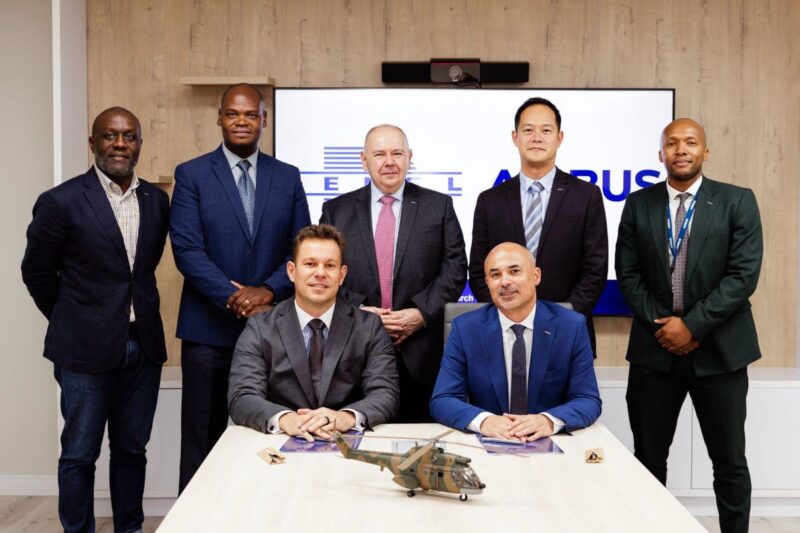
South Africa’s helicopter fleet has spent years waiting for spare parts, funding, and workshop capacity. At the Africa Aerospace and Defence (AAD) 2026 exhibition in Pretoria, Airbus Helicopters and Denel Aerospace signed an agreement intended to shorten that wait. The two companies say the Memorandum of Understanding (MoU) sets a long-term framework for industrial cooperation that should strengthen support to the South African Air Force’s (SAAF’s) helicopter fleet and raise its rotary-wing serviceability.
According to a DefenceWeb’s post, the signing took place during AAD 2026, held from 16 to 20 September at Air Force Base Waterkloof, and it matters because the SAAF’s flying hours have fallen well short of what the service plans each year.
What the Two Companies Signed
An MoU is a statement of intent and not a purchase contract, and the published account does not give a value, a schedule, or a list of work packages. Airbus says the agreement establishes a long-term framework to increase national air defence capabilities and to boost aviation industrial growth across Southern and East Africa.
The practical aim is to combine what each company already does. Airbus Helicopters brings the manufacturer’s engineering knowledge and its global support network. Denel Aerospace brings local engineering, fabrication, and maintenance facilities, and long experience on SAAF aircraft. Airbus says the agreement intends to build on the companies’ existing capabilities and anchor a self-reliant domestic support ecosystem that can serve both South Africa and regional operators across Southern and East Africa.
Arnaud Montalvo Chastellier, Head of Africa Middle-East Region at Airbus Helicopters, framed the agreement as a commitment to local industrial skills alongside mission-critical capability for the SAAF and the wider African market. He said the pairing of Airbus’s helicopter know-how with Denel’s local expertise would build an ecosystem that improves operational readiness. Chris Boshoff, Chief Executive Officer of Denel Aerospace, said the partnership will develop the “sovereign aviation capabilities” needed to sustain the SAAF’s current and future fleets, and that an extended industrial footprint across the country and the region would provide long-term self-reliance and operational resilience.
A Shared Heritage in Metal
The two companies are not strangers. Denel Aerospace is the design authority for the Oryx medium transport helicopter and the original equipment manufacturer (OEM) of the Rooivalk attack helicopter. Both types use dynamic components derived from the Airbus Puma and Super Puma, the rotors and gearboxes that carry the heaviest loads, and both are powered by Turbomeca Makila turboshaft engines, now part of Safran.
That shared engineering base explains why the cooperation makes technical sense. Airbus and Denel also signed an MoU at AAD in 2016, covering a phased modernisation of the Rooivalk. That earlier agreement focused on improving the reliability of the Rooivalk Mk1 fleet and replacing obsolete items. The 2026 document is broader, since it covers the helicopter fleet’s support and a regional industrial footprint, and it does not name a single type.
Denel says it is also cooperating with Airbus on maintenance, repair, and overhaul (MRO) and refurbishment of the H215 and H225 military helicopters for Africa. Both are Airbus’s Super Puma-family aircraft, and a number of African air forces fly them.
The Serviceability Problem
The SAAF’s difficulty is documented in its own accounts. In the Department of Defence’s annual report for 2025/26, the SAAF said it planned to fly 12,000 hours during the financial year, but flew 6,340.08. That is 52.8% of the target for the period from 1 April 2025 to 31 March 2026. The hours break down into 5,085.51 Force Preparation hours, 610.47 Force Employment hours, and 644.10 flown for very important person (VVIP) transport.
The report links the shortfall to budget constraints and says air defence capabilities remained under pressure. It attributes the unavailability of serviceable aircraft to delays in placing contracts, a lack of funding for maintenance and spare parts, long lead times for parts, inadequate stock levels, and obsolescence.
The helicopter fleet has been among the hardest hit. A written parliamentary reply from the Minister of Defence in October 2023, showed that 15 of the SAAF’s 88 helicopters across five types were available to fly. Of 11 Rooivalks, three were serviceable with restrictions. Of 41 Oryx, five were serviceable. Those figures are three years old, and the picture has since improved in places, but they show the scale of the problem the partnership is meant to address.
Part of the difficulty lies in how specialised the support is. Denel operates a Makila engine repair shop for the Oryx and Rooivalk that needs accreditation from Safran, and the Department of Defence has warned that the facility is at risk of losing that capability without enough work from the SAAF. Capability that goes unused tends to disappear.
Signs of Recovery
Boshoff told DefenceWeb earlier that Denel Aerospace is making progress across the business, rebuilding its engineering, fabrication, and maintenance capabilities and investing in technical skills development. He said that, working with the SAAF, Denel is putting more fixed- and rotary-wing aircraft into the air, while opening opportunities in Africa and elsewhere.
There is evidence behind that. This year, Denel Aerospace has returned multiple Oryx and Rooivalk helicopters to service. At AAD in September, the SAAF flew a large number of aircraft, including several Hawk and Gripen jets alongside Oryx, Rooivalk, A109, and BK117 helicopters. The display was the sort of show that an air force chooses to put on when it has aircraft to show.
Denel’s own position has also shifted. AAD 2026 was the first time the group exhibited with the Department of Defence as its shareholder, and Denel’s Group Chief Executive, Tsepo Monaheng, described it as part of a renewal of the company.
Airbus’s Existing Footprint in Southern Africa
Airbus is not new to South African military and security aviation. It has long supported the SAAF with maintenance contracts for the air force’s three C212 light transport aircraft. On the rotary-wing side, it has a long relationship with the South African Police Service (SAPS), which operates 16 AS350 (H125) helicopters, with more being acquired. Namibia and Botswana also fly Airbus helicopters for their police forces.
The wider market is large. Airbus says there are more than 60 operators of its helicopters in Africa, flying more than 500 aircraft, of which 300 are in Southern Africa. Customers come from government and commercial sectors, and the helicopters are used for emergency medical services, law enforcement, anti-poaching, and inspection of critical infrastructure. A support network in South Africa that can service those aircraft is the commercial logic behind the regional language in the agreement.
What Has to Follow the Signature
The agreement will be judged on what comes after it. The first test is whether it turns into funded work orders, since the SAAF’s maintenance problems have been as much about contracts and money as about workshop capacity. An MoU does not place an order, and the annual report names late contract placement as a cause of unavailability.
The second is skills and parts. Denel has said it is investing in technical skills, and the partnership could bring Airbus training and parts supply into the process. Whether spare parts arrive faster is the measure that matters to squadron commanders.
The third is the regional promise. A service centre that supports Airbus helicopters across Southern and East Africa would need certifications, customers, and export approvals, and it would compete with established support networks in Europe and the Gulf.
The fourth is the SAAF’s own budget. A better-supported fleet still needs flying hours funded, and a 52.8% flying-hour result reflects constraints that no industrial agreement can remove on its own.
If those pieces fall into place, the Oryx and Rooivalk fleets could spend more of their lives in the air and less in the hangar, and South Africa could build a support industry that earns income from neighbours. If they do not, the MoU will join a list of agreements whose intentions were good.