

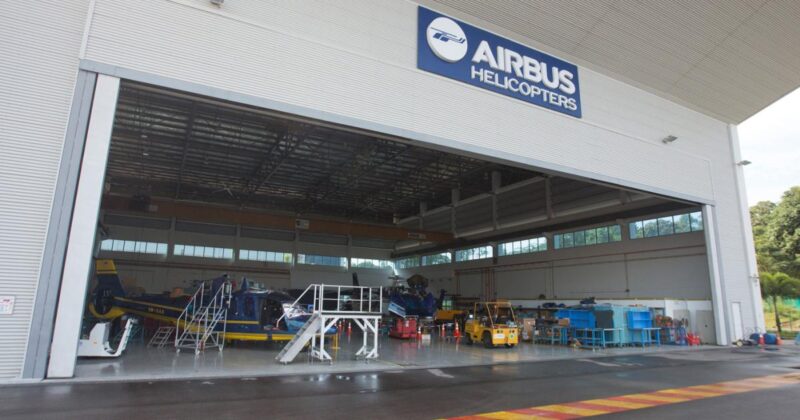
Airbus will open a helicopter maintenance, repair and overhaul (MRO) subsidiary in Morocco in the coming months, Mickaël Bertrand, Managing Director of Airbus Helicopters Morocco, told Morocco World News (MWN) at the Marrakech Air Show.
The centre will serve Morocco first and is designed to cover all of West Africa, Bertrand said.
Bertrand framed the step as a climb up the value chain. Airbus started “75 years ago with basic parts,” he told MWN, moved into composites, and now moves into helicopter maintenance.
What Airbus already supports in Morocco
Airbus supports “more than 60 aircraft today, mainly helicopters” in the kingdom. The Royal Moroccan Air Force, the Royal Navy and the Royal Gendarmerie operate them.
Airbus Helicopters first announced the Moroccan subsidiary in July 2024. The plan has three parts: technical and customer support for the roughly 60 helicopters in service, more MRO capacity, and a training centre with flight simulators for Moroccan and international pilots.
Two orders drive the timing. On 18 November 2025 at the Dubai Airshow, Morocco signed for ten H225M helicopters for the Royal Moroccan Air Force. They replace Puma helicopters that have flown for more than 40 years, according to Airbus. The H225M order centres on combat search and rescue (CSAR). Airbus says the aircraft carry a double rescue hoist, a searchlight and a Safran Euroflir 410 electro-optical system, a sensor turret that gives day and night imaging.
Training fleet and support partner
The Royal Moroccan Air Force also ordered the H135 light twin-engine helicopter for primary military training. Airbus announced the order at the Farnborough Airshow in July 2022 and named Moroccan firm Heliconia as its support partner. Arnaud Montalvo, Head of Africa and Middle East at Airbus Helicopters, called the type “a reliable, cost-efficient multirole helicopter” at the time.
The order covered 12 H135M helicopters, according to later Airbus reporting. The first two arrived in Meknes on 7 September 2023 and replace the AgustaBell AB206A and AB206B helicopters at the air force flight school at 1 Air Base, Rabat/Salé. The package includes flight training devices and training for instructor and maintenance pilots. Bertrand told Hespress in July 2024 that all 12 had been delivered.
A mixed fleet to support
The workload is not uniform. The Royal Gendarmerie alone flies a long list of Airbus-family types, according to Airbus Helicopters reporting on its H125 delivery: AS355 Ecureuil, AS365 Dauphin II, AS550 Fennec, SA315 Lama, SA316 Alouette III, SA342 Gazelle, SE3130 Alouette II, EC135 and EC145 helicopters, plus two new H125s for search, rescue and firefighting. That inventory is undated, so current numbers may differ.
Older types like the Alouette and Lama need spares and skills that are harder to source each year. New types like the H225M and H135M need connected diagnostics and trained technicians. One facility that handles both would carry real cost, and the trade-off is how fast Airbus can build the workforce.
Industrial base behind the hub
Airbus runs five legal entities in Morocco, Bertrand told MWN: Airbus Atlantic Maroc, Airbus Atlantic Maroc Composites, Airbus Atlantic Maroc Aero, Airbus Defence and Space Maroc and Airbus Helicopters Maroc. They employ about 1,300 people directly and support “more or less 10,000” indirect jobs, by his account.
Airbus Atlantic Maroc Aero is the newest. It is the former Spirit AeroSystems site in Casablanca, which makes A321 and A220 components. Airbus closed the Spirit purchase on 8 December 2025.
On 7 October, Gabriel Sémelas, Airbus President for Africa and the Middle East, signed the consortium agreement for the African Centre of Manufacturing Excellence (ACME). The consortium is tied to Mohammed VI Polytechnic University and includes Morocco’s Ministry of Industry and Trade, the National Defense Administration, OCP, Boeing, Lockheed Martin, Safran Nacelles, Airbus and CETIM Maroc. Bertrand said it opens research and engineering work for military and civil programmes.
Asked about a final assembly line, Bertrand said that is “really complex in terms of aircraft” and that Airbus is not at that stage.
Asharq Bloomberg reported on 10 October that Airbus plans a third Moroccan factory of about 6,900 square metres, which would raise its local footprint by 30%.
What it means
A local MRO centre shortens the support chain for Moroccan operators. Helicopters that now depend on overseas facilities for heavy checks could be serviced at home, which should raise availability for the incoming H225M fleet.
The regional case is still prospective. Airbus has not said how many helicopters the site can handle or which West African air forces and civil operators will use it. A formal announcement is expected in the coming months, and the site, the investment and the first outside customer are the details to watch.