

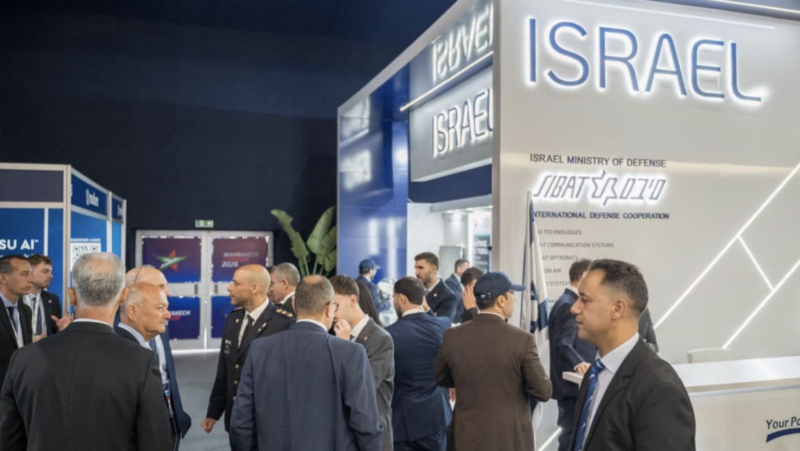
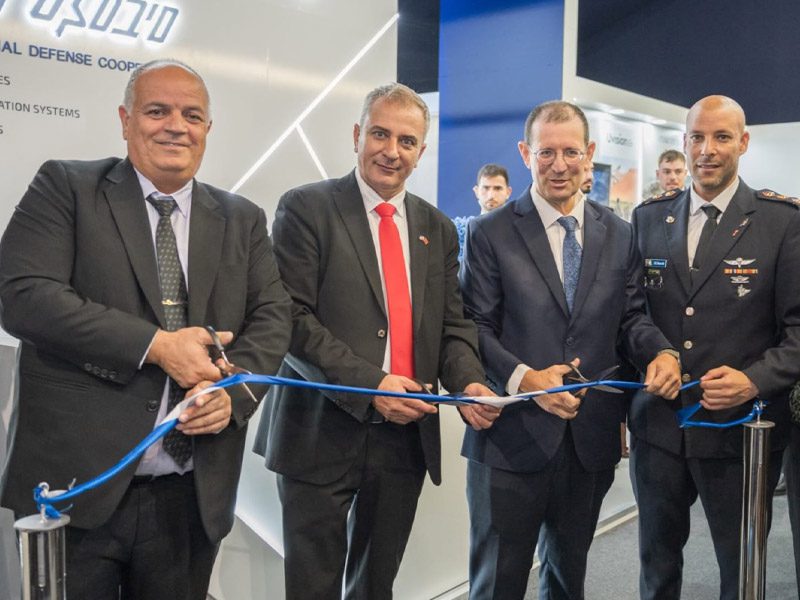
The Israel Ministry of Defense (IMOD) opened a national pavilion at the Marrakech Airshow in Morocco on 8 October 2026, its first official presence at a Moroccan defence show since the two countries normalised ties in 2020.
The ministry’s International Defense Cooperation Directorate, known as SIBAT, led a delegation of eight Israeli companies. The biennial show ran from 7 to 10 October at the Royal Moroccan Air Force base in Marrakech and covers civil and military aerospace.
Five firms shared the national pavilion: ASIO Technologies, Orbit Communication Systems, SHILAT Optronics, UVision Air and XTEND Systems. Elbit Systems, Israel Aerospace Industries (IAI), and Rafael Advanced Defense Systems exhibited separately.
Between them, the companies showed loitering munitions (drones that circle an area, then dive onto a target), AI-enabled robotic systems and autonomous navigation for unmanned aerial vehicles. They also showed laser guidance for first-person-view (FPV) drones and satellite communications.
Brigadier General (Reserve) Yair Kulas, head of SIBAT, called the debut “an important milestone for the Israel Ministry of Defense and the Israeli defense industry.” The ministry said officials also met delegations and government officials from other countries during the show. It described the pavilion as part of a strategy to raise defence exports, which it says also supports the Israel Defense Forces’ force build-up and Israeli foreign policy.
The venue matters. In June, the ministry said French authorities barred Israel from a national pavilion at Eurosatory in Paris and limited Israeli firms to air defence displays. Marrakech gave Israeli industry the open stage that Paris refused.
What Morocco already buys
Morocco is an established customer. Reports say it signed a $150 million deal for Elbit’s Precise and Universal Launching System (PULS), a rocket artillery launcher, with delivery due by 2026. Reports also say it bought 36 Atmos 155 mm self-propelled howitzers from Elbit in February 2025, with a range beyond 40 kilometres.
Press material tied to the show also lists Elbit’s Hermes 900 drone and SkyStriker loitering munition as systems already supplied to Morocco. Morocco has also reportedly bought the Barak 8 air defence system from IAI and the Spyder system from Rafael. It buys elsewhere too: the United States supplies Abrams tanks, and Rabat has launched drone production hubs with Turkey’s Baykar and India’s Tata Advanced Systems. Local media reported a 2026 defence budget of about $15.7 billion.
The most telling Israeli project is local manufacturing. BlueBird Aero Systems, an IAI subsidiary, trained a Moroccan technical team at its Israeli facilities. The aim is a plant in Benslimane, in the Casablanca-Settat region, to build the SpyX loitering munition.
The SpyX can strike tanks, armoured vehicles and troop concentrations, and that Morocco would be the first country in North Africa and the Middle East after Israel to build it. SpyX is a small electric strike drone with a 2.5 kilogram warhead and a top speed near 250 kilometres per hour. Moroccan forces reportedly tested the drone in March 2024. Sources give a range of 50 kilometres. They disagree on endurance, citing 90 minutes in some reports and about two hours in others. In early November 2025, BlueBird had inaugurated the site, and production would begin in April.
Politics around the deal
The airshow followed a diplomatic step. On 16 September 2026, Israeli Foreign Minister Gideon Sa’ar and Moroccan Foreign Minister Nasser Bourita met in New York, hosted by US Ambassador to the United Nations Mike Waltz. They agreed to raise their liaison offices to full embassies and exchange ambassadors for the first time.
They also agreed to expand direct flights and to finish investment protection and double taxation agreements by the end of 2026. The two sides had not named ambassadors in any source I found.
Morocco is also tied to Israel through Gaza. In July, Rabat signed an agreement to join the US-backed International Stabilization Force. Foreign Minister Bourita said in February that Morocco would send police officers, and the July agreement covers senior officers in the force’s command structure, police training and a field hospital.
For Israel, the pavilion shows how its export push is adapting to closed doors in Europe. Venues that welcome its firms, backed by formal embassies, give SIBAT a steady base for marketing in Africa and the Middle East.
For Morocco, local assembly of the SpyX would cut import dependence and give its engineers hands-on experience. It would not end reliance on Israeli designs, software and spares, and it carries a domestic political cost that Rabat has so far accepted. Spreading orders across several suppliers also gives Rabat room to bargain on price and terms.