

BELL BUILDS NIGERIA’S FIRST AH-1Z VIPER ATTACK HELICOPTERS
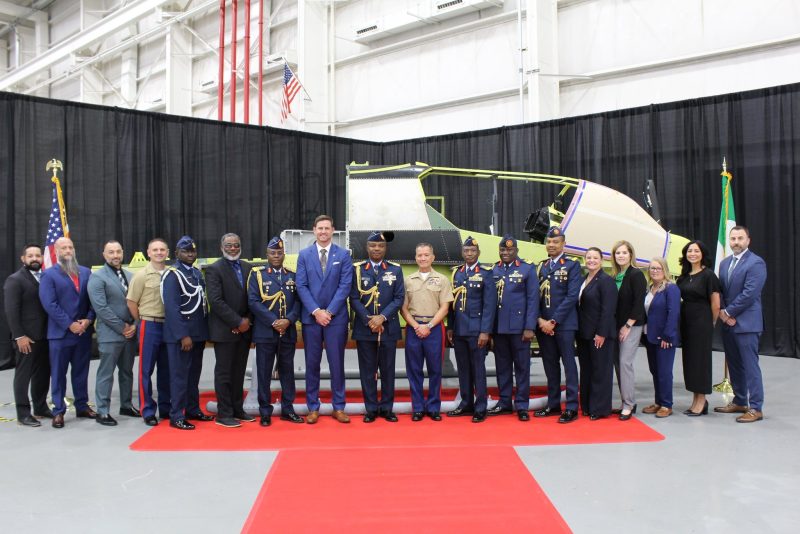
Bell Textron began production of Nigeria’s first AH-1Z Viper attack helicopter on 16 September 2026, at its Amarillo Assembly Center in Texas, marking the start of a long-delayed Foreign Military Sales programme.
A Nigerian delegation, including Chief of the Air Staff Air Marshal Sunday Kelvin Aneke, signed the aircraft’s structural beam during a ceremony at the Texas facility. The event capped more than four years of negotiation, financing and delay since the United States first cleared the sale.
Bell will build 12 Vipers for the Nigerian Air Force (NAF) under a contract worth about $455 million, awarded by the US Department of Defense in March 2024. The wider package, covering engines, weapons, training and support, is valued at roughly $997 million. Bell projects all 12 aircraft will be delivered by early 2029.
“We are honored to host the Nigerian Air Force and share this milestone in production for the AH-1Z,” said Scott Sims, Bell’s H-1 programme director. “The beam of the first production Viper for Nigeria will forever carry the names, hopes, and commitment of those who brought this aircraft to life.”


Air Commodore Ehimen Ejodame, spokesperson for the Nigerian Air Force, said the aircraft would strengthen the service’s ability to conduct such operations.
Air Commodore Ehimen Ejodame, the NAF spokesperson, framed the aircraft’s arrival in operational terms. “The Bell AH-1Z Viper will play an important role in strengthening our counterterrorism and counterinsurgency operations and enhancing our ability to protect the citizens of Nigeria,” he said.
A decade in the making
Nigeria first pursued the AH-1Z in the early 2020s, but the deal stalled for years over US concerns about human rights conduct during counterinsurgency operations. Arms transfers slowed under the Obama administration; when Donald Trump took office in 2016, his government instead cleared the sale of 12 A-29 Super Tucano light attack aircraft, built by Sierra Nevada Corporation, which Nigeria has flown against Boko Haram and the Islamic State West Africa Province (ISWAP) since 2021.
The State Department cleared a possible Viper sale in April 2022, at a value of nearly $1 billion. That package included 28 General Electric T700-GE-401C engines, 2,000 Advanced Precision Kill Weapon System (APKWS) laser-guidance sections for rockets, M197 20mm cannons, sighting equipment and logistics support. The formal production contract followed in March 2024, under a Foreign Military Sales agreement now overseen by the US Naval Air Warfare Center Training Systems Division. Bell will also handle pilot and technician training alongside manufacturing.
What the Viper brings
The AH-1Z, nicknamed the “Zulu Cobra,” is a twin-engine attack helicopter developed for the US Marine Corps and descended from the Vietnam-era AH-1 Cobra family. It evolved from the earlier AH-1W SuperCobra, first flying in its current configuration in December 2000 after a programme launched in 1996.
Two T700-GE-401C turboshaft engines, each rated at 1,800 shaft horsepower, give the aircraft a top speed of 222 knots (411 km/h) and a combat radius of around 150 miles. Maximum takeoff weight is about 18,500 lbs, with a service ceiling of 20,000 feet. A four-blade, bearingless composite main rotor, which folds for storage aboard ships, replaced the two-blade system on earlier Cobra variants and gives the Viper better agility, a faster climb rate and less vibration.
Armament includes a three-barrel M197 20mm cannon, AGM-114 Hellfire and newer AGM-179 Joint Air-to-Ground Missiles, Hydra 70 rockets and APKWS laser-guided rocket kits, spread across six wing stations. Bell notes the Viper is the only attack helicopter with a fully integrated air-to-air capability, carrying AIM-9 Sidewinder missiles to counter both rotary and fixed-wing threats. An integrated Target Sight System handles day and night targeting, and the aircraft carries Link 16 for sharing tactical data with other forces.
Filling a gap against insurgents
Nigeria has spent years trying to close a capability gap in its long campaign against Boko Haram and ISWAP in the northeast, alongside separate operations against oil theft and kidnapping gangs further south. The Viper will join an attack helicopter fleet that already includes Russian-built Mi-24 and Mi-35 gunships and, since February 2024, the first of six T-129 ATAK helicopters bought from Turkish Aerospace Industries. The Nigerian Army is separately acquiring 12 MD 530F Cayuse Warrior light attack helicopters from MD Helicopters.
That mix illustrates a wider pattern across the continent. Most African air forces still depend on imported hardware, and the leading suppliers, the United States, Russia, China and Türkiye, are increasingly competing for the same customers rather than dominating single markets. Turkish platforms such as the Bayraktar TB2 and Akıncı drones already have a broad African customer base, and Nigeria’s parallel purchase from Washington shows that buyers are hedging across suppliers rather than settling on one.
The timing lines up with this year’s Africa Aerospace and Defence exhibition, held 16 to 20 September at Air Force Base Waterkloof near Pretoria, which drew more than 30,000 trade visitors and delegations from over 30 countries, according to South Africa’s Department of Defence and Military Veterans. The overlap shows how much procurement activity is concentrated on the continent this month, even if the Viper deal itself was negotiated separately.
Nigeria will become the fourth country in the world to operate the Bell AH-1Z Viper attack helicopter after the United States, Bahrain and Czechia. The U.S. maintains strict export controls over the AH-1Z Viper because of its advanced frontline attack capabilities, so Nigeria getting an an entire squadron (twelve units) is a notable development. Paired with the T-129 ATAK, and with the pending reactivation of the Mi-35M gunships, arguably, Nigeria will have the most advanced and lethal attack helicopter fleet in Africa, eclipsed only by the major North African powers of Egypt, Algeria and Morocco.
For Nigeria, the next milestone is less ceremonial: getting pilots and ground crews trained and the first aircraft off the Amarillo line before Bell’s early-2029 completion target. Congress and Nigerian budget officials will be watching closely, given how long this particular sale took to move from approval to assembly.