

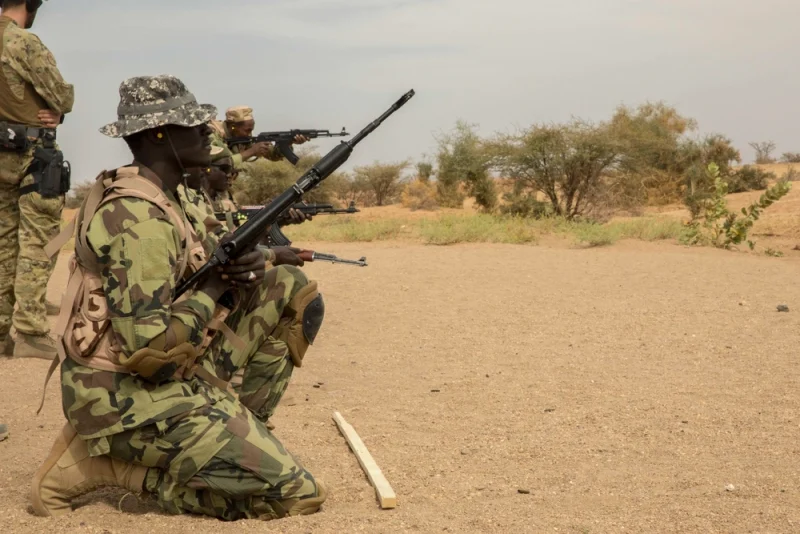
President Mahamat Idriss Déby has created a new state-owned company tasked with building Chad’s first domestic arms industry, a move that arms suppliers in N’Djamena are already scrambling to respond to. The company, Sahel Defence Industry (SDI), was established in early August with a mandate to reduce Chad’s near-total dependence on imported military equipment by developing local assembly lines and, over time, technology transfer arrangements with foreign partners.
A meeting held in the Chadian capital earlier this week began sketching out SDI’s initial priorities. Discussions with defence specialists have centred on assembling AK-pattern Kalashnikov rifles, machine guns and rocket-propelled grenades, alongside establishing production lines for small-calibre ammunition spanning 9mm to 12.7mm. Chadian security officials are also reportedly weighing the manufacture of kamikaze drones, a category of weapon that has spread rapidly across the Sahel’s battlefields in recent years. How any of this will be financed, and which investors might back it, remains unresolved.
Who Is Running It
Déby appointed Idriss Saleh Bachar, an engineer-turned-academic and a trusted ally, to head SDI. Bachar served as Chad’s minister for posts and new information technologies from 2019 before moving to the infrastructure and regional connectivity portfolio in 2022, and joined the presidency in 2024 as Déby’s civilian chief of staff. His deputy at SDI, air force Brigadier-General Mahamat Bongo, brings direct defence procurement experience, having served as Chad’s defence attaché in Russia from 2017.
Bachar’s elevation carries a pointed backstory. He replaced Idriss Youssouf Boy, a cousin of the president once considered one of his closest collaborators, as civilian chief of staff. Boy was arrested in February 2025 and, according to Chadian court records, convicted of corruption tied to the embezzlement of funds earmarked for reconstruction projects in eastern Chad, a sentence a Chadian appeals court later increased from five to seven years. Boy had previously operated as a central figure in Chad’s arms procurement channels, maintaining close relationships with suppliers in the United Arab Emirates and Turkey. His fall from favour, and Bachar’s subsequent appointment to lead an entity explicitly designed to formalise and bring under closer state control the very kind of arms procurement Boy once managed informally, is difficult to read as coincidental.
Why Now
Chad’s reliance on imported hardware has deep roots. Military Africa’s own tracking of the country’s modernisation drive has documented a force that has leaned heavily on China for armoured vehicles, on France for light tanks, and on a rotating cast of Gulf and Turkish suppliers for everything from air defence radars to fighter jets, a pattern that leaves N’Djamena exposed every time a supplier relationship cools or a shipment is delayed. Chad’s tag archive on this outlet alone records a steady drumbeat of individual acquisitions over the past two years, Chinese FK-2000 air defence systems delivered via the UAE, a Turkish military presence established at the Abéché base, and a broader picture of a government buying piecemeal rather than building capacity at home.
That pattern of dependence is now colliding with a rapidly shifting diplomatic landscape. Military Africa reported in August 2026 that French manufacturer Arquus had won a contract worth more than 50 million euros to renew Chad’s logistics vehicle fleet, a deal made possible by the same rapprochement that has seen Paris and N’Djamena rebuild military ties less than two years after Chad ended its 65-year defence cooperation agreement with France outright and watched French Mirage 2000D jets depart Kossei airbase in December 2024. SDI’s creation suggests Déby wants to use this moment of renewed French engagement, and continued Emirati, Turkish and Chinese supply, not simply to diversify import sources further but to begin converting at least some of that foreign relationship into domestic manufacturing capacity through technology transfer, rather than remaining a customer indefinitely.
Chad is gradually enhancing its military might by acquiring new equipment and modernizing legacy systems across all its service branches. This modernization effort follows significant losses, including half of its air force in a hurricane in 2015 and several defeats at the hands of terrorists. Despite these setbacks, Chad’s military has historically been known for its formidable fighting capabilities, using limited resources to achieve remarkable battlefield victories.
Chad continues to bolster its ground forces through a deliberate program of acquisitions and upgrades, focusing on armoured vehicles to address persistent security challenges in the Sahel region. As of mid-2025, the nation’s army has integrated a mix of new platforms from diverse international partners, reflecting a pragmatic approach to procurement amid fluctuating geopolitical alliances.
This effort aims to replace losses from conflicts with insurgents like Boko Haram and Islamic State groups along borders with Nigeria and Libya, while enhancing mobility and firepower in desert terrains. President Mahamat Idriss Déby’s administration has prioritised these enhancements to secure internal stability and contribute to regional operations, such as the G5 Sahel Joint Force involving Burkina Faso, Mali, Mauritania, and Niger.
Part of a Wider Sahelian Pattern
Chad is not the first Sahelian government to make this pivot. Mali’s transitional leader, now President, Assimi Goïta, announced during the Malian Armed Forces’ 64th anniversary celebrations in January 2025 that Bamako would establish “assembly units for individual and collective weapons” and “assembly of light tactical vehicles” that same year, alongside ammunition and explosives manufacturing, framing the goal explicitly as making Mali “militarily independent.” Military Africa’s coverage of Mali’s ongoing equipment build-up shows that, eighteen months on, Bamako remains far more reliant on Chinese Norinco imports than on any domestic production line, a gap between announcement and delivery Chad’s own SDI will need to avoid repeating if it wants a different outcome.
The broader continental precedent for this kind of pivot is Nigeria, where the 2023 Defence Industries Corporation of Nigeria Act has, over roughly two years, produced a genuine cluster of joint ventures, indigenous armoured vehicles from the Ezugwu MRAP to the AEGIS-X light tactical vehicle, a domestic rifle production line, and counter-drone development, built on partnerships with private manufacturers and foreign technology partners rather than a single state monopoly. That model offers Chad a plausible template, though it also took Nigeria’s much larger economy and a dedicated legal framework several years to produce tangible hardware rather than announcements.
The Open Questions
Chad’s own security environment supplies an obvious rationale for the push: a force still fighting Boko Haram and Islamic State-aligned militants around Lake Chad, watching instability spill over its borders from Libya and Sudan, and increasingly aware that armed groups across the region now field the same commercial drone technology SDI hopes eventually to manufacture domestically. What SDI cannot yet answer is whether Chad has the industrial base, the financing, or the sustained political attention to move faster than Mali has. Both governments have set out ambitions to reduce dependence on the same handful of foreign suppliers that currently arm them. For now, in both Bamako and N’Djamena, those ambitions remain exactly that.