

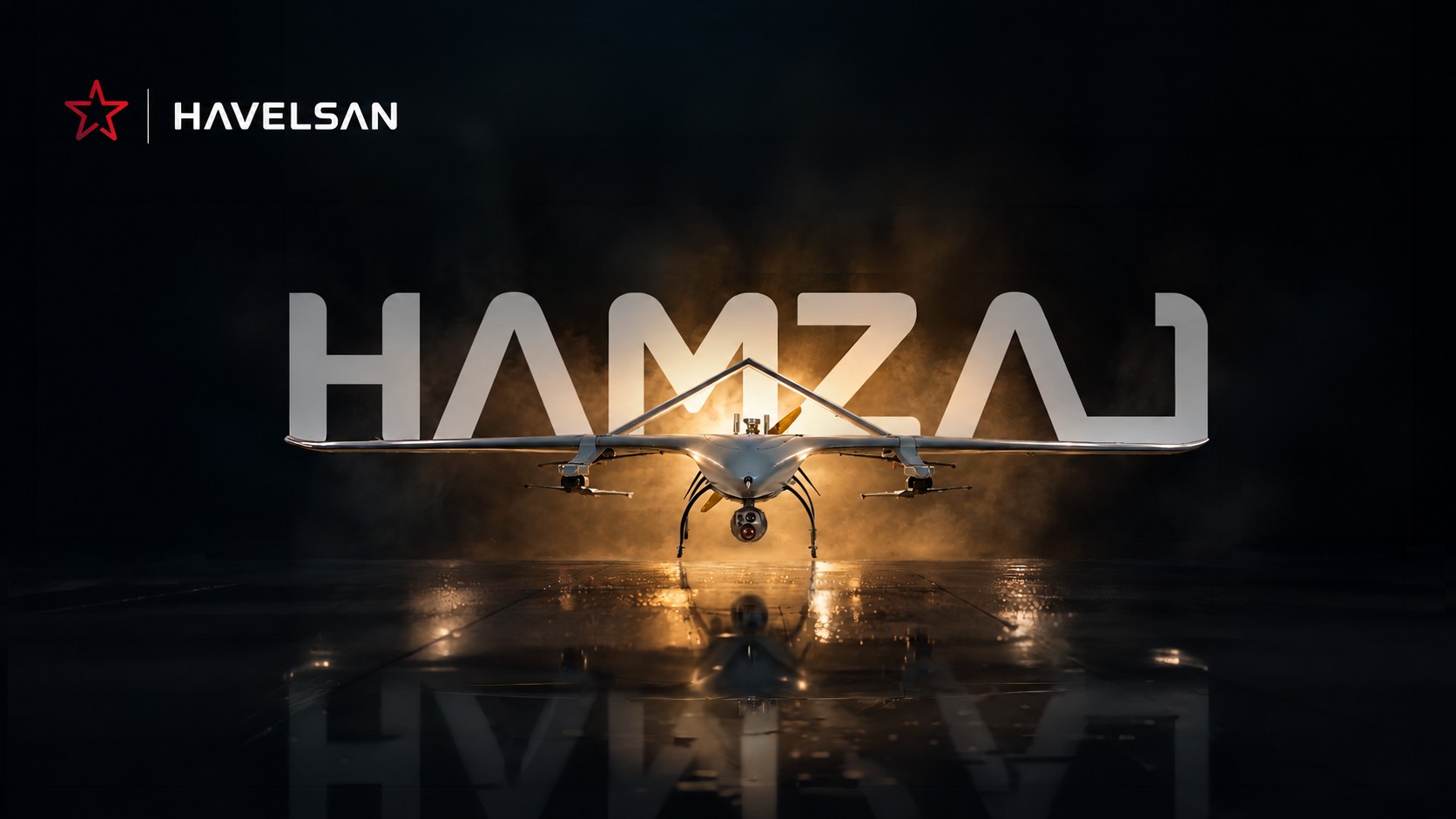
Turkish defence company Havelsan and Egypt’s Arab Organisation for Industrialisation (AOI) signed a sales agreement for the Hamza-1 unmanned aerial vehicle (UAV) at the El Alamein International Airshow last week, converting a year-long joint development programme into a commercial deal for the first time. The agreement follows a strategic cooperation accord the two organisations signed on 26 August 2025 covering the joint production, inside Egypt, of autonomous vertical take-off and landing (VTOL) UAVs, and it arrives against the backdrop of one of the more consequential diplomatic reversals in the region’s recent history.
What Hamza-1 Actually Is
Hamza-1 is a fixed-wing VTOL UAV fitted with an electro-optical gimbal on its nose, built as a localised derivative of Havelsan’s own Baha sub-cloud drone. The electrically powered platform has a maximum take-off weight of 28 kilograms, carries a 2-kilogram payload, communicates with its ground station over a range of 50 kilometres, and offers an endurance of up to two hours, figures Havelsan disclosed alongside the sales announcement. Its VTOL capability lets it operate from confined sites without a runway, an advantage in the kind of dispersed, infrastructure-light operating environments AOI has said it is targeting across Egypt and the wider region. Egypt’s version trades some of the parent Baha’s original specification, a 12-kilogram gasoline-powered airframe offering roughly six hours of endurance and 150 kilometres of intelligence, surveillance and reconnaissance (ISR) range in Turkish service, for the quieter, shorter-range profile that comes with switching to electric propulsion, a configuration Havelsan has previously offered as an alternative variant suited to sensitive urban settings.
Havelsan inducted the parent Baha platform into the Turkish Armed Forces’ own inventory in 2024, positioning it as a building block of the military’s wider “Digital Troops” concept alongside the tracked Barkan unmanned ground vehicle (UGV). That the same underlying airframe has since been re-engineered for Egyptian production illustrates the kind of technology transfer AOI has consistently sought from its foreign partners rather than simple equipment purchases.

A Year in the Making
The Hamza-1 sales agreement is the latest step in a partnership that has moved with unusual speed. Military Africa first reported the Havelsan-AOI cooperation when the August 2025 strategic accord was signed, though the relationship’s practical roots reach back further still, to a March 2025 agreement between Havelsan and Egypt’s Kader Factory for Developed Industries, an AOI subsidiary, that set assembly of the eventual drone in motion with a target of localising 70 percent of its components within two years. The first physical Hamza-1 system was unveiled that December at EDEX 2025 in Cairo, where AOI Chairman Major General Mokhtar Abdel Latif tied the programme to Egypt’s Vision 2030 self-reliance strategy, and Havelsan Chief Executive Officer Mehmet Akif Nacar framed it as a way to open African export markets to what he described as affordable, proven technology. The commercial agreement signed at El Alamein converts roughly thirteen months of development and one high-profile unveiling into an actual sales contract, though Havelsan has disclosed no specific delivery schedule or unit count, saying only that deliveries are expected to begin imminently.
One Name, Three Different Foreign Partners
What the Hamza-1 announcement does not make obvious on its own is that Hamza is not a single Turkish programme but a naming convention AOI has applied across several parallel drone efforts built with entirely different foreign partners. Military Africa reported in February 2026 that AOI had also unveiled a Hamza-2, a combat drone modelled on China’s ASN-209 and developed with Chinese manufacturer Norinco, alongside a Hamza-3, described by a company official as a fire-and-forget loitering munition with swarming capability, again involving Chinese-sourced subsystems that AOI intends to eventually localise fully within Egyptian factories. Egypt had separately agreed with Turkey in 2024 to purchase complete Bayraktar TB2 or Akinci combat drones outright as part of the broader diplomatic normalisation process, an arrangement Military Africa noted in December 2025 had produced no tangible deliveries, in contrast to the steadier progress of the co-production route Hamza-1 represents.
Read together, the picture is of an AOI running simultaneous drone partnerships with Turkey, China and, as Military Africa has also reported, Pakistan’s Global Industrial and Defence Solutions, each contributing a different segment of Egypt’s unmanned systems ambitions rather than any single foreign supplier dominating the relationship. That pattern extends beyond aircraft: AOI’s Anubis combat UGV, unveiled in November 2025, is understood to draw on engineering and software architecture similar to Havelsan’s own Barkan UGV series, suggesting Turkish technology transfer has reached into Egypt’s ground robotics programme as well as its aerial one.
A Deal That Reflects a Bigger Reconciliation
Havelsan’s own statement on the sales agreement described the Hamza-1 programme as reflecting “the developing defence technology cooperation between Türkiye and Egypt,” language that undersells just how significant that cooperation’s return actually is. Turkey and Egypt severed close ties in 2013, after Turkish-backed President Mohamed Morsi was removed in the coup that brought Abdel Fattah el-Sisi to power, and the two governments spent the following decade on opposite sides of regional disputes in Libya and the Eastern Mediterranean. A tentative thaw began around 2020 and gained visible momentum when Erdogan and Sisi shook hands at the 2022 World Cup in Qatar, leading to the restoration of full diplomatic relations and an exchange of ambassadors in July 2023 for the first time in a decade. The pace accelerated further after the October 2023 Gaza war gave both governments overlapping strategic incentives, culminating in a September 2024 Erdogan-Sisi summit in Ankara, the first “Sea of Friendship” joint naval exercise between the two navies in thirteen years, held in 2025, and a formal military cooperation framework agreement Erdogan and Sisi signed during his February 2026 visit to Cairo, alongside reported discussions of deals worth roughly 350 million US dollars covering short-range air defence systems and potential Egyptian participation in Turkey’s fifth-generation fighter programme.
Set against that arc, a modest 28-kilogram surveillance drone matters less for its own capability than as one of the clearest, most concrete industrial outcomes the Turkey-Egypt rapprochement has produced to date. Havelsan also developed the Aqrab, meaning scorpion, a 6×6 unmanned ground vehicle with AOI, fitted with a remotely operated 12.7-millimetre gun, electro-optical and infrared cameras, and a laser rangefinder, built for patrol, fire support or reconnaissance missions without exposing personnel to direct risk, a further sign that the two organisations’ cooperation now spans more than one domain.
Havelsan’s Wider Footprint
Established in 1982 and majority-owned by Turkey’s military-linked foundations, Havelsan operates across defence and information technology, with core work in command, control, communications, computers, intelligence, surveillance and reconnaissance (C4ISR) systems, naval combat management systems, simulation and training systems for land, naval and air platforms, homeland and cyber security systems, and a range of e-government applications spanning election systems, land registries and judicial networks. Its unmanned systems catalogue extends well beyond the Baha and Hamza-1 lineage to include the Bozbey and Bulut fixed-wing VTOL UAVs, the Poyraz quadcopter, the tracked Barkan and wheeled Kapgan unmanned ground vehicles, and, at sea, the armed Sancar unmanned surface vessel and the Caka submersible kamikaze vessel. For a company with more than 2,000 engineers and technicians and a client base already spanning NATO members and African militaries, the Hamza-1 sales agreement is a comparatively small transaction. Its significance lies in what it confirms about the durability of Turkey’s newest major regional partnership, and about how many different foreign suppliers Egypt’s defence-industrial base is now positioned to draw from at once.