

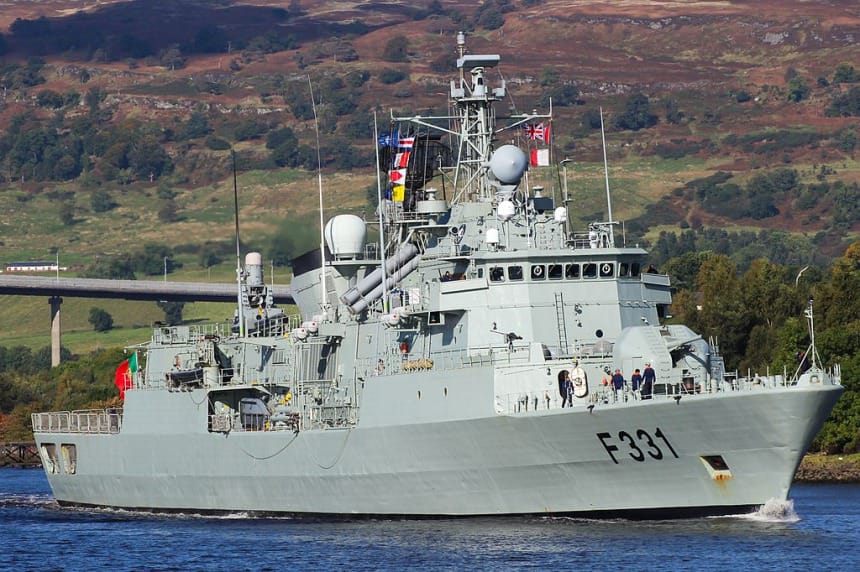
The Nigerian Navy and the Portuguese Navy opened a five-day joint exercise, codenamed Coastal Grip II, on Friday at Nigerian Navy Ship (NNS) Beecroft Jetty in Apapa, Lagos, to sharpen maritime security cooperation in the Gulf of Guinea. Representatives of the Nigerian Army, the Nigerian Air Force, the Nigeria Police Force, the Nigeria Customs Service and the National Drug Law Enforcement Agency (NDLEA) attended the flag-off. Chief of the Naval Staff (CNS), Vice Admiral Idi Abbas, was represented by the Flag Officer Commanding (FOC) Western Naval Command (WNC), Rear Admiral Abubakar Abdullahi Mustapha, who read the CNS’s remarks on his behalf.
Abbas said the drills fit the Navy’s Total Spectrum Maritime Strategy, which treats sea robbery, oil theft, illegal fishing and trafficking in people, weapons and drugs as problems that no single country can solve alone. He called Coastal Grip II a chance to sharpen tactics and procedures while building interoperability with the Portuguese Navy, saying it would “enhance collective ability to address emerging maritime threats through cooperation and military professionalism”.
The exercise draws on ships, helicopters, Special Boat Service teams and the Western Naval Command’s Mission Control Centre. The Portuguese frigate Álvares Cabral, a Vasco da Gama-class ship, is taking part alongside the Nigerian units. Planned activities include maritime interdiction drills, air-sea coordination, communication exercises, ship manoeuvres and mission planning. Also present at the launch were Air Officer Commanding Logistics Command, Air Vice Marshal Abdul Suleh, and the Commander of 9 Brigade, Nigerian Army, Brigadier-General Ayokunle Owolabi. Abbas credited Portugal with donating two Rigid Hull Inflatable Boats (RHIBs) to the Navy in July and training 8 Special Forces personnel in high-speed intercept and special operations techniques.
Exercise Coastal Grip II builds directly on Coastal Grip I, a one-day exercise the Western Naval Command ran with the Spanish Navy Ship BAM Furor on 11 April 2026. Both drills fall under the European Union’s Support to West Africa Integrated Maritime Security programme (SWAIMS). The programme, funded by the EU and coordinated through the Economic Community of West African States (ECOWAS), channels equipment and training to the region’s coastal navies, largely through Portugal’s Camões Institute working alongside the Portuguese Navy.
The RHIB donations described by the Nigerian Navy match a pattern seen elsewhere in the region this year. Portuguese Navy instructors ran a boat-handling course for the Gambia Navy in January, and the EU handed over two RHIBs to the Ghana Navy in early August after a similar training course delivered by Portuguese personnel. Nigeria’s own account of a July handover and Special Forces training fits that broader rollout.
The practical value of these exercises lies less in firepower and more in procedure. Rigid Hull Inflatable Boats are fast, shallow-draft craft used for boarding, interdiction and special operations insertion; they are cheap relative to a frigate but demand trained crews to use safely at speed in open water. Training 8 personnel to operate them would meaningfully expand the Special Boat Service’s capacity to intercept smaller, faster targets such as smugglers’ skiffs or hijacked tankers close inshore.
The exercise is one entry in a long list of bilateral and multinational drills the Nigerian Navy has run in recent years, including Obangame Express with the United States Navy, exercises with French counterparts, and Coastal Grip I with Spain. Grand African Nemo, the 8th edition, ran from 10 to 17 November 2025, drew 19 African coastal states and 7 partner navies, including Portugal, and reinforced the Yaoundé Architecture, the regional framework that coordinates information-sharing zones across the Gulf of Guinea.
Nigeria’s own fleet has grown alongside this exercise schedule. The Nigerian Navy marked its 69th anniversary from May 23 to June 1, 2025, by commissioning 3 new patrol vessels and 3 AW109 Trekker helicopters at NNS Beecroft, and it has continued to add ships and unmanned systems since. Also, the 70th anniversary on 31 May 2026 was explicitly celebrated as the major “Seven Decades of Operational Excellence,” in which President Bola Ahmed Tinubu commissioned 3 brand-new fighting vessels into the Nigerian Navy. Set against that build-up, Coastal Grip II reads as training meant to make new hardware and new partnerships work together under pressure.
Rear Admiral Abdullahi Mustapha closed the flag-off by telling participating personnel that the lessons learned and relationships built over the 5 days would carry into future operations, and thanked the Portuguese Navy for what he called a reflection of the “strong bond of friendship and cooperation” between the two countries. The exercise is due to run through Wednesday, with a debrief expected once the interdiction and coordination drills conclude.