

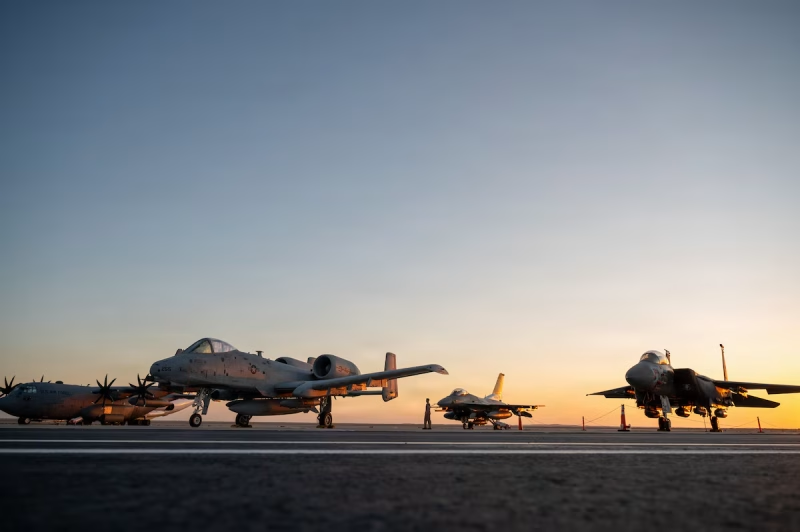
The second edition of Egypt’s flagship aerospace event opens at El Alamein International Airport on 8 September 2026, following a conference day on 7 September, and the United States is bringing a larger military contingent than it did to the inaugural show two years ago. U.S. Air Force and Texas Air National Guard aircraft and personnel are participating alongside Egyptian and international counterparts from more than 80 countries, with organisers expecting upward of 250 exhibitors and roughly 12,000 trade visitors across the three-day exhibition, according to event listings and Egypt’s State Information Service.
What the U.S. Is Sending
The American military presence spans five distinct aircraft types, each representing a different mission set. The C-130J Super Hercules and the older C-130H Hercules cover tactical airlift, moving troops, equipment and supplies into and out of austere airfields, a role that has made the C-130 family a mainstay of U.S. and allied air forces for decades. The A-10 Thunderbolt II, commonly known as the Warthog, brings close air support capability built around its 30mm GAU-8 Avenger rotary cannon and heavy armour protecting the cockpit and critical systems, designed originally to survive ground fire while supporting troops in contact. The F-16 Fighting Falcon, a single-engine multirole fighter that Egypt itself operates in substantial numbers, represents the most widely exported Western fighter of the last four decades. The F-15E Strike Eagle rounds out the display as a two-seat, twin-engine strike fighter capable of both air-to-air and precision air-to-ground missions at long range.
Eric Gaudiosi, Chargé d’Affaires ad interim at the U.S. Embassy in Cairo, framed the American presence around the broader relationship rather than the hardware alone. “The United States is proud to participate in the El Alamein International Air Show 2026 and to open the U.S. Pavilion, featuring more than 25 American companies from among the world’s leading aerospace and defense innovators,” he said. “Our strong presence reflects the depth of the U.S.-Egypt partnership and our longstanding cooperation across the aviation, aerospace, defense, space, and commercial sectors.”
A Bigger Presence Than 2024
This year’s American contingent builds directly on the U.S. role at the airshow’s first edition. Military Africa reported in September 2024 that F-16, F-15E and A-10 aircraft assigned to U.S. Air Forces Central deployed to El Alamein for that inaugural show, with then-AFCENT commander Lieutenant General Derek France calling it an honour to support “the historic first iteration” and noting that such events give a coalition rare opportunity “to come together and evaluate and compare aircraft and capabilities in a non-operational environment.” The addition of both C-130 variants for 2026 extends that fighter-and-attack lineup into airlift, giving this year’s American display a broader operational cross-section than the strike-and-fighter-only presence two years earlier.
The show itself has grown similarly. Egypt’s first-ever airshow was originally announced for May 2024 before ultimately running from 3 to 5 September that year, opened by President Abdel Fattah el-Sisi, who called it “a landmark event for Egypt and the region.” Military Africa’s coverage of that opening recorded participation from more than 300 manufacturers and over 100 countries, figures that later settled closer to 200 exhibitors and 80 countries in most retrospective accounts, alongside early cooperation agreements between Egypt’s state-owned Arab Organisation for Industrialization and firms such as France’s Safran. Organisers are projecting the 2026 edition will exceed that debut on every measure, with roughly 90 percent of exhibition floor space already allocated months before the show and confirmed participation from prime contractors including Lockheed Martin, serving as headline symposium sponsor, alongside Dassault, GE Aerospace, Thales, L3Harris, Korea Aerospace Industries, Turkish Aerospace and Leonardo. The Royal Aeronautical Society, reviewing the 2024 debut, called it “a well-run show” with “genuine promise” that “may well become a fixture on the international circuit,” an assessment the 2026 growth figures appear to be bearing out.
Why Texas, Specifically
The Texas Air National Guard’s involvement is not incidental. Texas has served as Egypt’s partner state under the U.S. National Guard Bureau’s State Partnership Program (SPP) since the two sides began formalising the relationship in August 2020, with a signing ceremony in Cairo in June 2021 making Egypt one of 84 countries worldwide paired with a U.S. state guard force. The Texas National Guard’s size and range of capability make it the only U.S. state guard currently holding three separate international partnerships, alongside Chile and a shared arrangement with Nebraska covering Czechia. General Daniel Hokanson, Chief of the National Guard Bureau, described the Egypt pairing at the time as resting on “more than 40 years of military cooperation and assistance,” building on Texas Guard participation in successive rounds of Exercise Bright Star, the long-running multilateral exercise hosted in Egypt, and Texas Guard support to the Multinational Force and Observers mission monitoring the Sinai Peninsula.
That partnership has centred specifically on the aircraft types now on display at El Alamein. Exchange activities under the SPP have focused on C-130 Hercules flight maintenance and maneuvers, F-16 Fighting Falcon operations, and AH-64 Apache helicopter flight and maintenance, alongside cyber defence, logistics and special forces cooperation. The Texas Guard’s 136th Airlift Wing, based in Fort Worth, operates the C-130J variant now appearing at the airshow, giving this year’s tactical airlift presence a direct institutional link to a bilateral relationship that predates the airshow itself by several years.
A Crowded, Competitive Field
Egypt’s positioning of El Alamein as, in event materials, a “strategic aerospace gateway” between Africa, the Middle East and Europe is drawing interest well beyond Washington. The 2024 debut included a dedicated Russian pavilion organised through Rosoboronexport, featuring United Aircraft Corporation and United Engine Corporation, both Rostec subsidiaries, and Military Africa’s reporting at the time noted the same period saw Russian Tu-160 bombers deployed to South Africa’s Africa Aerospace and Defence exhibition, part of a wider pattern of Russian defence-industrial outreach across the continent running in parallel with, rather than instead of, Western participation. German manufacturer General Atomics AeroTec Systems has confirmed it will showcase its Do228 NXT turboprop at El Alamein this year before moving on to South Africa’s AAD Expo the following week, explicitly citing Africa and the Middle East as strategic growth markets for the aircraft, which already operates with more than 30 operators across nearly 20 African countries.
Egypt’s own defence-industrial ambitions sit at the centre of this competition for attention. The country has separately built out its Egypt Defence Expo (EDEX), a biennial event distinct from El Alamein, and has used both platforms to advance indigenous programmes, including a licence production agreement signed with Russia at EDEX 2023 for Zashchita anti-drone systems and, more recently, integration of German-made Diehl SkyWolf high-power electromagnetic systems into Egypt’s layered air defence architecture. That dual-track approach, courting Western primes for advanced platforms while also localising production capacity with a range of international partners, reflects a broader strategy visible across Egypt’s defence posture rather than something specific to either exhibition.
What the Show Signals
For Washington, sending a fighter, attack and airlift package to Egypt’s second airshow, larger than the one sent to the first, offers a low-cost, high-visibility way to reinforce a partnership that has anchored U.S. Middle East policy for more than four decades, spanning counterterrorism cooperation, Sinai peacekeeping support, and a defence relationship that remains one of the largest U.S. Foreign Military Financing programmes in the region. For Egypt, hosting an expanding roster of American, European, Russian and Asian exhibitors simultaneously, while its own state-owned industrial base signs deals across that same span of partners, positions El Alamein as a venue where Cairo can extract commercial and diplomatic value from all sides of an increasingly multipolar defence market rather than being asked to choose between them.