

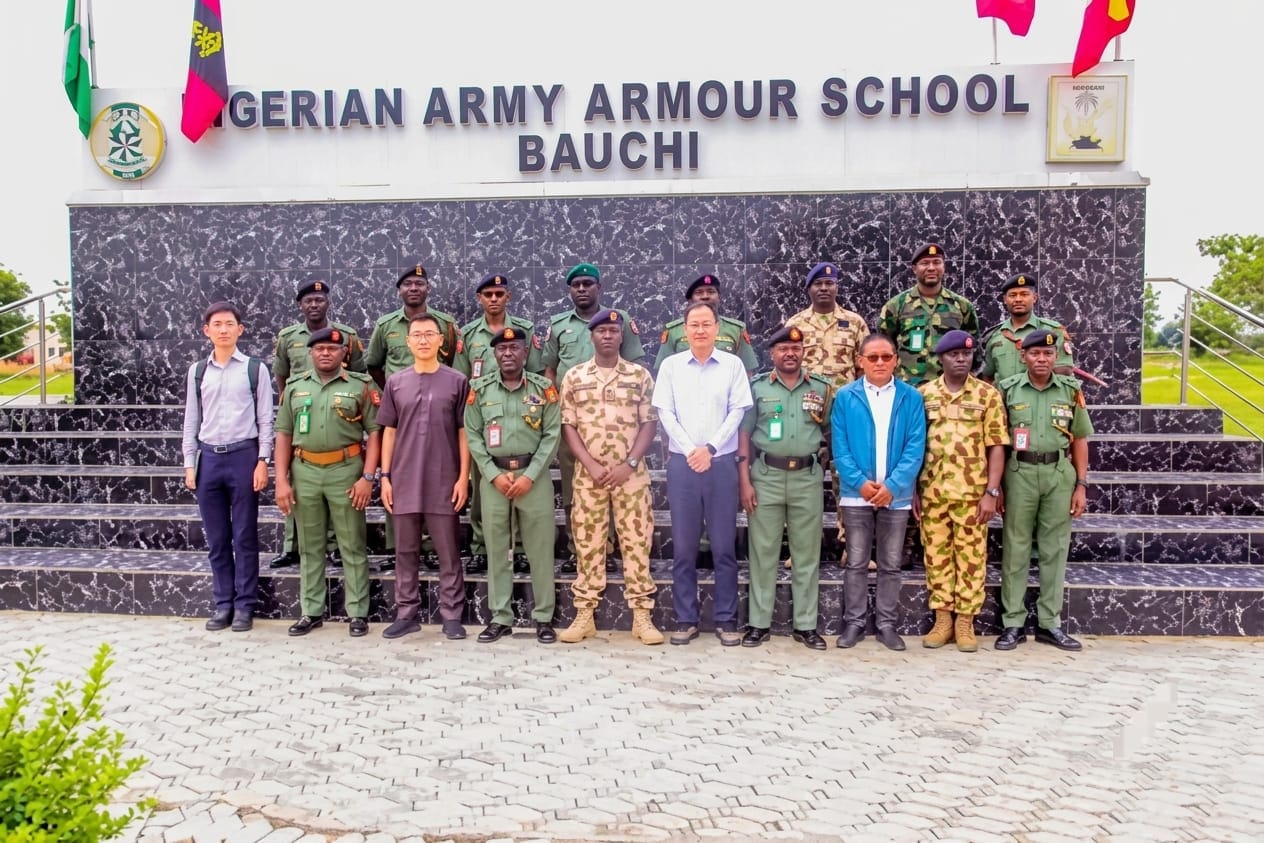
On Thursday, August 27, 2026, the Nigerian Army and China’s state-owned defense giant, NORINCO (China North Industries Corporation), officially launched full operations at a new joint Comprehensive Service Center. Located within the Obienu Barracks at the Nigerian Army Armoured Corps base in Bauchi, this sophisticated facility is in a key region of northeastern Nigeria, chosen for its tactical importance and existing military infrastructure. The strategic partnership aims to boost the military’s self-sufficiency and combat readiness by providing advanced maintenance and repair capabilities for its armored vehicle fleet.
Its formal handover to the Nigerian Army by its Chinese partners was celebrated at an official ceremony, attended by numerous senior officers from both the Nigerian military and NORINCO, highlighting the strategic significance of this joint venture. The center was meticulously planned and originally commissioned in April 2025 by the then-Chief of Army Staff, Lieutenant General Olufemi Oluyede. The intervening 16 months were dedicated to crucial phases of fully equipping the facility with state-of-the-art machinery and specialized tools, alongside an intensive training program for the dedicated Nigerian staff, ensuring that by this week’s official handover, the center was robustly prepared and fully operational to meet its critical mandate.
Major General Chima A. Ekeator, the center’s managing director, personally guided a contingent of eager reporters on a comprehensive tour of the expansive site, meticulously outlining its intended functions and the breadth of its capabilities. He proudly explained that the modern facility possesses the advanced expertise to efficiently handle maintenance tasks up to what the Nigerian Army classifies as Level 4. This designation represents the deepest and most complex tier of repair work, stopping just short of a complete factory rebuild, and is crucial for extending the lifespan of vital military assets.
This major high-level service encompasses extensive overhauls, the precise replacement of large and detailed assemblies, and the essential retrofitting of older equipment with advanced, newer parts to enhance their performance and extend operational relevance. Echoing the high standards, Ekeator confidently declared, “Whatever might be the condition of equipment used in the field, once it is brought here, it will go back as new”, underscoring the center’s commitment to restoring vehicles to peak condition.
According to Major General Ekeator, the state-of-the-art center boasts an impressive operational capacity, enabling it to efficiently work on up to 20 pieces of diverse military equipment simultaneously. This capacity spans a wide array of vehicles, including various infantry vehicles, heavy armour, and crucial artillery pieces, significantly boosting the Army’s readiness. Its primary workload is anticipated to involve the extensive fleet of Chinese-supplied armoured fighting vehicles that the Nigerian Army has strategically acquired and integrated into its forces over the past decade. This includes powerful VT-4 main battle tanks, versatile ST-1 light tanks, and formidable SH-5 self-propelled howitzers, with other specialized NORINCO-built armour models which are already integral to the Nigerian military’s operational capabilities.
Present at the landmark event were Major General Sunday Mokolo, the distinguished commandant of the Nigerian Army Armour School in Bauchi, and Tian Bei, the esteemed deputy general manager of NORINCO, among other high-ranking officials, signifying the deep strategic partnership.
Ekeator said Nigerian personnel will learn equipment support skills on-site, work intended to build maintenance capacity the army can eventually run without Chinese technicians. Much of the Nigerian Army’s NORINCO-supplied armour operates far from Bauchi, deployed against insurgents and armed groups in the North-East and North-West. A repair hub within the country cuts the time equipment spends off the road waiting for parts or specialists to arrive from abroad, and Ekeator said improving that availability was central to the center’s purpose.
The center is the clearest sign yet of how deep the Nigeria-NORINCO relationship has grown. It dates back at least to 2015, when the army took delivery of 120 CS/VP3 mine-resistant ambush-protected vehicles, a wheeled troop carrier built to survive roadside bombs. In 2020, the army received its first VT-4 tanks, ST-1 light tanks and SH-5 howitzers, followed in 2021 by 60 Type-89 tracked armoured vehicles pressed into service against Boko Haram and allied insurgent groups in the northeast. NORINCO has been expanding its footprint across West Africa on the back of that business, opening a regional office in Dakar, Senegal, in 2023 and sending a delegation to Abuja in March 2025 to deepen ties further.
A Nigerian Air Force delegation led by the Chief of the Air Staff, Air Marshal Hasan Bala Abubakar, visited China from April 20 to 25, 2025, to discuss radar coverage and air defence systems, an area where Nigeria has limited domestic capability. The following month, Defence Minister Bello Mohammed Matawalle signed a memorandum of understanding in China covering local ammunition production and further work on tank repair and engineering support.
Operating tracked armour in a counterinsurgency campaign quickly wears down running gear, engines and transmissions, and platforms like the VT-4 (a roughly 52-tonne export tank built by NORINCO for customers outside China) and the lighter ST-1 tank destroyer need a steady supply of spare parts and skilled technicians to stay in the fight. Until now, deep repair work on this equipment likely meant shipping components back to China or flying in contractors, both of which cost time the army does not have, whilst it runs simultaneous operations against insurgents, bandits and separatist groups across multiple regions. A domestic Level 4 facility shortens that cycle.
China has become one of the more active arms suppliers to militaries across the Sahel and West Africa as Western partners have pulled back or tightened conditions on some governments, and NORINCO in particular has paired equipment sales with local infrastructure such as maintenance centers and, per the May 2025 MOU, planned ammunition production. The company has taken a similar approach elsewhere on the continent, supplying armoured vehicles to Côte d’Ivoire and agreeing to build a comprehensive facility with Uganda covering drone assembly, maintenance and personnel training, part of a broader push to embed itself in African militaries’ logistics chains rather than sell equipment and move on.
Nigeria’s defence establishment has framed the Bauchi center and the broader relationship as part of building homegrown sustainment capacity rather than simple dependency. Ekeator said the center’s next phase will focus on scaling up the training pipeline for army technicians so more of the Level 2 and Level 3 work, the routine and intermediate repairs that make up most of a fleet’s maintenance load, can eventually be handled without NORINCO staff on site. For now, the center moves from handover into its first full year of operations with a full slate of armour and artillery from ongoing operations in the North-East and North-West already lined up for repair.