

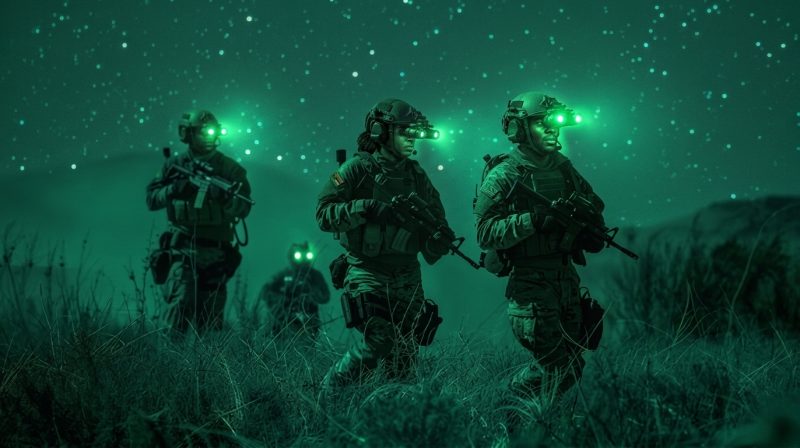
A soldier wearing a Generation 3 (Gen-3) night vision monocular can pick out a human silhouette against Sahelian scrubland at ranges most of his adversaries would need moonlight and luck to manage with the naked eye. That technological gap is real, measurable and has shaped how African state forces and their foreign partners have tried to fight after dark for two decades. It has not, however, delivered the decisive night-time dominance the technology’s specifications suggest it should. Insurgent groups across the Sahel, the Lake Chad Basin and the Horn of Africa have spent years adapting movement patterns that do not depend on seeing in the dark at all, and that adaptation has repeatedly narrowed the advantage Gen-3 optics are supposed to confer.
What Gen-3 Technology Actually Delivers
The defining feature of Gen-3 image intensification is its gallium arsenide (GaAs) photocathode, a semiconductor layer that converts incoming photons, whatever faint starlight or moonlight is available, into electrons far more efficiently than the photocathode materials used in earlier Generation 2 tubes. Those electrons are then amplified through a microchannel plate, a wafer containing millions of microscopic channels that multiply each electron thousands of times before it strikes a phosphor screen and produces the familiar intensified image. The result, in a typical mil-spec monocular such as the widely fielded AN/PVS-14, is a resolution of roughly 64 to 76 line pairs per millimetre, a luminance gain in the range of 40,000 to 80,000 foot-lamberts per foot-candle, and a combined figure of merit, the industry metric multiplying resolution by signal-to-noise ratio, of 1,800 to 2,200 or higher for premium units. Modern tubes also incorporate auto-gating, an electronic circuit that instantly dims the image the moment it detects a sudden bright flash, a muzzle flare or an explosion, protecting the operator from being blinded at the exact moment visibility matters most.
That capability comes with real constraints that matter considerably in an African operational context. Standard monocular and binocular Gen-3 goggles offer a field of view of roughly 40 degrees, compared with the 190-plus degrees of unaided human peripheral vision, producing a tunnel effect that experienced operators learn to compensate for through constant head movement but that never fully disappears. The devices depend on ambient starlight or moonlight to function well; under heavy cloud cover or in dense forest canopy, even Gen-3 tubes struggle without supplementary infrared illumination, and that illuminator, while invisible to the naked eye, is clearly visible to anyone else wearing night vision, turning a tool meant to grant an advantage into a potential beacon if the adversary has matching equipment. Dust, a near-constant feature of Sahelian and Sahara-adjacent operations, degrades optical clarity and accelerates wear on external lens surfaces, while humidity in coastal and forested regions such as Mozambique’s Cabo Delgado province tests seals and electronics differently. None of this makes the technology unreliable. It does mean the theoretical performance figures printed on a datasheet rarely translate cleanly into the same advantage on a humid riverbank in the Niger Delta as they would on a clear, dry range.
Access to the technology has also been far less evenly distributed across African militaries than its NATO-standard status might suggest. Algeria’s elite Special Intervention Group, the country’s premier counterterrorism unit, was denied night vision goggles entirely for years under an arms embargo imposed after the 1992 military takeover, only gaining access to Western-standard equipment after 2001, when the global war on terror reopened supply channels that had been closed for the better part of a decade. That history is a useful reminder that even sophisticated African security services have often operated with a meaningful night-vision gap relative to well-resourced insurgent financiers or foreign-backed non-state actors, not the reverse image most procurement literature assumes.
What “Indigenous Low-Light Movement” Actually Means
The insurgent groups operating against Gen-3-equipped forces across the continent, Jama’at Nusrat al-Islam wal-Muslimin (JNIM) and the Azawad Liberation Front (FLA) in Mali, the Islamic State West Africa Province (ISWAP) in the Lake Chad Basin, al-Shabaab in Somalia, have not attempted to match this technology system for system. They have instead built movement doctrine around not needing it, an approach grounded in three overlapping practices that show up consistently in how these groups operate at night.
The first is terrain familiarity so deep it functions as a substitute for vision. Fighters recruited locally, or embedded for years within a specific operating area, move along paths, wadis and livestock trails they know by memory and by feel rather than by sight, a form of movement that does not require illumination of any kind because it does not depend on seeing the ground so much as recognising it. This is not a new insight specific to the current generation of Sahelian conflict; it is the same logic that shaped Rhodesian and South African security force doctrine during the bush wars of the 1970s and 1980s, when units such as the Selous Scouts found that insurgent groups crossing into Rhodesia from Mozambique and Zambia routinely used the same infiltration routes for years at a time, routes chosen for their familiarity to local guides rather than for any tactical sophistication, and which counter-insurgency trackers learned to anticipate as reliably as a fixed patrol schedule.
The second practice is a deliberate no-technology discipline. Groups that cannot compete with a state force’s optics avoid emitting any signature a modern detection system could exploit, no active infrared illumination, minimal radio chatter, no thermal-signature vehicles moving in the open. Jama’at Nusrat al-Islam wal-Muslimin’s escalating use of fibre-optic guided drones in Mali, tethered to the operator by a physical cable rather than a radio link, follows the identical logic one domain over: rather than trying to out-technology a better-resourced adversary’s electronic countermeasures, the group has adopted a method that denies the adversary’s detection apparatus a signal to find in the first place. Applied to foot movement, the same instinct produces columns that travel dispersed, in small groups, at a walking pace slow enough to avoid raising dust or noise, timed to arrive at an objective just before first light rather than to spend hours transiting in full darkness where any single mistake becomes catastrophic.
The third is dependence on local guide networks and civilian pattern-of-life knowledge, allowing fighters to move through populated areas at night looking, to any observer without specific intelligence, indistinguishable from ordinary nocturnal activity, herders moving livestock, traders on established routes, itinerant labour. This blends movement into the background noise of rural life rather than avoiding it, a much harder problem for a technologically superior force to solve than simply detecting motion in open terrain, since the challenge shifts from can you see them to can you tell them apart from everyone else moving in the dark.
Where the Balance Actually Sits
French-led Operation Barkhane, before its expulsion from the Alliance of Sahel States juntas in 2022 and 2023, offers the clearest documented test case for how these two approaches interacted in practice. French special operations units, equipped with night vision at a standard few African forces could match at the time, conducted night raids that killed or captured a number of senior jihadist commanders and disrupted networks across Mali, Niger and Burkina Faso, real, verifiable successes that depended directly on the ability to move, identify and engage after dark when insurgent forces expected less scrutiny. Those same operations also took place against an adversary that, over nearly a decade of contact with a night-vision-equipped adversary, adapted its own movement patterns specifically to blunt that advantage, dispersing further, reducing predictable staging behaviour, and increasingly relying on the terrain-and-network approach described above rather than contesting French forces on anything resembling equal technological terms. Barkhane’s tactical successes did not translate into a strategic defeat of the groups it targeted, and the insurgency it fought expanded southward toward coastal West Africa in the years after France’s withdrawal, a trajectory that suggests the night-vision advantage, however real at the tactical level, was never sufficient by itself to resolve the underlying contest.
The most honest way to characterise the current balance is asymmetric rather than one-sided. Gen-3 optics give a properly trained, well-supplied force a genuine edge in specific engagement types: precision raids against a known, fixed target; ambush denial along a predictable route; extended patrol duration into hours an unequipped adversary would consider safe. What they do not deliver is the kind of blanket area denial that would make an entire operating environment unsafe for an insurgent force to move through at night, because insurgent movement has adapted specifically around not depending on visibility at all, using knowledge, discipline and human networks that a superior optical sensor cannot detect or disrupt. A device built to defeat darkness has limited purchase against an adversary that has restructured its own tactics to make darkness irrelevant to how it navigates.
What This Means for African Force Planners
The practical implication for African militaries weighing further investment in night-fighting capability is not that Gen-3 technology is not worth acquiring. It clearly is, and the capability gap that left forces such as Algeria’s own counterterrorism units without it for years is not one any modern security service should accept as a permanent condition. The implication is narrower and more specific: night vision procurement delivers its full value only when paired with the intelligence, tracking and human-terrain expertise that let a force actually locate an adversary who has spent years learning to move without needing to be seen. Optics alone answer the question of how well you can see. They do not answer the harder question, the one insurgent movement doctrine across the continent has been built around for decades, of where to look.