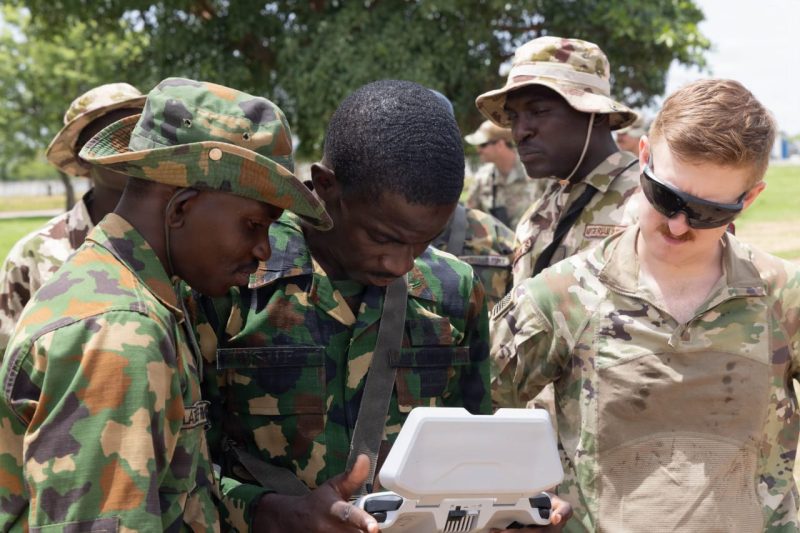
U.S. and Nigerian forces conducted unmanned aircraft system (UAS) training at Operating Location Bauchi in northeastern Nigeria. Sgt. Mark Murphy, an intelligence analyst assigned to the U.S. Army’s 13th Combat Sustainment Support Battalion, led about 10 members of the Nigerian Air Force Special Forces Regiment through a session at Operating Location Bauchi.
The class opened with about 45 minutes of classroom instruction before moving to hands-on flying, according to the Army account. Sgt. Murphy walked the Nigerian troops through the aircraft’s controls and the tactics that U.S. personnel have used while operating UAS at the base. “They were really excited about being able to get hands-on time with it”, Sgt. Murphy said. “They were excited about doing more training with it in the future”.
The UAS session was one strand of a wider training calendar at Bauchi that has also covered Combat Lifesaver and Tactical Combat Casualty Care (TCCC) instruction, weapons familiarization, camouflage, water treatment and testing, explosive ordnance disposal (EOD) and small-unit tactics. Capt. Gabriel Feingold, a logistics officer assigned to U.S. Army Southern European Task Force, Africa (SETAF-AF) and the operations officer at Operating Location Bauchi, said the schedule is not fixed in advance. “We bring them a list of several different training topics, and they select what they think would be most beneficial for them”, Capt. Feingold said.
Capt. Feingold said the arrangement lets U.S. units teach what they are equipped to teach while Nigerian commanders steer the program toward their own priorities. Unmanned systems drew particular interest, he said, a pattern consistent with Nigeria’s growing reliance on drones for surveillance and strike missions against Boko Haram and Islamic State West Africa Province fighters in the country’s northeast. For the Nigerian Air Force Special Forces Regiment, gaining hands-on UAS proficiency has practical value beyond the classroom. Small, hand-launched or portable systems used in this kind of familiarization training typically give a ground unit its own overhead view of a target area without waiting on a manned aircraft or a larger surveillance platform, letting a small element scout terrain, confirm a target or watch a route before committing troops. Sgt. Murphy said the fundamentals translate regardless of who is being trained. “It just goes back to the importance of teaching Soldiers fundamentals that can be applied to any kind of discipline”, he said.
Capt. Feingold said the training has also built personal ties between the two forces, particularly at junior ranks that would not otherwise interact closely. “It helps build relationships between Soldiers and the partner force, especially at the lower levels”, he said. Sgt. Murphy said Nigerian personnel who once passed him without a word now stop to talk about the sessions. Soldiers from both countries have also taken to playing basketball and volleyball together when schedules and weather allow, according to the Army account, adding an informal layer to the formal instruction.
The Bauchi program sits inside a broader U.S.-Nigeria security cooperation relationship built around combined training, advising, intelligence sharing, and professional exchanges, and it follows a pattern of growing U.S. military engagement with Nigeria and its neighbors. African Lion 25, the annual U.S. Africa Command exercise led by SETAF-AF, ran from April 14 to May 23, 2025, across Tunisia, Ghana, Senegal and Morocco with more than 10,000 troops from over 50 nations, including 7 NATO allies, making it the largest edition in the exercise’s history at the time. Maj. Gen. Andrew C. Gainey, commanding general of SETAF-AF, said the drill was designed “to deploy, fight, and win in a complex multi-domain environment”. The exercise included airborne operations, amphibious landings, and a first-time defensive cyber component, and its scale illustrates the resources the U.S. Army has committed to African partnerships.
U.S. support for Nigerian airpower development also predates the current Bauchi program by several years. In December 2021, Maj. Gen. David Baldwin, then the Adjutant General of the California National Guard, pledged during a visit to Nigerian Air Force headquarters in Abuja that his organization would help build the service’s Air-Ground Integration School and train its instructors.
Nigerian Air Force Special Forces Regiment operators who complete the UAS course gain a reconnaissance tool they can deploy without waiting on higher headquarters; a capability that matters in the dispersed, fast-moving fight against militant groups in Nigeria’s northeast. Army officials at OL Bauchi say additional training is already being planned, with topics to be selected jointly by U.S. and Nigerian commanders based on what each side can offer and what the Nigerian force says it still needs.