

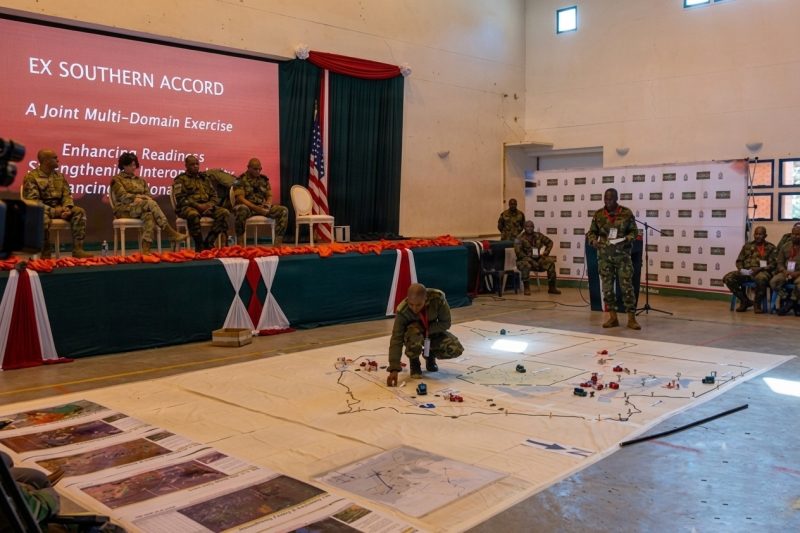
Botswana and the United States wrapped up Exercise Southern Accord 2026 on 15 August 2026, closing 6 days of joint military planning that, for the first time, brought the US Space Force into the drills alongside the Botswana Defence Force (BDF) and the North Carolina National Guard (NCNG). The exercise ran from 10 to 15 August 2026 and brought together US and Botswana military personnel to enhance regional security and foster mutual readiness. The closing ceremony took place at Gaborone Technical College.
This year’s iteration shifted the focus from field training to staff work. Several functional areas were stood up during the exercise, including cells for cyber, intelligence, space operations, and the main staff planning group. That marks a departure from earlier editions, which leaned more heavily on hands-on skills. Southern Accord 2024 centered on humanitarian assistance, disaster relief, peacekeeping, and aeromedical evacuation.
US Air Force Colonel Anthony Sullins, the exercise’s deputy director, said the shift toward multi-domain planning pushed both militaries into unfamiliar territory. “The rigor of this exercise challenged participants to learn new concepts in cyber defense and space operations”, he said. US Ambassador to Botswana, Howard A. Van Vranken, struck a similar note at the closing ceremony, telling attendees that “you can see two capable militaries working side by side to make Africa better”. He added that the exercise should feed into planning for the next edition, saying “as we look toward Southern Accord 2028, we should build on the lessons, relationships and capabilities developed during both exercises”.
Southern Accord sits inside the US State Partnership Program (SPP), a Pentagon initiative that pairs individual US states’ National Guard units with foreign militaries for long-term cooperation. The NCNG and BDF have been paired under the programme since 2008, and the relationship extends well beyond the annual exercise into education, science and technology, and civil agency coordination. The clearest expression of that partnership sits on the tarmac at Botswana’s air bases.
The BDF has flown the C-130 Hercules, a four-engine turboprop transport aircraft, since the 1990s, when it received 3 C-130B models from the United States. That fleet aged out of service by 2024, and Washington has spent the past two years rebuilding Botswana’s airlift capacity around the newer C-130H variant. In June 2024, the United States handed over a C-130H cargo aircraft valued at roughly $30 million, giving the BDF enhanced airlift for disaster relief, peacekeeping, and logistical support. The US Embassy in Botswana notified Congress in August 2025 of a proposed donation of 2 further C-130H aircraft, each valued at more than $12 million.
At a ceremony on 15 January 2026 at Sir Seretse Khama International Airport, Ambassador Van Vranken presented nearly 13 million pula, about $1 million, worth of new C-130 maintenance parts to the BDF. The shipment consisted of 26 pallets holding more than 12,000 individual components, handled on arrival by the BDF Air Arm and Air Logistics Squadron. Ambassador Van Vranken framed the shift plainly, noting that an air force’s ability to stay operational depends largely on having spare parts on hand. The C-130H’s Allison T56-A-15 engines produce about 4,591 shaft horsepower each, giving it stronger performance in the hot, high-altitude conditions typical of the southern African plateau, and it carries roughly twice the payload of the smaller CASA aircraft in the BDF’s transport fleet.
Botswana signed the Artemis Accords, a US-led framework of principles for peaceful and transparent space exploration, on 25 June 2026 at NASA headquarters in Washington, becoming the sixth African signatory and the 68th country overall. Botswana’s Minister of Communications and Innovation, David Tshere, signed on the country’s behalf, months after Botswana launched its first satellite, BOTSAT-1, aboard a SpaceX rocket from Vandenberg Space Force Base in March 2025.
Two more C-130H aircraft are working through the US donation pipeline; the spares depot at Sir Seretse Khama International Airport should ease maintenance strain on the existing fleet, and planners on both sides have already flagged Southern Accord 2028 as the next checkpoint for folding space and cyber planning more deeply into the exercise.