

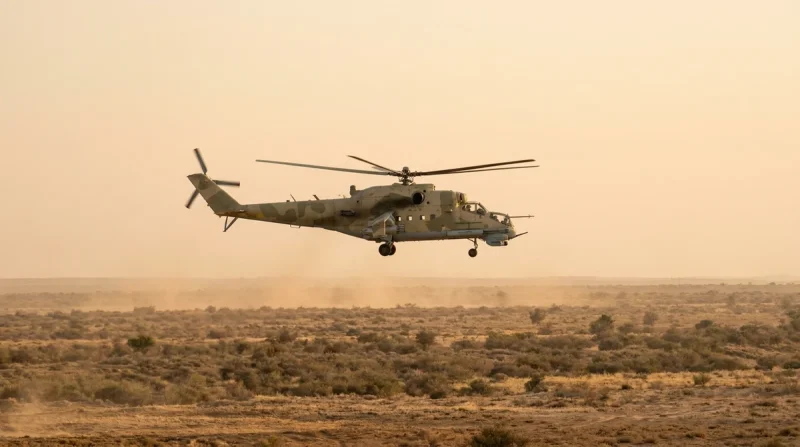
On 5 July 2026, the Azawad Liberation Front (FLA) downed a Russian-operated Mil Mi-24P attack helicopter during a joint FLA-Jamaa’at Nusrat al-Islam wal Muslimeen (JNIM) siege on Anefis in northern Mali. Videos circulating on pro-FLA channels show fighters recovering the attack helicopter’s 30mm Gryazev-Shipunov “GSh-30-2K” twin-barreled autocannon for future use. The helicopter, stationed in Gao, was supporting a Malian Armed Forces (FAMA) and Africa Corps convoy tasked with breaking the siege of Anefis and resupplying the garrisoned forces.
The attack helicopter was delivered to Mali as part of a series of Russian equipment consignments between March 2022 and early 2023. The shipments included at least three Mi-24P attack helicopters, two Su-25 attack aircraft, nine L-39 light attack aircraft, two Mi-8 transport helicopters, and P-18 and 59N6-TE “Protivnik-GE” radar systems. The equipment, integrated into the Africa Corps aviation structure, significantly bolstered Mali’s aerial capabilities.
The Aircraft
The Mi-24P has become one of Mali’s primary close air support assets. Unlike Mali’s older equipment and earlier Mi-24 variants, the Mi-24P is equipped with a fixed 30mm GSh-30K cannon capable of destroying light armored vehicles and fortified troop positions. Paired with the helicopters’ heavy armor, troop cabin, and ability to fly at low altitude, the Mi-24P serves as one of the backbones of the junta’s aerial counterinsurgency strategy.
Erosion of Malian Air Superiority.
The destruction of the escorting Mi-24P in July 2026 likely leaves FAMA with few operational attack helicopters, a serious loss that underscores a broader trend. Since 2023, the Malian junta’s aerial capabilities have rapidly eroded. To date, open-source reporting indicates that at least 13 modern manned and unmanned aircraft have been destroyed. Of note, the junta has lost four of its Russian Mi-24P attack helicopters, at least one of its Turkish Bayraktar Akıncı drones, more than four transport helicopters, and at least two Su-25 aircraft.
The degradation of the Malian junta’s aerial capabilities puts at risk one of the junta’s few remaining advantages over Malian insurgents. The junta’s aerial airpower force plays a critical role in the junta’s counterinsurgency capabilities. Air assets not only inhibit non-state actors from amassing large forces but are critical for ISR, guarding convoys and providing support to besieged encampments. Aerial support has become especially important to the junta’s ability to counter JNIM’s economic blockade. The Mi-24P is particularly useful due to the helicopter’s advanced armor plating and ability to fly at low-altitude.
The detriment of Mali’s degraded aerial capacity will only grow as non-state actors improve their own aerial capabilities. As non-state actors continue to use drones for kinetic and non-kinetic means, such as to surveil troop movements, adjust mortar fire, or deploy FPV drones, fixed military positions will become increasingly vulnerable. Air capabilities have therefore become not only a means to conduct offensive operations, but a requisite to protect fixed military positions and logistical corridors. Non-state actors will also continue to innovate new means to use drones, further increasing this vulnerability. Thus, the growing losses may drive the Malian junta deeper into Russia’s orbit as it attempts to respond to the growing complexity of its ongoing insurgency.