

Nigeria has emerged as the continent’s largest investor in artificial intelligence-powered surveillance, spending $470 million to deploy advanced monitoring systems across its major urban centres.
The investment accounts for nearly 23% of the $2.1 billion spent by 11 African nations on smart surveillance infrastructure. These figures come from a March 12, 2026, report by the Institute of Development Studies (IDS) titled “Smart City Surveillance in Africa: Mapping Chinese AI Surveillance Across 11 Countries.”
The study verified that Nigeria’s expenditure is nearly double the regional average of $240 million per country. Most of the funding is directed toward Safe City initiatives, which integrate facial recognition and Automatic Number Plate Recognition (ANPR) tools into centralised command facilities.
INFRASTRUCTURE AND CHINESE FINANCING
The report identifies Nigeria as the primary buyer in a regional market heavily influenced by Chinese technology and credit, with the Nigerian government providing 15% of the capital and the bank covering the remaining 85%. Financing typically involves “soft loans” from the China Eximbank, often tied to the procurement of hardware from vendors like Hikvision, ZTE, and Huawei.
Nigeria’s primary surveillance backbone, the National Public Security Communication System (NPSCS), utilised this model to support the Nigeria Police Force. The network currently includes approximately 10,000 smart cameras in cities such as Lagos and Abuja, which transmit geo-located data in real time.
Also, the Nigerian Ministry of Defence signed a $190 million Memorandum of Understanding (MoU) with UK-based defence technology firm MARSS Group, on March 19, 2026, to establish a national artificial intelligence (AI) powered security network. The agreement, finalised in London during an official state visit, initiates a multi-year program to deploy a comprehensive Command, Control, Communications, Computers, and Intelligence (C4I) framework across the country.
The shift from passive recording to active, AI-enabled monitoring allows security forces to track vehicle movements and identify individuals in public spaces. However, the IDS report found limited evidence that this massive expansion has reduced crime or improved prosecution rates. Researchers noted that court records rarely show convictions secured through surveillance footage. Furthermore, no country studied has established a legal framework robust enough to balance state security needs with the protection of fundamental human rights. Critics argue that relying on foreign-backed “soft loans” creates long-term dependencies on external vendors for software updates and technical support.
The following 11 countries are ranked by their documented investment in smart camera systems as of March 2026:
- Nigeria: $470 million (10,000 cameras)
- Mauritius: $456 million (4,143 cameras)
- Kenya: $219 million (2,000 cameras)
- Zambia: $210 million (1,600 cameras)
- Uganda: $189 million (5,000 cameras)
- Senegal: $167 million (500 cameras)
- Mozambique: $147 million (450 cameras)
- Egypt: $58 million (6,000 cameras)
- Zimbabwe: $10 million (Camera count not specified)
- Algeria: Cost not specified (5,000 cameras)
- Rwanda: Cost not specified (849 cameras)
Actual spending across the region is likely higher than the $2.1 billion documented. Many surveillance budgets remain classified, and public financial records in several of the studied nations are incomplete.
The African Union is attempting to address these governance gaps through its Continental AI Strategy (2025-2030). This framework emphasises data sovereignty and ethical use, though the IDS report warns that the current lack of oversight leaves journalists and political opponents at high risk of being tracked.
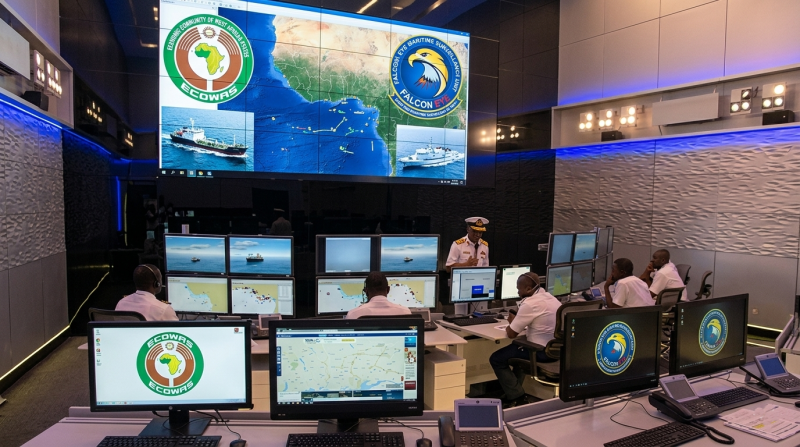
The Nigerian Navy has also begun integrating AI into its maritime strategy. Since August 2023, the Navy has prioritised AI-driven situational awareness to combat oil theft and piracy. These systems process data from radar and satellite imagery to provide a real-time picture of the Gulf of Guinea.
The Nigerian Navy’s Falcon Eye is a state-of-the-art AI-integrated maritime surveillance system designed to secure Nigeria’s Exclusive Economic Zone (EEZ) and Gulf of Guinea waterways against piracy, oil theft, and smuggling. Developed by RTcom, this system integrates coastal radars, cameras, and automated data tracking to provide 24/7, AI-driven situational awareness.
The system uses artificial intelligence for automatic identification and predictive analytics to track vessels and detect illegal activities, including drug trafficking and vessel-to-vessel transfer of stolen crude.
The trend toward AI adoption shows no sign of slowing as African nations seek to modernise defence capabilities with fewer personnel. Future procurement is expected to focus on indigenous AI solutions and drone integration to close existing capability gaps in border and maritime security.