

The 2025 edition of the Egypt Defence Expo (EDEX) in Cairo served as a demonstration of the nation’s accelerating drive toward industrial sovereignty. Held from 1 to 4 December, the event featured over 450 exhibitors and official delegations from 100 countries, but the central narrative was the substantial expansion of locally manufactured hardware. Egyptian state-owned enterprises, particularly the Arab Organisation for Industrialisation (AOI) and the Ministry of Military Production, unveiled platforms ranging from modular rocket artillery to turbojet-powered loitering munitions, signalling a shift from licensed assembly to domestic adaptation and design.
Modular Artillery Solutions
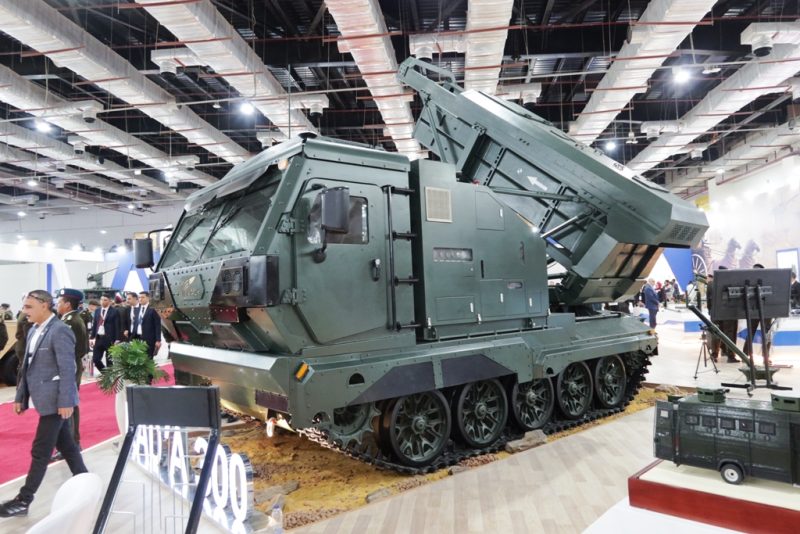
A focal point of the AOI pavilion was the public debut of the Rad’a 300 multiple rocket launcher (MRL). This system represents a hybrid engineering approach, integrating foreign firepower with domestic mobility platforms. The launcher utilizes a single munitions pod derived from the Chinese Norinco SR5 system, mounted on a heavily modified, Egyptian-built version of the Soviet-era ATS-59G tracked carrier.
The Rad’a 300 offers distinct logistical advantages over larger, truck-mounted systems. It is designed for rapid shoot-and-scoot operations, capable of deploying in two minutes and relocating immediately after firing. The single pod architecture provides versatile loadout options. It can carry twenty 122 mm artillery rockets for saturation fire or be reconfigured to launch Norinco’s Fire Dragon family of guided surface-to-surface missiles.

Specific missile configurations displayed for the system include a 220 mm option (six per pod) with a 75 km range, a 300 mm variant (four per pod) reaching 150 km, and a heavy 610 mm missile (one per pod) capable of striking targets at 290 km. The system features an automated fire-control suite allowing for remote firing from a distance of 60 meters, enhancing crew survivability during counter-battery fire. Although tested and approved by the Egyptian Armed Forces, the system is currently positioned for the export market under an agreement with Norinco.
In the tube artillery domain, the Ministry of Military Production provided updates on the K9A1EGY 155 mm howitzer program. This platform is being produced jointly with South Korea’s Hanwha Aerospace. Officials confirmed that a dedicated production line is nearing completion, with the first domestically assembled battalion scheduled for delivery in the first half of 2026. This timeline is supported by the local manufacturing of 155 mm ammunition, ensuring supply chain security for the new fleet. Additionally, the legacy Raad 200 rocket launcher has received a mid-life update, featuring a new hydraulic control system to improve laying speed and accuracy.
Egypt’s state-owned Arab Organisation for Industrialisation (AOI) unveiled the Sakr 105 shoulder-launched rocket system at the Egypt Defence Expo (EDEX) 2025, held in Cairo from 1 to 4 December. The system fires a 105 mm projectile with an effective range of 50 to 700 metres and is offered with either an anti-tank or thermobaric warhead, reflecting its intended versatility on the battlefield.
The Sakr 105 employs a disposable launch tube mated to a reusable launcher equipped with an optical sight, with provision for integrating a night-vision device. Two examples were on display at EDEX, although only the system exhibited at the Arab International Optronics stand—an AOI subsidiary—was fitted with the sight, designated D98.
While the overall concept is broadly comparable to the RPG-32 Nashshab developed by Jordan’s Jadara Equipment & Defence Systems with Russian support, the D98 sight differs in appearance from the DS-2R used on the Jordanian system. AOI stated the launcher weight as 3.25 kg, likely excluding the rocket itself, though no data was released on the armour penetration performance of the anti-tank warhead.
loitering Munitions and Strike Drones
The exhibition revealed a concerted effort by Egyptian industry to bridge the capability gap in unmanned aerial systems (UAS), specifically regarding one-way attack (OWA) platforms. The Egyptian firm Tornex introduced the Jabbar series, a tiered family of strike drones designed to operate between tactical guided missiles and strategic ballistic assets.
The Jabbar 250 stands out as the high-performance variant. Powered by a small turbojet engine, it achieves speeds of 576 km/h, making it difficult for standard anti-aircraft artillery to intercept. With a maximum takeoff weight (MTOW) of 250 kg and a wingspan of 3.45 meters, it delivers a 50 kg payload to ranges of up to 1,500 km, though its endurance is limited to 2.5 hours due to fuel consumption.

Photo: Tornex

Photo: Tornex

Photo: Tornex
Conversely, the Jabbar 200 prioritises endurance over speed. Resembling the Iranian Shahed-136 in planform, this piston-driven aircraft has an MTOW of 200 kg and can remain airborne for 14 hours. It cruises at a modest 200 km/h, carrying the same 50 kg payload as its jet-powered sibling. A smaller variant, the Jabbar 150, offers 10 hours of endurance with a gimballed camera for operator-in-the-loop targeting.
For tactical units requiring immediate precision fire, Tornex displayed the Voltex series. The Voltex-5 is a man-portable loitering munition comparable to the US-made Switchblade. Electrically powered, it offers a 60-minute endurance and a 10 kg warhead, suitable for engaging light vehicles or dug-in infantry. The company also showcased guidance kits for gravity bombs, including the GK-6, which claims a circular error probability (CEP) of just 2 meters.
Robotics and Autonomous Systems
Collaboration with Turkey’s Havelsan and Canik Tech has yielded new unmanned ground and air assets for AOI. The Aqrab (Scorpion) unmanned ground vehicle (UGV) drew attention for its modular weapon station. The 6×6 platform was displayed with a Trakon Lite remote weapon station (ROWS) armed with a 12.7 mm machine gun. The vehicle is designed for high-risk reconnaissance and fire support, utilising electro-optical and infrared cameras for navigation and targeting. Its open architecture allows end-users to swap the gun turret for non-lethal payloads or engineering tools.
The Arab Organisation for Industrialisation (AOI), Egypt’s state-owned defence conglomerate, had earlier unveiled a new range of indigenous military systems, headlined by the “Anubis” combat Unmanned Ground Vehicle (UGV). The reveal came during a high-level inspection visit by AOI Chairman Lieutenant General Mokhtar Abdel Latif, signalling a major step forward in Cairo’s efforts to localise advanced autonomous technologies.
In the aerial domain, the AOI Hamza 1 was unveiled as a localised version of Havelsan’s Baha sub-cloud UAV. This fixed-wing, vertical takeoff and landing (VTOL) drone is optimised for intelligence, surveillance, and reconnaissance (ISR) missions, featuring a nose-mounted gimbal.
AOI also exhibited the FL350, a micro-munition weighing only 500 grams. With a range of 3 km and 15 minutes of battery life, it provides individual soldiers with a localised precision strike capability. On the naval front, the USV-001 unmanned surface vessel featured an Eagle-2 remote weapon station, produced in partnership with Spanish firm Escribano, indicating a broadening of Egypt’s technology partner base beyond traditional eastern suppliers.
Armoured Vehicles and Material Science
The push for localisation extends to the materials used in heavy armour. Minister of State for Military Production Mohamed Salah El-Din noted that domestic factories can now produce armoured steel plates up to 30 mm thick and 240 cm wide. This doubling of previous capacity reduces reliance on imported steel for the production of tanks and combat vehicles.

This material capability supports new vehicle programs like the Sinai 806. Developed to support the Sinai 200 tracked vehicle family, this armoured recovery vehicle features a 2-ton lifting winch and 30-ton towing capacity. It ensures that mechanised units can conduct field repairs under armour protection.
For special operations forces, a new variant of the Temsah-3 4×4 was displayed. This vehicle prioritises firepower and speed, featuring a protected cab for two crew members and an open rear deck mounting four 7.62 mm machine guns on pintle mounts. Powered by a 6.5-litre diesel engine, it reaches speeds of 125 km/h.
Innovation was also evident in air defence integration. A light 4×4 platform was shown fitted with a modified 23 mm twin-barrel anti-aircraft gun. Engineers adapted the recoil mechanism to suit the lighter chassis, providing a mobile solution capable of engaging aerial targets at 2.5 km and ground targets at 2 km with a firing rate of 1,600 rounds per minute.
Egypt seeks to deepen industrial integration
The hardware on display was underpinned by a series of strategic agreements aimed at deepening industrial integration. AOI signed a memorandum of understanding (MoU) with Norinco to further localise defence production, alongside agreements with Emirati-Chinese firm Qalaa Red Flag and Chinese entity Shadow Wings.
A substantial partnership was solidified between AOI and the UAE’s Abu Dhabi Aviation Group. This seven-part agreement covers manufacturing, maintenance, and logistics, linking AOI’s Aircraft and Engine factories with Abu Dhabi Aviation subsidiaries such as Global Aerospace Logistics (GAL) and AMMROC. This moves the relationship beyond simple procurement to joint sustainment of regional fleets.
EDEX 2025 demonstrated that Egypt is effectively leveraging its diversified procurement strategy to build a robust domestic base. By integrating technologies from China, South Korea, Turkey, and Europe, Egyptian industry is steadily moving up the value chain, offering cost-effective solutions like the Rad’a 300 and Jabbar drones to the global market while securing its own supply lines.