
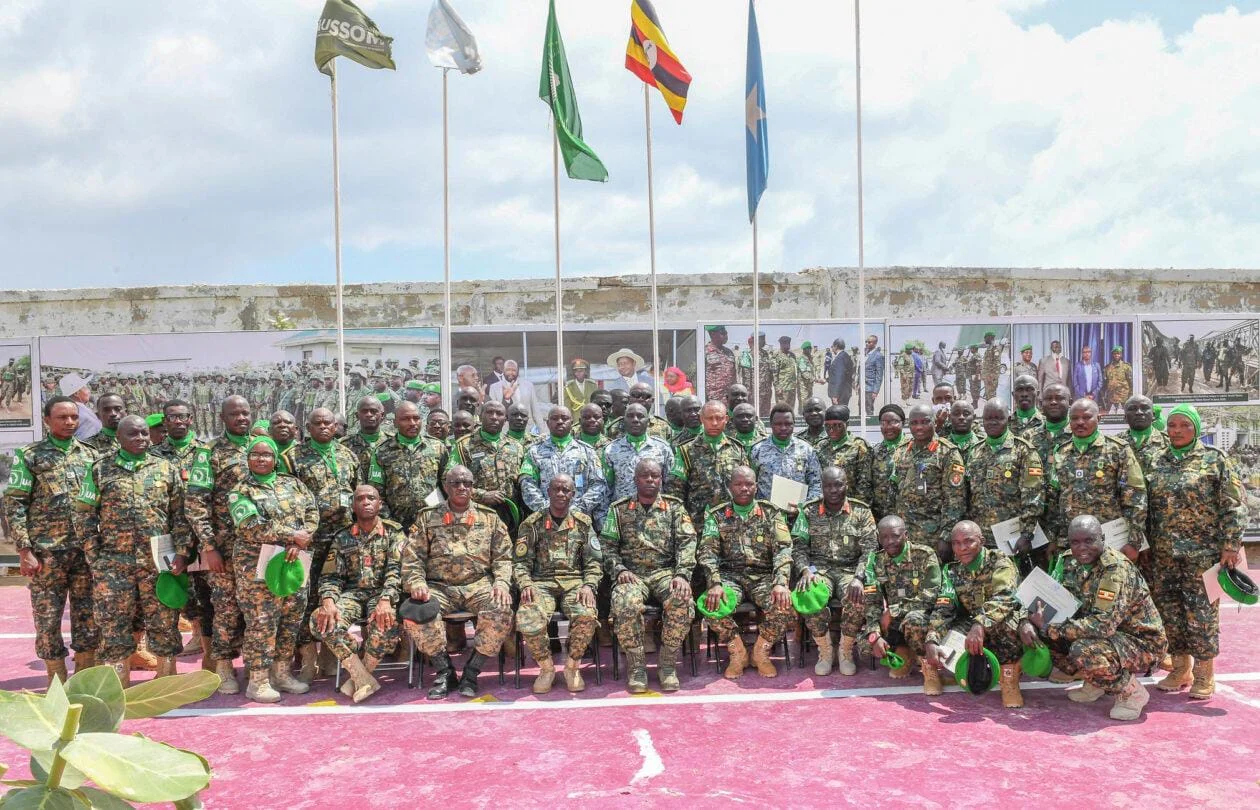
Uganda has begun withdrawing its troops from Somalia, initiating the final phase of a nearly 2-decade military deployment that helped drive al-Shabaab out of Mogadishu. Colonel Chris Magezi, spokesperson for the Uganda People’s Defence Forces (UPDF), said on 2 November, 2026 that the first group of soldiers had already returned home. He said the withdrawal initially targeted troops deployed under a bilateral security arrangement with Somalia’s federal government, “effective immediately”.
A larger contingent serving under the African Union’s mission will follow in a slower, phased withdrawal. “UPDF has embarked on the drawdown of troops deployed in Somalia under bilateral arrangements with Somalia’s Federal Government, effective immediately”, Magezi said in the statement, adding that the remaining bilateral troops would return home within days.
All Ugandan forces, including those serving under the African Union Support and Stabilization Mission in Somalia (AUSSOM), are scheduled to leave by the end of 2027. Uganda’s army chief, General Muhoozi Kainerugaba, had signaled the move in January and confirmed on October 29, 2026, on social media, writing that after “20 years of a lot of blood and sacrifice, we are handing over security to our Somali brothers”. The announcement followed a visit to Kampala by Somali President Hassan Sheikh Mohamud, who met with Ugandan President Yoweri Museveni to discuss Somalia’s security situation, as well as trade and economic relations. Somali officials reportedly urged Uganda to maintain its forces in place for longer. On 31 August, 2026, Defence Minister Kiryowa Kiwanuka had said Ugandan troops would remain under the bilateral pact even if the multinational mission wound down.
Uganda was the first country to deploy troops to Somalia, sending forces in March 2007 under the African Union Mission in Somalia (AMISOM), an emergency peace-enforcement operation launched after Ethiopia’s withdrawal from Mogadishu. The UPDF formed the backbone of the African Union presence from the outset, fighting alongside the Somali National Army to drive al-Shabaab, the al-Qaeda-linked insurgent group, from the capital and other major towns.
The mission has undergone two changes in name and mandate. It became the African Union Transition Mission in Somalia (ATMIS) in April 2022, reflecting a shift toward a gradual drawdown. In January 2025, it was rebranded as AUSSOM, with a mandate focused on stabilization and strengthening Somali security institutions rather than a combat-led transition. Uganda’s troop numbers have fluctuated throughout these transitions. At its peak, the UPDF contingent under AMISOM numbered close to 6,000. Phased drawdowns beginning in 2023, linked to UN Security Council resolutions on the ATMIS transition, gradually reduced Uganda’s multilateral contingent to approximately 4,500 troops. The bilateral contingent, operating under a security agreement signed by Uganda and Somalia at the end of 2024, is estimated at around 2,000 troops, reflecting the limited tracking of this parallel deployment.
The UN Security Council extended AUSSOM’s mandate through 31 December 2026 under a UK-sponsored resolution passed in late December 2025. However, on 1 July 2026, the United States informed the African Union that it would not support a further renewal of UN-funded logistical assistance for the mission after the mandate expires. Administered through the UN Support Office in Somalia (UNSOS), this assistance is funded by an annual budget of roughly $500 million, covering food, fuel, water, medical care, and casualty evacuation for AU troops. UNSOS has supported the mission continuously since 2009.
A 12-month transition plan is scheduled to begin in January 2027, giving Somalia and the African Union time to identify alternative sources of funding. Uganda hosted an extraordinary summit of AUSSOM’s troop-contributing countries, including Burundi, Djibouti, Ethiopia, Egypt, Kenya, Uganda, and Somalia, in Kampala from 29 to 31 July 2026 to consider the mission’s options. Farhan Isak Yusuf, deputy executive director of the Mogadishu-based Somali Public Agenda research group, has identified funding shortages as a factor behind the accelerated pace of Uganda’s withdrawal.
In an October 31 letter to the UN Support Office in Somalia, AUSSOM warned that the withdrawal could leave parts of the Lower Shabelle region vulnerable to al-Shabaab attacks. The same letter, cited by several news organizations, including the Associated Press, said AU peacekeepers planned to take over 4 bases near Mogadishu during troop rotations scheduled for November 2026, to close the security gap before insurgents could exploit it. Somalia’s State Minister for Foreign Affairs, Ali Omar, adopted a measured tone, saying “things are not dire now, but it could create problems if their troops suddenly pull out”.
Uganda’s drawdown comes days after the UN’s political mission in Somalia closed, ending more than three decades of successive missions that had supported the country’s political transition. Together, the closures mark a significant reduction in the international security presence that has supported Somalia’s federal government since the mid-2000s. The bilateral withdrawal is expected to conclude within days, whilst the larger AUSSOM contingent is expected to draw down over a longer period extending into 2027, depending on the funding arrangements that emerge from January’s transition planning.