

The Russian Navy’s Baltic Fleet training ship Perekop docked at Walvis Bay, Namibia, on 20 October 2026, after sailing round the southern tip of Africa from the Indian Ocean into the Atlantic as part of a long-range voyage around Eurasia and Africa. The fleet’s press service confirmed the ship’s arrival that day.
The ship covered more than 1,800 nautical miles in seven days before reaching the Namibian port. Representatives of the Russian Embassy in Namibia and personnel from the Namibian Navy met the crew on arrival. Visitors who toured the vessel were briefed on its operations and on the training programme for future naval officers. The Baltic Fleet described the stop as an unofficial visit and reported on 22 October that embassy staff and Namibian naval personnel had seen the ship off as it departed.
Perekop is carrying cadets from the Admiral Ushakov Baltic Naval Institute in Kaliningrad, who are completing navigation and watchkeeping training during the voyage. Four Namibian cadets joined the ship for this leg. According to TASS, they are studying in Russia at the foreign personnel training centre of the Admiral N.G. Kuznetsov Naval Academy. The Baltic Fleet said cadets from the Republic of Congo, Cameroon and Guinea are expected to board later in the voyage.
Before reaching Namibia, the ship called at Victoria in Seychelles and Dar es Salaam in Tanzania in September, followed by Maputo, Mozambique, in early October, according to Russian state broadcaster RT, citing the Russian Ministry of Defence. After leaving Walvis Bay, Perekop sailed north to Pointe-Noire in the Republic of Congo, where TASS reported on 27 October that Russia’s chargé d’affaires, Sofia Sitnikova, and Congolese naval commanders welcomed the crew. During the port call, cadets served as officers of the watch and their deputies, plotted courses with navigation instruments and practised passage through straits and narrow channels.
A Half-Century-Old Ship with Modern Reach
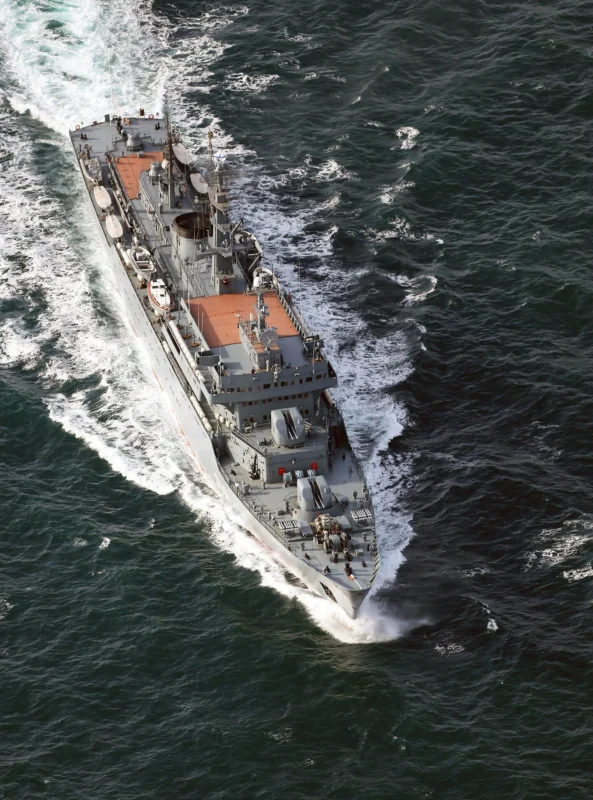
Perekop is the second of three Smolnyy-class training ships built for the Soviet Navy at the Szczecin shipyard in Poland. Launched in December 1976 and commissioned on 30 September 1977, it was designed to combine classroom instruction with practical training at sea. The class has a standard displacement of about 6,120 tonnes, rising to roughly 7,270 tonnes at full load, a length of 138 metres, a top speed of 20 knots and a range of about 9,000 nautical miles at 14 knots. Alongside a crew of 132, it carries around 30 instructors and 300 cadets.
Despite its training role, the ship retains armament typical of a 1970s Soviet combatant. It mounts two twin 76mm gun turrets, two twin 30mm anti-aircraft guns and an RBU-2500 anti-submarine rocket launcher, supported by an air search radar and a hull-mounted sonar, according to the naval reference database RusNavy and published specifications.
That mix of classroom and combat capability is common for training ships of the era, most of which were built to defend themselves and support basic fleet tasks if required. For Russia, sending an armed training ship across four oceans serves two purposes. It gives cadets sustained open-ocean experience that the confined Baltic cannot offer, and it keeps Russian naval officers in direct contact with foreign navies along a route that passes dozens of countries.
Part of a Longer Voyage and a Longer Pattern
The Perekop expedition began in early July 2026 and is scheduled to end on 9 December. Its planned route passes through the Arctic, Pacific, Indian and Atlantic Oceans, taking in 14 seas, 23 straits and nine bays, with about 20 port calls, around a dozen of them abroad, according to the Baltic Fleet. TASS and the maritime publication SeaWaves Magazine put the total distance at about 30,000 nautical miles, routed through Russia’s Northern Sea Route, with TASS listing 11 foreign port calls. The figures differ slightly, but every account agrees on the broad scope of the deployment. The ship has sailed this way before: in 2018 and 2019 it completed four-ocean voyages that included passages of the Northern Sea Route.
The Namibian stop fits a pattern of Russian naval diplomacy on the continent. The sister ship Smolny visited Namibia, Angola and South Africa in 2024, including a stop in Cape Town from 29 August to 1 September. In 2025 it called at the Republic of Congo and Equatorial Guinea in July, returned to Cape Town on 5 August and then docked in Dar es Salaam in mid-August.

Russian warships have also joined multinational drills off South Africa, including the China-led Will for Peace 2026 exercise in January, where Russia sent the corvette Stoikiy and the tanker Yelnya, as USNI News reported. Russia and Egypt held the Friendship Bridge 2025 naval exercise last year. Separately, the frigate Admiral Gorshkov visited Tunisia in October 2024, and a Udaloy-class destroyer called at Eritrea the same year.
Walvis Bay itself has become a regular stop for visiting navies. In May 2026 the Brazilian offshore patrol vessel Araguari spent four days in the port before exercising with the Namibian Navy flagship NS Elephant.
Old Ties Between Windhoek and Moscow
Namibia’s relationship with Moscow predates these visits. Soviet military and political support for the South West Africa People’s Organisation (SWAPO) during the independence struggle of the 1970s and 1980s built goodwill that still shapes public reaction to Russian visits. This week, Namibians took to social media to welcome Perekop as a sign of warming ties between Windhoek and Moscow. A single port call does not amount to a new defence agreement, however, and officials on both sides have described the stop as routine. The presence of Namibian cadets studying at a Russian naval academy points to a training relationship that runs deeper than ceremonial visits.
Europe Looks North as Russia Sails South
The voyage comes as European governments sharpen their focus on waters farther north. On 20 October, the day Perekop reached Walvis Bay, the European Commission unveiled a revised Arctic strategy that, for the first time since the policy was last updated in 2021, places security ahead of climate and economic objectives. The plan calls for a new maritime security hub, an Arctic cable hub to protect undersea infrastructure, expanded satellite surveillance and more icebreaker capacity for European Union (EU) members.
“The Arctic is one place where the tectonic plates of geopolitics are colliding,” Commission President Ursula von der Leyen said at the launch. EU foreign policy chief Kaja Kallas cited drone incursions, GPS (Global Positioning System) jamming and cable sabotage as evidence that Russia’s military presence in the High North is growing. Perekop‘s own route through the Northern Sea Route is a reminder that the Arctic and African legs of Russia’s naval activity are, for Moscow, parts of the same global reach.