

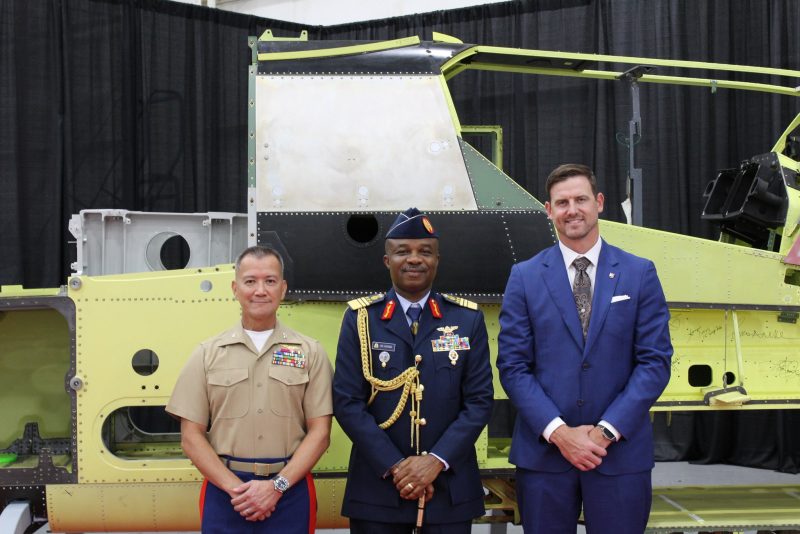
Bell Textron began building the first of 12 AH-1Z Viper attack helicopters for the Nigerian Air Force (NAF) on 16 September 2026 at its Amarillo Assembly Center in Texas, starting manufacture under a sale first cleared more than four years earlier.
The milestone follows a long approval process. The US State Department cleared a possible Foreign Military Sales (FMS) package valued at about $997 million in April 2022, covering the aircraft, engines, munitions, training and support. The manufacturing contract for the 12 helicopters, along with engineering, programme management and logistics support, was not awarded to Bell until March 2024, at a reported value of about $455 million. Bell says production will run until early 2029. A Nigerian delegation that included Chief of the Air Staff Air Marshal Sunday Kelvin Aneke toured the Amarillo line and signed the first fuselage, as Military Africa reported in September.
“We are honored to host the Nigerian Air Force and share this milestone in production for the AH-1Z,” Scott Sims, Bell’s H-1 programme director, said in a company statement. NAF spokesman Air Commodore Ehimen Ejodame said the Viper “will play an important role in strengthening our counterterrorism and counterinsurgency operations.”

A Year of Re-equipment
The timing coincides with a broader NAF modernisation effort. Ejodame confirmed the Viper programme in a statement issued ahead of Aneke’s first anniversary as Chief of the Air Staff on 30 October, describing it as part of an initiative to modernise the service’s combat, airlift, training and intelligence, surveillance and reconnaissance (ISR) capabilities.
The same statement confirmed that the NAF received five more helicopters in September 2026: three Leonardo AW109 Trekker B light helicopters and two Airbus H125 utility helicopters. The AW109s arrived in Lagos on 15 September as part of a ten-aircraft order, with seven more expected by the end of the year, and were formally accepted on 6 October. Ejodame also said six L-39ZA jet trainers are being reactivated and upgraded in Slovakia and Nigeria, while a C-130 Hercules transport is undergoing depot maintenance in Portugal.
On operations, Ejodame said the NAF flew more than 6,100 hours and over 2,900 sorties between November 2025 and September 2026, burning close to 10 million litres of Jet A-1 fuel. He described the missions as precision air strikes, armed reconnaissance, surveillance and close air support intended to degrade hostile groups and make ground forces more effective. “Between November 2025 and September 2026, the NAF recorded over 6,100 flying hours and more than 2,900 sorties,” he said.
What the Viper Brings
The Viper is the more consequential development. It is a twin-engine attack helicopter built around a four-blade, bearingless main rotor. Derived from the AH-1W SuperCobra, it shares more than 80 percent of its components with Bell’s UH-1Y Venom utility helicopter, which simplifies spares and crew training for operators of both types. Two General Electric T700-GE-401C turboshafts, each rated at about 1,800 shaft horsepower, let it carry a heavier weapons load than earlier Cobra variants.
Its weapons include the M197 20mm three-barrel cannon, AGM-114 Hellfire anti-armour missiles, 70mm rockets and the AIM-9 Sidewinder air-to-air missile. Bell markets the Viper as the only attack helicopter with a fully integrated air-to-air missile, allowing crews to engage both ground targets and enemy aircraft from the same platform. A multi-sensor Target Sight System handles identification and tracking and feeds data that improves the accuracy of unguided rockets as well as guided munitions. Washington has also cleared precision munitions for Nigeria’s Vipers and A-29 Super Tucanos, including a package of about $346 million approved in 2025.

Twelve Helicopters for a Large Country
For Nigeria, the Viper will support a counter-insurgency and counter-terrorism campaign that has run for years against Boko Haram and Islamic State West Africa Province (ISWAP) in the north-east and armed bandits in the north-west. The NAF already operates Turkish T129 ATAK attack helicopters, delivered in pairs from November 2023 with a second batch in 2024, and has announced plans for six more. It is also acquiring 24 Leonardo M-346FA light fighter-attack jets, the first three of which completed factory acceptance testing in late June and early July 2026. The Viper will give the service a heavier, longer-range rotary-wing strike option alongside these platforms, although a fleet of 12 spread across a country of Nigeria’s size remains modest by the standards of sustained counter-insurgency operations.
Spreading Risk Across Suppliers
The purchase also shows Nigeria’s effort to diversify suppliers rather than depend on a single country or aircraft type. American, Italian, Turkish, European and Chinese manufacturers are all represented in the current fleet expansion, and Abuja is now talking to the Czech Republic about trainers, transports and ammunition production. That approach spreads political and financial risk across several defence relationships, but it also makes logistics and maintenance planning more complex, a burden that will grow as the Vipers begin arriving.