

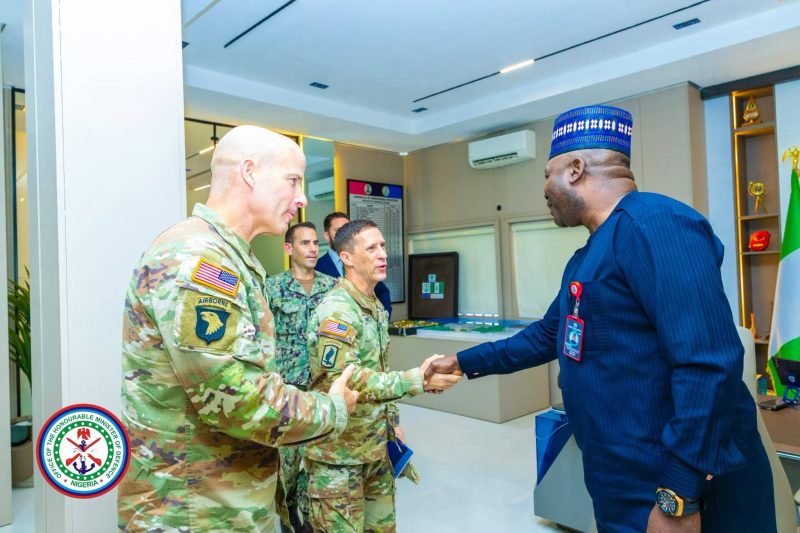
Nigeria’s Minister of Defence, General Christopher Musa (retd), told the head of US Army Southern European Task Force, Africa that Abuja wants closer counter-terrorism ties with Washington. The two met in Abuja on Wednesday 30 September 2026.
Major General Matthew Brown commands the task force, known as SETAF-AF, and was on a working visit to the Ministry of Defence. A statement from the minister’s media office said the visit aimed to review current joint security work and build a more results-focused framework for future cooperation.
Musa thanked the United States for its sustained partnership. He said joint operations in the northeast, especially around the Lake Chad Basin, have lifted troop morale.


He then named five priorities. They are specialised joint training for special forces, intelligence sharing and capacity building, border surveillance, support against counter-improvised explosive devices (C-IED, meaning roadside bombs and other homemade explosives), and modernisation of defence infrastructure.
Brown offered early Independence Day greetings; Nigeria marks the date on 1 October. He praised recent counter-terrorism work against ISIS-affiliated groups in Africa and commended the troops involved.
He also addressed the US footprint directly. After the departure of soldiers who served in the Combined Special Task Force around Bauchi, he said American activity in Nigeria is temporary and focused on institutional support. The main goal of his trip, he said, was to hear Nigeria’s defence priorities first-hand so US help and intelligence sharing line up with them.
Brown is new to the job. He took command at Caserma Ederle in Vicenza, Italy, on 26 June 2026, succeeding Major General Andrew Gainey. He previously led Combined Joint Task Force-Horn of Africa in Djibouti. Musa has held his post since 4 December 2025, when President Bola Tinubu swore him in. He served as Chief of Defence Staff from 2023 to October 2025.
How the partnership got here
The meeting follows a year of fast-moving US engagement. In November 2025, President Donald Trump warned that Washington might intervene if Nigeria did not stop violence against Christian communities. In late December, US forces struck ISIS-linked targets in the northwest, an action Nigeria’s government approved.
Cooperation then moved from strikes to a shared presence on the ground. About 200 US personnel arrived at Bauchi Airfield in February 2026 to provide intelligence support, advice and training. Multiple MQ-9 Reaper drones followed, and AFRICOM, the US Africa Command, said they would fly intelligence missions and training only.
Both governments say the American troops are not in combat roles. Nigeria’s Defence Headquarters has also pointed to a new US-Nigeria intelligence fusion cell, which feeds information to field commanders.
The MQ-9 is a medium-altitude, long-endurance drone built for surveillance. It can stay airborne for about 27 hours and fly above 40,000 feet. Each costs around $30 million. For a force fighting dispersed insurgents across the northeast, that endurance gives commanders a persistent view that Nigerian manned aircraft cannot easily match.
In June 2026, US and Nigerian personnel also trained on unmanned aircraft systems at Operating Location Bauchi. Brown’s reference to training and intelligence fits a long record. In 2022, Nigerian Navy Special Boat Service operators and the US Army’s 3rd Special Forces Group (Airborne) finished a five-week Joint Combined Exchange Training exercise. A year earlier, the US Mission delivered $2.38 million in equipment under the Air Ground Integration programme.
Hardware is the other track. Bell Textron began building Nigeria’s first AH-1Z Viper attack helicopter on 16 September 2026 at its Amarillo Assembly Center in Texas. A Nigerian Air Force delegation attended a ceremonial airframe signing.
The US Department of Defense awarded Bell a $455 million Foreign Military Sales contract in March 2024 for 12 aircraft. Janes puts the wider Viper programme, including equipment, spares, weapons, training and support, at $997 million. Army Recognition reports the package also covers 28 engines and 2,000 APKWS precision-guidance kits. Bell expects production to finish in early 2029. In 2025, the US approved $346 million munition sale to Nigeria.
The AH-1Z is a twin-engine, two-crew attack helicopter that descends from the Vietnam-era Cobra. Its usual weapons are a 20 mm chin-mounted cannon, Hellfire anti-tank missiles and APKWS guided rockets. The APKWS kit turns an unguided 70 mm rocket into a laser-guided round, which gives crews a cheaper option against small targets such as vehicles and camps.
Nigeria’s Air Force spokesperson, Air Commodore Ehimen Ejodame, said the helicopter “will play an important role in strengthening our counterterrorism and counterinsurgency operations.”
Support infrastructure matters as much as the airframes. The US Air Force finished support facilities for the Nigerian Air Force’s A-29 Super Tucano light attack aircraft at Kainji Air Base in 2023, and Nigeria and the US H-1 programme office were already working on facilities and sustainment for the Viper in February 2026. In 2024, Nigeria also sought to expand domestic arms production by partnering with a US firm, NEANY, to set up weapons lines at the Defence Industry Corporation of Nigeria (DICON).
What it means
Musa’s priority list reads as a plan to move from episodic US help to a steadier, Nigerian-led capability. Special forces training, C-IED support and border surveillance address gaps that drone feeds and attack helicopters cannot close alone. Brown’s message that the US presence is temporary suggests Washington wants to hand over those functions, not run them.
The Viper deal carries its own timeline. Production runs to 2029, so the aircraft will not change operations in the northeast soon. Crew training, spares and munitions will decide how quickly the helicopters become useful once they arrive.