

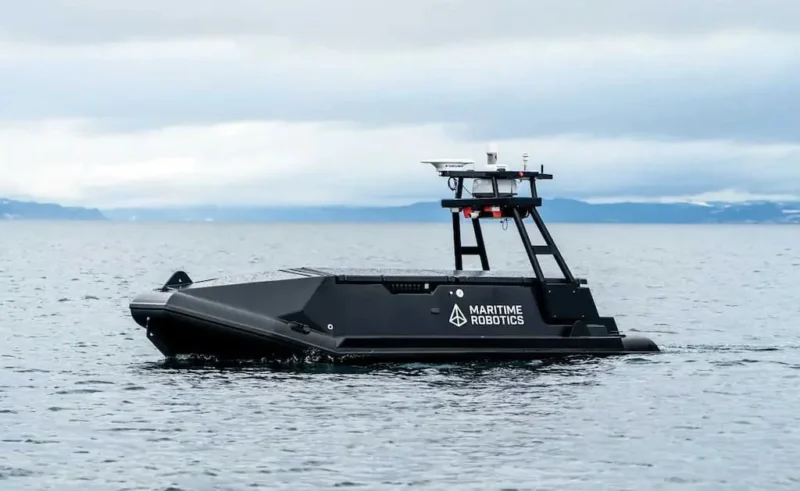
The Royal Moroccan Navy is to receive two Dutch-built unmanned surface vessels (USVs) for anti-submarine warfare (ASW) and mine countermeasures (MCM), after the Netherlands approved a €13 million ($14.7 million) export licence for the systems. The Dutch government disclosed the decision in a letter to the House of Representatives in July. Neither the letter nor the reporting that followed named the Dutch company that will build the boats.
First reported by Unmanned Africa, the package covers more than the hulls. It includes the vessels’ sensors, control systems, a mission control station, spare parts, operational documentation, support equipment, training and technical services. Moroccan reporting says the systems will be fully integrated with their ASW and MCM equipment before delivery, so the navy should receive working capabilities rather than bare platforms.
What the Boats Will Do
According to the Dutch assessment, the USVs can carry out multi-day missions with a high degree of autonomy. That lets a navy keep sensors at sea for long periods, watching approaches, searching for mines or listening for submarines, without exposing crews to the risk that comes with those tasks.
Mine countermeasures are a natural fit for uncrewed vessels. Traditional minehunting puts a crewed ship close to the very weapons it is looking for. A drone boat towing or deploying sonar can survey a channel or harbour approach and pass contacts to operators ashore or aboard a mother ship, keeping people out of the minefield. In anti-submarine work, an autonomous surface vessel can carry a sonar for long-endurance patrol of a chokepoint or port approach, extending the reach of frigates and helicopters rather than replacing them.
The value of the deal also gives a sense of scale. At €13 million for two vessels plus a control station, payloads, training and support, these are small to medium craft, not ocean-going warships. They are best understood as coastal and littoral tools for guarding ports, anchorages and shipping lanes close to shore.
Filling Out Morocco’s Anti-Submarine Layer
The drones will join an existing ASW force. The navy’s flagship, the FREMM frigate RMNS Mohammed VI, was ordered as the anti-submarine variant of the class and handed over by DCNS in 2014. Moroccan press reports that the navy’s current ASW capability rests on sonar-equipped surface ships and helicopters fitted with dipping sonar. The Dutch USVs add persistent, uncrewed coverage to that mix.
The requirement has an obvious regional driver. Algeria fields one of Africa’s few submarine forces, with six Russian-built Kilo-class boats, two older Type 877s and four improved Type 636s, according to GlobalSecurity. Morocco has no submarines of its own, although it has long been reported to want them. The same source notes that Rabat stepped up its interest after Algeria received its newer Kilos. In that context, the ability to detect and track submarines near Moroccan ports and the Strait of Gibraltar matters more than adding a submarine of its own in the short term.
The purchase also fits a wider pattern of Moroccan spending on uncrewed and protective systems. Military Africa has reported on the Barak MX air defence deployment, local production of Israeli SpyX loitering munitions, Baykar’s planned drone facility and Aerodrive’s first domestic loitering munition contract. The Dutch boats are the naval counterpart of that drive toward unmanned capability. Other African navies are moving in the same direction; Military Africa’s analysis of naval air defence in the drone era looks at how the continent’s fleets are adapting to uncrewed threats.
How the Netherlands Assessed the Sale
The Dutch Ministry of Foreign Affairs and the Ministry of Foreign Trade and Development Cooperation assessed the application against the eight criteria of the EU Common Position on arms exports. These cover factors including regional stability, security risks, human rights and the intended end use of the equipment. The government then informed parliament of its decision, as is Dutch practice for larger licences to non-allied countries.
In its review, the Netherlands described Morocco as “a stable and strategic partner in an unstable region,” pointing to its position on the EU’s southern border and its role in regional security cooperation, including on maritime challenges. Dutch officials judged that the sale did not threaten regional stability.
The assessment also considered Western Sahara, where Morocco exercises de facto control and the territory’s final status remains the subject of a UN-led political process, now centred on Morocco’s autonomy proposal. The Hague concluded that the vessels are intended for defensive missions and that any auxiliary equipment in the package would serve only to protect the vessels themselves, not for offensive use. The government added that the platforms “cannot be deployed for other tasks without extensive modifications.”
That language reflects the scrutiny European governments apply to sales to Morocco because of the Western Sahara dispute. By stressing that the boats are configured for submarine detection and minehunting and cannot easily be repurposed, the Dutch government was setting out why it judged the licence compatible with EU rules.
A Dutch Niche
The Netherlands has become an active developer of naval drones. Moroccan outlet Médias24 noted that the Dutch Ministry of Defence launched the design phase of its own anti-submarine USV in 2024. Dutch industry has also long specialised in mine countermeasures, a field in which the Royal Netherlands Navy and its Belgian partner are replacing traditional minehunters with mother ships that deploy uncrewed systems. Selling to Morocco gives Dutch suppliers an early export reference in a market that is still taking shape.