

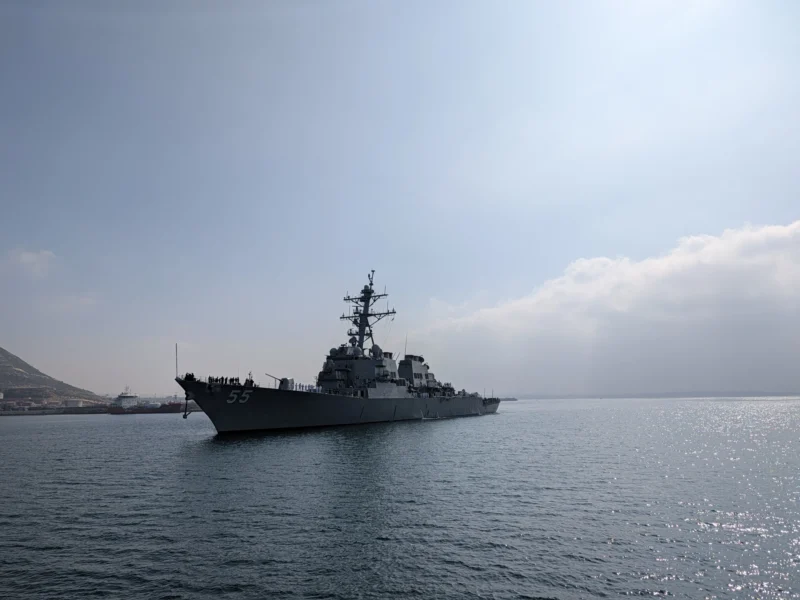
The US Navy destroyer USS Stout (DDG 55) left the Moroccan port of Agadir on 13 October 2026, ending a three-day visit that began on 11 October, the US Embassy in Rabat said.
The Arleigh Burke-class guided-missile destroyer is on an independent deployment from its home port of Norfolk, Virginia. It sailed in September and operates in the area covered by US Naval Forces Europe-Africa, which reports to US 6th Fleet in Naples, Italy.
Commander Kevin Taylor, the ship’s commanding officer, said Morocco’s leadership in regional maritime security made the stop worthwhile. “Our sailors were proud to represent the Navy while experiencing all the country has to offer,” Commander Taylor said.
The statement described a scheduled port visit, with the crew spending liberty ashore in the local community. It mentioned no joint drills or ship tours with the Royal Moroccan Navy.
The embassy tied the call to the long US-Morocco relationship and cited a treaty it described as the longest-standing in US history. Morocco was the first nation to recognize the United States, in 1777.
Morocco World News linked the stop to the 2026 Marrakech Airshow, where a high-level US delegation presented Washington’s security and defense approach alongside American defense companies.
What Stout brings
Stout is a Flight I ship of the Arleigh Burke class, commissioned in 1994. It carries the name of Rear Admiral Herald F. Stout, a Navy Cross recipient who commanded the destroyer USS Claxton (DD 571) at the Battle of Bougainville in World War II.
Reference listings put the ship at about 505 feet long and roughly 8,300 tons at full load, with a crew near 300. Those figures come from open sources, not a current Navy fact file, and I verified them on 19 October 2026.
Its main battery sits in the Mk 41 vertical launching system, which stores missiles in cells below the deck. Flight I ships carry 90 cells, filled with a mix of Standard air-defence missiles, Tomahawk land-attack missiles and ASROC anti-submarine rockets. The Aegis combat system and the SPY-1D radar tie those weapons together.
The class can perform anti-air, anti-submarine and anti-surface missions. Flight I ships have a helicopter deck but no hangar, so Stout cannot keep its own helicopters aboard. That limits its anti-submarine reach and its patrol range compared with later Flight IIA ships.
Stout has endurance credentials. In 2020 it spent 215 consecutive days at sea, a record for the modern Navy, and finished that run in Rota, Spain. The ship made two Rota port visits that year, one on each side of the stretch, and used a week at sea for scheduled maintenance, the first such repair period of its kind in the modern fleet. It returned to Norfolk in October 2020 after a nine-month deployment.
The wider Morocco picture
Describing Morocco as a valued regional ally for the US, the statement recalled the commitment of both countries and their longest-standing treaty in US history.
“Strengthening partnerships during the port visit builds enduring bonds and demonstrates a common commitment to ensuring maritime security and regional stability, which is shared across all regional allies and partners,” the statement said.
The visit follows a busy autumn for US-Moroccan military planning in the same city. US Army Southern European Task Force, Africa (SETAF-AF) and the Royal Moroccan Armed Forces (Forces Armees Royales, or FAR) held the first planning meeting for African Lion 2027 in Agadir from 21 to 25 September 2026.
Planners met at the FAR Southern Zone headquarters. Moroccan press reports say the exercise will run from 25 April to 7 May 2027 across Agadir, Tan-Tan, Guelmim, Benguerir, Kenitra and Dakhla. The FAR said the programme covers land, air and maritime operations, plus special forces.
African Lion is the largest multinational exercise on the continent. Morocco and the United States have run it since 2004, and the 2027 edition falls on the 250th anniversary of the 1777 recognition.
Colonel Benjamin Roark, director of training and exercises for the SETAF-AF G7 staff section, called the meeting a starting point. In remarks supplied to this desk, which I could not confirm in published sources, he said planners expect more than 45 nations. No personnel total has been published for 2027.
For scale, US Africa Command (AFRICOM) reported that the 2026 edition, held from 20 April to 8 May, drew more than 5,600 personnel from over 40 nations across Morocco, Ghana, Senegal and Tunisia.
The 2026 edition also served as a test bed for a drone hub. General Christopher Donahue, commander of US Army Europe and Africa, announced a regional drone training center in Morocco at the African Land Forces Summit in Rome on 23 and 24 March 2026. He described the goal as “a sustainable, enduring capability.”
The pilot ran inside African Lion 2026 with 16 participants and two courses on integrating unmanned aerial systems into planning and on hands-on flight training. The Army has since reported that the inaugural drone academics took place in Morocco. I found no public assessment of the pilot and no date for a permanent site.
A destroyer call adds a maritime strand to a partnership that has leaned on Army-led, land-focused training. African Lion 2026 featured B-52H bomber flights over Tan-Tan and Army drone courses, while Stout’s visit brought the surface fleet into the same relationship.
For Morocco, the call signals continued US interest in its Atlantic coast. For the Navy, Agadir gives Stout a friendly port and a chance to work with a partner that hosts the continent’s largest exercise. Neither side has said whether Stout or a similar ship will join African Lion 2027.
Exercise planners now have a firm calendar. Earlier cycles held a mid-planning event about two months after the first meeting, so a second session is plausible, though no date has been announced. The next fixed marker is the opening of African Lion 2027 on 25 April 2027, when the maritime component should show whether Navy visits like Stout’s feed into the exercise.