

Turkey’s state defense manufacturer, Mechanical and Chemical Industry Corporation (MKE), has opened its first company in Africa, a Cairo-based subsidiary called Zafer (meaning Victory), MKE General Manager Ilhami Keles announced on 8 September 2026 at the El Alamein International Airshow in Egypt.
Keles told the Anadolu Agency that Zafer is registered entirely under Egyptian law, with MKE holding all of its shares. The company will run MKE’s commercial activities in Egypt and act as the legal partner for joint ventures with Egyptian firms. It mirrors a similar legal entity MKE already runs in Azerbaijan, its only other foreign subsidiary.
MKE, a Turkish state-owned firm with roots tracing back centuries, makes munitions, artillery ammunition, small arms and air defense hardware. Keles said Zafer will help MKE use Egypt as more than a customer, positioning it as a manufacturing and export base reaching into wider Africa and the Gulf. “Egypt can produce military vehicles”, he said, according to Anadolu. “We are moving forward with joint production integrating Egypt’s capabilities with our turret and command-and-control systems, as well as our hard-kill and soft-kill solutions”.
At the same airshow, Keles said MKE views Egypt less as a “market” and more as a country with which it can do joint business, pointing to the shared political and historical ties between the two nations. He also noted that MKE signed a separate contract at a defense exhibition in Sarajevo shortly before traveling to El Alamein; A sign the company is pursuing similar legal-entity arrangements elsewhere as it expands beyond Turkey and Azerbaijan.
The Egypt launch builds on a framework defense agreement signed in February 2026, when Turkish President Recep Tayyip Erdogan met Egyptian President Abdel Fattah el-Sisi in Cairo. Turkish media put that contract’s value at roughly $350 million, including about $130 million for MKE’s Tolga short-range air defense system and the remainder for local production of artillery and small-arms ammunition, including a planned 155mm shell factory.
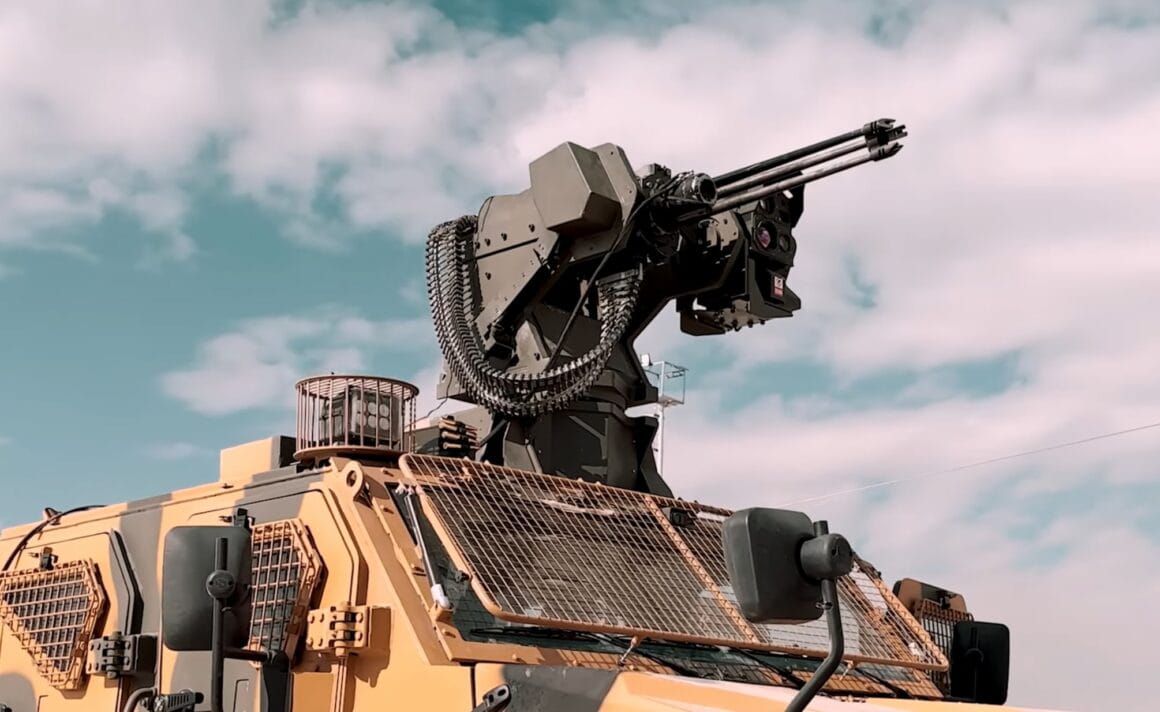
Tolga is the centerpiece of what MKE is now selling into Egypt. It is a layered short-range air defense system (SHORAD) built to counter drones, cruise missiles, and other low-flying threats. A mobile radar, electro-optical sensors, and an electronic jammer form the outer layer, detecting and disrupting drone navigation and communication links out to roughly 3 km. If a target keeps closing, the system switches to kinetic defense: a 35mm cannon effective to about 3,000 meters, a 20mm gun to 1,000 meters, and 12.7mm turrets for anything inside 300 meters. All 3calibers fire MKE’s own programmable fragmentation rounds, timed to burst near the target. MKE said it has integrated a laser weapon and its ENFAL-17 missile. In a live-fire trial on 17 July 2026, the company reported a 100 % success rate across 7 scenarios in front of about 150 military observers.
MKE’s Middle East and Africa regional manager, Ersin Kandur, said earlier this year that demand for air defense systems from Gulf states had risen since fighting started, involving Iran, with particular interest in the Tolga line. Turkey also sold Tolga to Qatar earlier in 2026. For Egypt, officials have described the initial sale as a symbolic first step meant to introduce the system into the country’s inventory before wider joint production begins. The system’s radar component, known as Gokboru, is an AESA (active electronically scanned array) unit that MKE says can track more than 200 targets at once across a 360-degree field, feeding data to a command-and-control center that can run the system manually, semi-autonomously or fully autonomously.
The Zafer venture fits a broader pattern of defense-industrial convergence between Ankara and Cairo since the two governments restored full diplomatic ties in 2024, following roughly a decade of estrangement after Egypt’s 2013 change of government. Since then, the countries have layered on agreements covering unmanned systems: A March 2025 deal to produce unmanned ground vehicles and drones in Cairo; an August 2025 agreement on vertical takeoff and landing drones; and a partnership between Turkish firm Havelsan and Egypt’s Arab Organization for Industrialization, signed later that same month. Turkey is also clearing a way for Egypt to join its KAAN fifth-generation fighter program, a move that would give Cairo a stake in next-generation airpower development alongside Ankara.
For MKE, the practical value of Zafer is legal and logistical rather than symbolic. An Egyptian-registered company lets the firm sign local contracts, hold assets, and structure joint production lines without routing every deal through Ankara, the same model it uses in Baku. For Egypt, the arrangement offers access to Turkish turret, command-and-control, and counter-drone technology while building domestic ammunition capacity, an appeal made sharper by how central drone warfare has become in current conflicts, giving Egypt an incentive to build domestic capacity rather than rely on imports.