

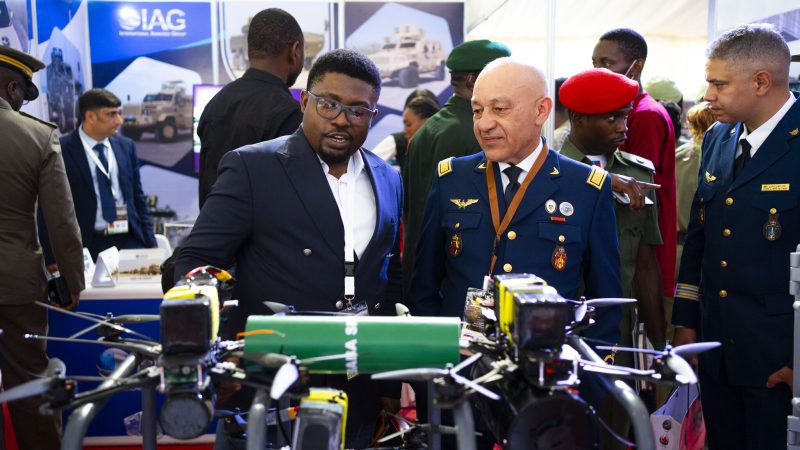
BabaSky Technologies, a Nigerian firm specializing in unmanned systems, showcased Africa’s first fibre-optic guided loitering munition at the third Africa Land Forces Forum in Port Harcourt from 4 to 6 July 2026. This event is part of a broader initiative by the Abuja-based UNICCON Group to develop a domestically produced drone industry
The forum, conducted under the patronage of the Nigerian Army in conjunction with the 163rd Nigerian Army Day Celebrations, attracted Chiefs of Army and senior officers from across Africa and beyond. It also featured defense suppliers presenting armoured vehicles, ISR (intelligence, surveillance, and reconnaissance) tools, and force modernization equipment. BabaSky utilized this platform to introduce its UNIKAM-FO1 (Fibre Optic Kamikaze) to potential buyers already considering countermeasures against insurgent activities and IED (improvised explosive device) threats.


The system is not entirely novel. BabaSky, a subsidiary of the UNICCON Group of Companies, initially launched the broader UNIKAM loitering munition family in December 2025. Flight trials of the FO1 variant took place at the Military Cantonment range in Jaji, Kaduna State, in late June 2026, with results published on 2 July 2026. These trials evaluated spool deployment, flight stability, structural integrity, and terminal guidance. Professor Chuks Ekwueme chairs the UNICCON Group.
What BabaSky claims as innovative is the control link. Unlike conventional first-person view (FPV) attack drones, which rely on radio connections for control and video feed—making them vulnerable to electronic countermeasures such as jamming, GPS spoofing, and video dropout—the UNIKAM-FO1 employs a physical fibre-optic cable reinforced with Kevlar. This cable transmits video and control commands through a tangible wire instead of radio signals.
The absence of radio transmission renders the aircraft highly resistant to electronic warfare tactics that have compromised traditional FPV drones in recent conflicts. The Kevlar reinforcement ensures the tether’s durability during maneuvering through complex terrains, including tree lines, hills, or urban environments, where radio signals are often obstructed.
In terms of specifications, BabaSky cites a payload capacity of 2.5 kg, a maximum speed exceeding 120 km/h, and a flight endurance ranging from 9 to 15 minutes depending on payload weight. The strike range varies from approximately 8 to 15 km, determined by the spool of cable installed, with individual options of 5, 10, and 15 km available. The aircraft carries an indigenous high-explosive warhead, manually operated by an operator, with detonation triggered solely through the hardwired fibre-optic line to a designated arming channel. BabaSky asserts that this design minimizes the risks of accidental detonation or interception by hostile parties via radio control.
The FO1 is part of a broader BabaSky product line, which includes counter-UAS (unmanned aircraft systems) equipment designed to detect and neutralize hostile drones. The company reports a concurrent system capable of tracking more than 40 aerial contacts within an 8 km radius, providing approximately six to eight minutes of warning, and capable of neutralizing threats within a 3 km radius through jamming and spoofing techniques. A demonstration conducted in December 2025 at the same Jaji range combined the UNIKAM series with the counter-drone system, featuring a 2.2 kg composite warhead with an effective blast radius of approximately 200 meters. UNICCON has indicated that larger UNIKAM warhead variants could be scaled up to 200 kg.
Professor Chuks Ekwueme, Founder and Chairman of UNICCON Group of Companies explained in an interview with Military Africa that “In this exhibition, we are displaying our counter-UAS system, our kamikaze drone, the Unikam, the fibre-optics variant, the, the fully manual variant and the new semi-autonomous system, which have been in training. These are, these are technology made by Nigerians.” According to Professor Ekwueme, “Nigerians have to start a kind of taking control of the defense industry, and that is exactly what Baba Sky is doing under the membership of Uniccon Group.”
He noted that Babasky also designed the munitions that go along with the drones. “We make different drones beside the tactical ones. So, we also have the ISR drones, and coming soon, we have the long endurance drone, which is going to say airborne for months.”
The driving force behind these developments is import substitution. African militaries have traditionally sourced their drones and precision munitions from suppliers in Europe, the United States, China, Turkey, and Israel, which can involve delays due to export licensing or end-use restrictions. UNICCON’s joint venture with Nigeria’s Defence Industries Corporation (DICON), the nation’s state ordnance manufacturer, aims to reduce this dependency. A technical presentation in December 2025 at Jaji, jointly conducted by DICON and UNICCON, was touted as a step towards validating the domestic manufacturing capability. Major General Babatunde Alaya, DICON’s Director-General, has publicly supported the initiative.
For military forces combating groups such as Boko Haram, Islamic State West Africa Province, or armed banditry in Nigeria’s northwest—and for other African armies confronting similar insurgent and IED threats—the development of a jam-resistant strike drone addresses a critical operational gap. While traditional radio-controlled FPV drones have proliferated in conflict zones due to their affordability and effectiveness, electronic jamming has become a widespread countermeasure. A wired alternative, although limited by tether weight and spool length affecting range and maneuverability, offers near-complete immunity to electronic attack.
Whether the UNIKAM-FO1 can compete in terms of cost and reliability with existing fibre-optic FPV drones deployed elsewhere remains uncertain. BabaSky has not disclosed unit pricing nor confirmed export orders. The company reports ongoing discussions with several African defense delegations that visited its ALFF exhibition stand and has plans to introduce additional unmanned systems later this year, including long-endurance ISR drones and a wireless-detonation smart munition line. The forthcoming tests will determine if these discussions translate into procurement contracts and whether the FO1 performs effectively in live counter-insurgency operations, comparable to its performance at the Jaji range.