

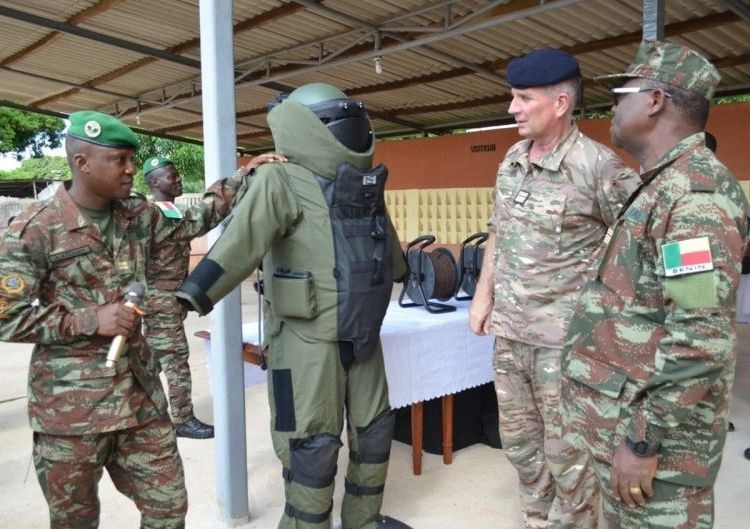
On Tuesday, June 23, 2026, Benin’s 1st Engineer Battalion and its Post-Conflict Demining and Remediation Training Center (CPADD) received a new shipment of French counter-improvised explosive device (C-IED) equipment. The handover occurred at the CPADD’s Colonel Jean Kouagou N’PINA headquarters in Ouidah, in the presence of military and diplomatic officials from both nations.
Colonel Gilbert Lossitode represented the Chief of the General Staff of the Beninese Armed Forces at the ceremony. France’s Defense Attaché to Benin, Lieutenant-Colonel Arnaud Ardillier, attended on behalf of the French Embassy, with CPADD director Lieutenant-Colonel Djimon Sahgui hosting the event.
The package includes IED detectors, disruptor cannons, portable jammers, specialized intervention vehicles, and other technical equipment, according to statements from both delegations. Disruptor cannons are barrel-mounted devices that fire a jet of water or projectile to disable a bomb’s triggering mechanism without detonating it; portable jammers are battery-powered units that broadcast on the same radio frequencies used by remote detonation devices, blocking signals before they reach the IED.
Sahgui stated that the proliferation of IEDs in northern Benin necessitates ongoing adjustments to both equipment and training. He described the partnership with France as “solid and exemplary,” a sentiment echoed by French officials present. Ardillier emphasized that the donation was a direct investment in the safety of Beninese troops and nearby civilians, highlighting the importance of jammers as essential tools for neutralization teams.

Lossitode, accepting the equipment on behalf of the high command, expressed gratitude to France for what he described as an act of solidarity and a tangible commitment to national security. He associated the donation with Operation Mirador, Benin’s ongoing campaign to secure its northern border with Burkina Faso and Niger.
This handover aligns with a pattern of support from France and allied nations that has strengthened over the past four years, as militant violence has encroached southward from the Sahel region into northern Benin. In 2022, France donated equipment valued at approximately 122 million CFA francs (around 200,000 US dollars) for the security sector. Subsequently, in January, Ambassador Marc Vizy delivered eight refurbished VAB armored personnel carriers in Cotonou for counter-terrorism purposes. In mid-2023, Benin’s air force received three Puma helicopters from France, and in September, the French Defense Ministry’s procurement agency signed an €11.7 million contract to support an intelligence, surveillance, and reconnaissance program within the country. Additionally, Benin added further armored vehicles in 2025 as part of broader modernization efforts.
Other international partners have contributed additional capacity. The European Union pledged €47 million in 2024 to fund drones and intelligence aircraft, in addition to a separate €5 million package aimed at enhancing operational efficiency. Spain has conducted mobile training courses on C-IED tactics through CPADD, and the United Nations Office on Drugs and Crime has worked with Beninese authorities to standardize evidence collection from explosive incidents in border areas, addressing a significant challenge in prosecuting counter-terrorism operations.
CPADD serves as the regional hub for such activities. Established with French support and inaugurated in 2003 in Ouidah, the center has trained over 3,800 students from Africa, Europe, and the Middle East in demining and explosive ordnance disposal (EOD), a technical discipline involving locating, identifying, and disarming unexploded ordnance and IEDs. France and Belgium maintain a small team of permanent instructors at the center. The role of the center in integrating new equipment, such as this latest shipment, is critical, as effective use depends on trained operators; hardware without skilled personnel offers limited protection.
The timing for Benin’s engineers is particularly relevant. IED-related attacks have become among the deadliest tactics employed by armed groups near the Niger border. Beninese forces have suffered repeated casualties in the country’s northern communes over the past year, including soldiers killed in ambushes and roadside blasts around Karimama. The new detectors and disruptor cannons supply EOD teams with additional options for addressing a device once discovered. Portable jammers mitigate the challenge of remotely triggered devices by radio or mobile signals, which has led militant groups to adopt more sophisticated detonation methods as detection capabilities have advanced.
Furthermore, this equipment signifies continuity in the France-Benin defense relationship amid a broader reduction in French military cooperation elsewhere in West Africa following the withdrawal of forces from Mali, Burkina Faso, and Niger. By contrast, Benin has maintained its bilateral ties with Paris, and this donation, though modest relative to earlier transfers of vehicles and helicopters, underscores France’s ongoing commitment by viewing CPADD and the 1st Engineer Battalion as active, functional partnerships rather than mere legacy commitments.
What unfolds next will depend on how effectively the equipment is integrated rather than on public announcements. Ardillier indicated that the new devices will be incorporated into CPADD’s EOD training curriculum, potentially extending their impact beyond the directly equipped units. While the Beninese defense ministry has not specified a schedule for further deliveries, the continued support since 2022 suggests that additional shipments related to Operation Mirador are probable before year’s end.