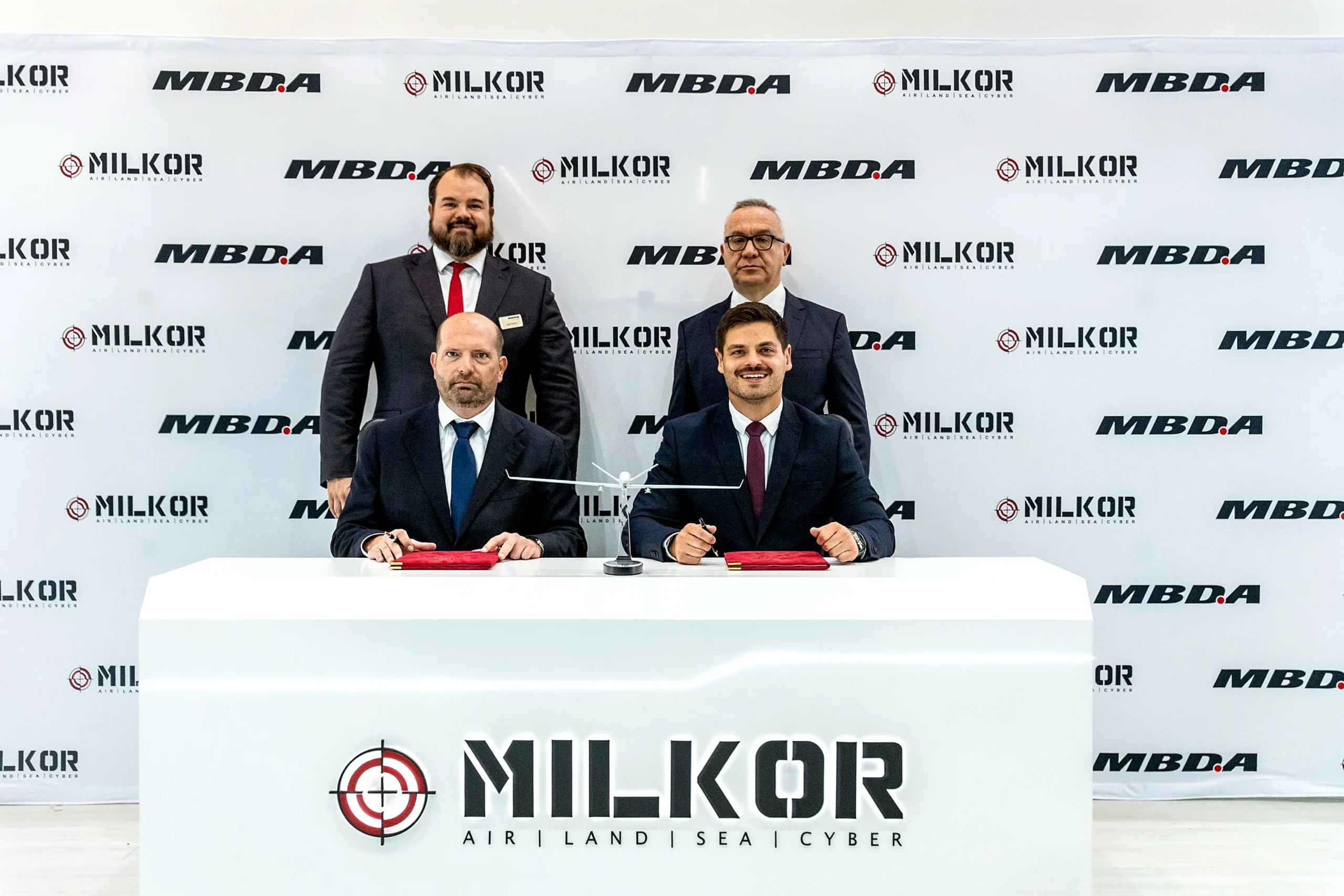
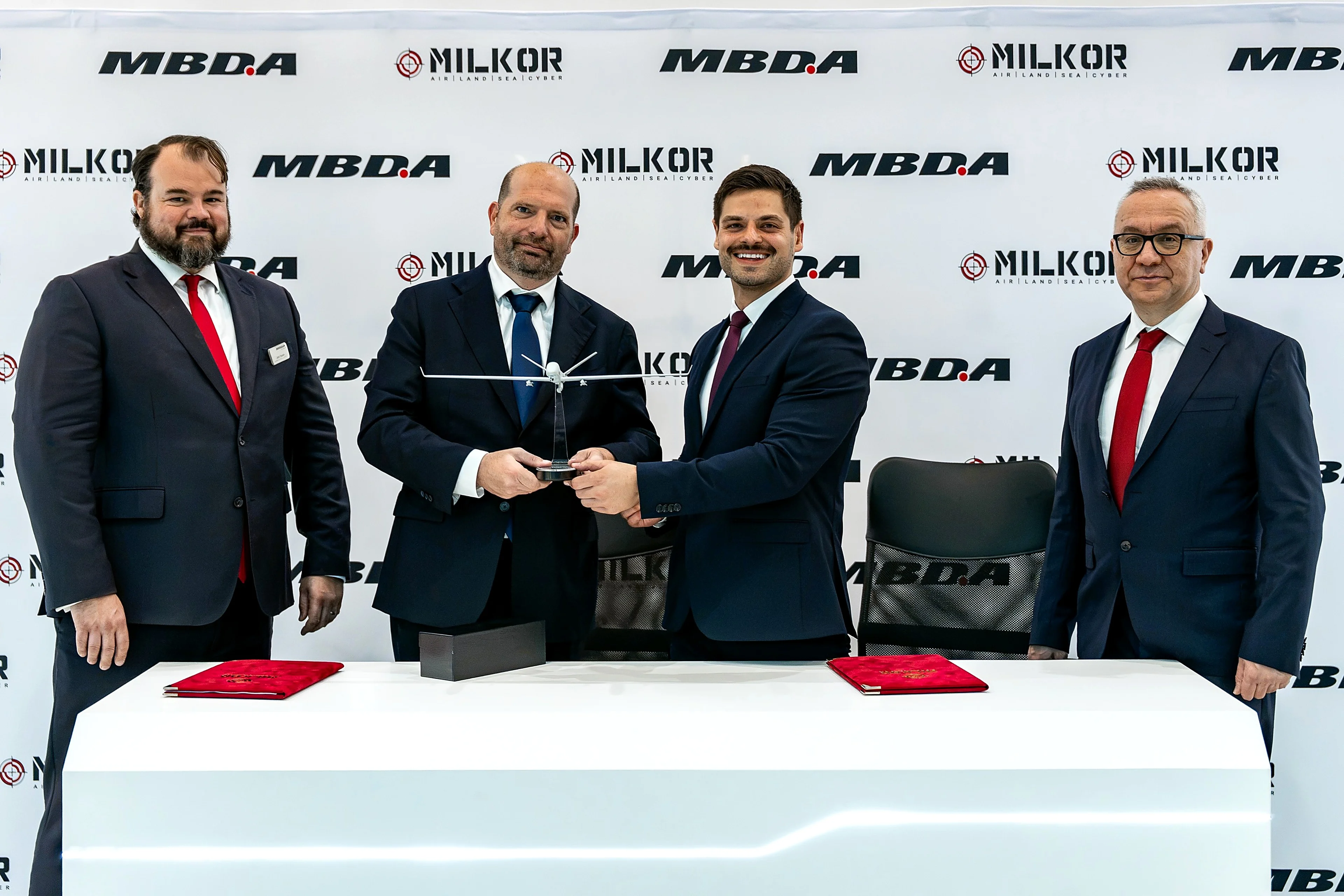
South African defence manufacturer Milkor and European missile maker MBDA signed a memorandum of understanding (MoU) at the Africa Aerospace and Defence (AAD) 2026 exhibition, held from 16 to 20 September at Air Force Base Waterkloof near Pretoria, to integrate and supply MBDA missile systems on the Milkor 380 medium-altitude long-endurance (MALE) unmanned aerial vehicle (UAV).
According to Milkor’s Vice President for Africa, Daniel du Plessis, the agreement sets up a partnership to integrate and supply MBDA’s range of missile systems and related technologies on the company’s flagship drone. While the production Milkor 380 is the immediate focus, the MoU also covers missiles and other systems for Milkor’s wider family of unmanned aircraft. Milkor was the Diamond Sponsor of AAD 2026, its fourth year in a row in that role, the Mail & Guardian reported.
From surveillance platform to strike drone
The Milkor 380 was designed mainly for intelligence, surveillance and reconnaissance (ISR), but export customers want it to carry out precision strikes as well. The MoU is aimed at that demand for air-launched and stand-off weapons across Milkor’s export markets, which include an operator in the Middle East and prospective buyers in Africa and Latin America. Du Plessis told TechCentral that the Middle East customer, which he would not name, has operated the 380 “for some time now”, that he expects orders from African countries, and that there is “huge interest” from Latin America.
The agreement adds a weapons partner to a string of payload deals. Milkor has signed MoUs with South Korea’s Hanwha Systems to integrate an active electronically scanned array (AESA) radar, with LIG D&A to co-develop unmanned systems, and, at the same AAD show, with France’s Safran Electronics & Defense to integrate airborne optronics and position, navigation and timing (PNT) systems on the 380 and the future Milkor 780. Du Plessis said these agreements “are for sensor and payload integration” and cover equipment “not manufactured by Milkor”, which builds the airframe itself in Cape Town.
Sea Venom under the wings
To show where the partnership is heading, Milkor displayed a Milkor 380 at AAD 2026 armed with two MBDA Sea Venom/ANL (Anti-Navire Léger) anti-ship missiles, defenceWeb reported. Each missile weighs 120 kilograms and carries a 30 kilogram semi-armour-piercing warhead. The display information gave a range of up to 30 kilometres against maritime and coastal targets; MBDA publicly describes the range as more than 20 kilometres.
Developed jointly for the Royal Navy and French Navy, Sea Venom combines inertial navigation with an imaging infrared seeker and a two-way datalink that sends seeker imagery back to the operator, who can stay in control throughout the flight or let the missile engage on its own. It was designed for naval helicopters such as the AW159 Wildcat, and the Royal Navy declared initial operating capability in October 2025. Fitting it to a long-endurance drone would give an operator a way to watch and strike small vessels far out at sea without risking a crewed aircraft.
A modular airframe built in Cape Town
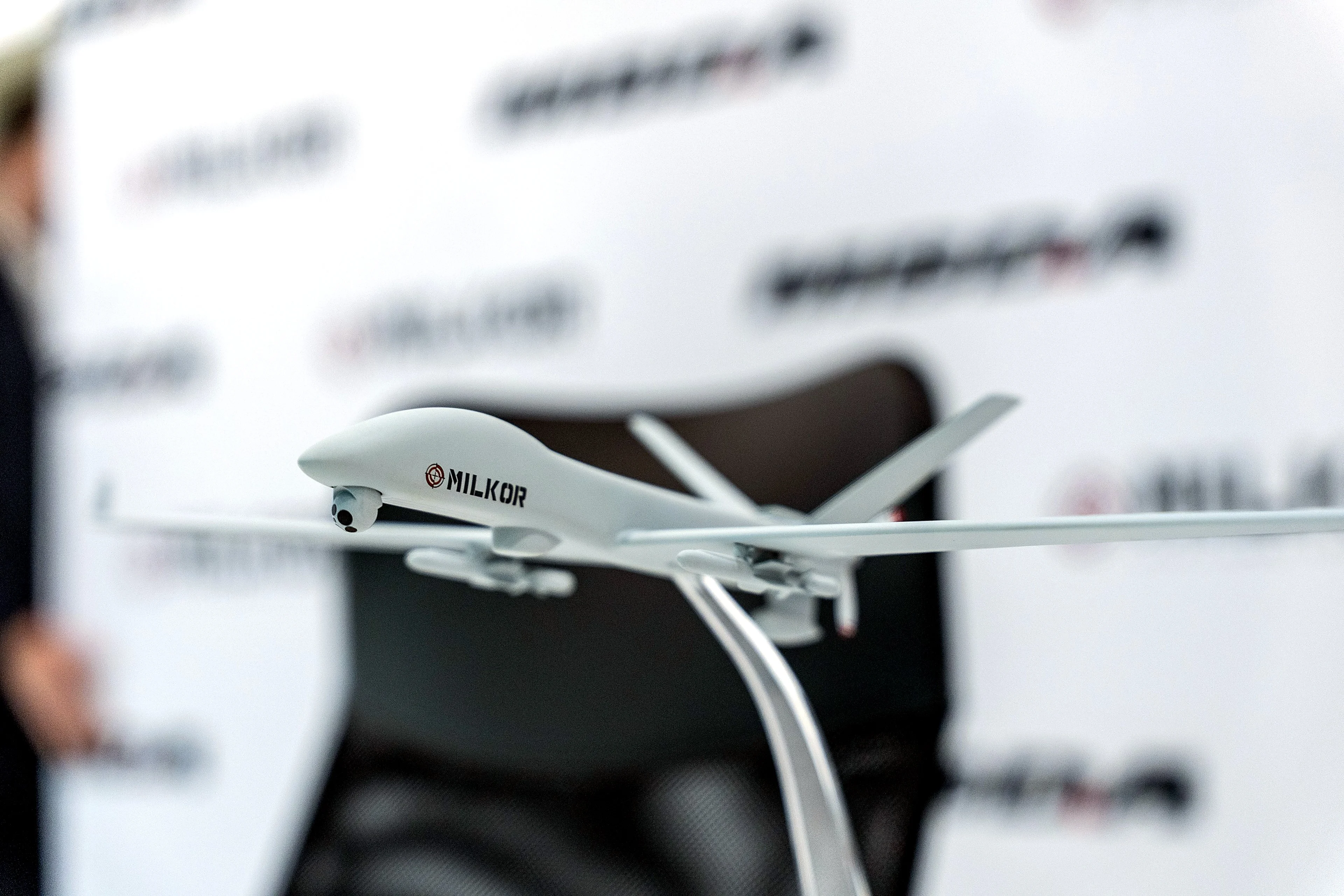
The Milkor 380 has an 18.6-metre wingspan and a maximum take-off weight of 1,500 kilograms, and Milkor describes it as the largest UAV designed and built in Africa. It carries a payload of about 220 kilograms, has an endurance of up to 30 hours and a range of more than 4,000 kilometres, according to defenceWeb. Alongside the Sea Venom rounds, the aircraft at AAD 2026 carried a synthetic aperture radar (SAR) pod, a Hensoldt Argos 15 gimbal, FZ rocket launchers and a larger satellite communications antenna, reflecting Milkor’s approach of offering third-party payloads on a home-built airframe.
At home, the drone has yet to enter service. Milkor earmarked five aircraft for the South African National Defence Force (SANDF) under a 2022 MoU with the Department of Defence, Armscor and the South African Air Force, but no order has followed. Du Plessis told TechCentral that trials, demonstrations and contract negotiations are ongoing and that funding is the main obstacle, describing the SANDF as “severely underfunded”. The Mail & Guardian reported this month that talks with the government are at a sensitive stage, as Milkor pitches the 380 for border surveillance.
Africa’s Answer to the Armed MALE Drone
Armed MALE drones in African service today come mostly from Türkiye and China, from the Bayraktar TB2 and Akıncı to the Wing Loong family. An MBDA-armed Milkor 380 would give African buyers a locally built alternative that carries Western missiles, with the export flexibility a South African airframe brings. The MoU is a framework rather than a contract, and integration, firing trials and export approvals for the missiles still lie ahead. Whether the Sea Venom shown at Waterkloof becomes an operational fit will depend on a first customer willing to pay for it, at home or abroad.