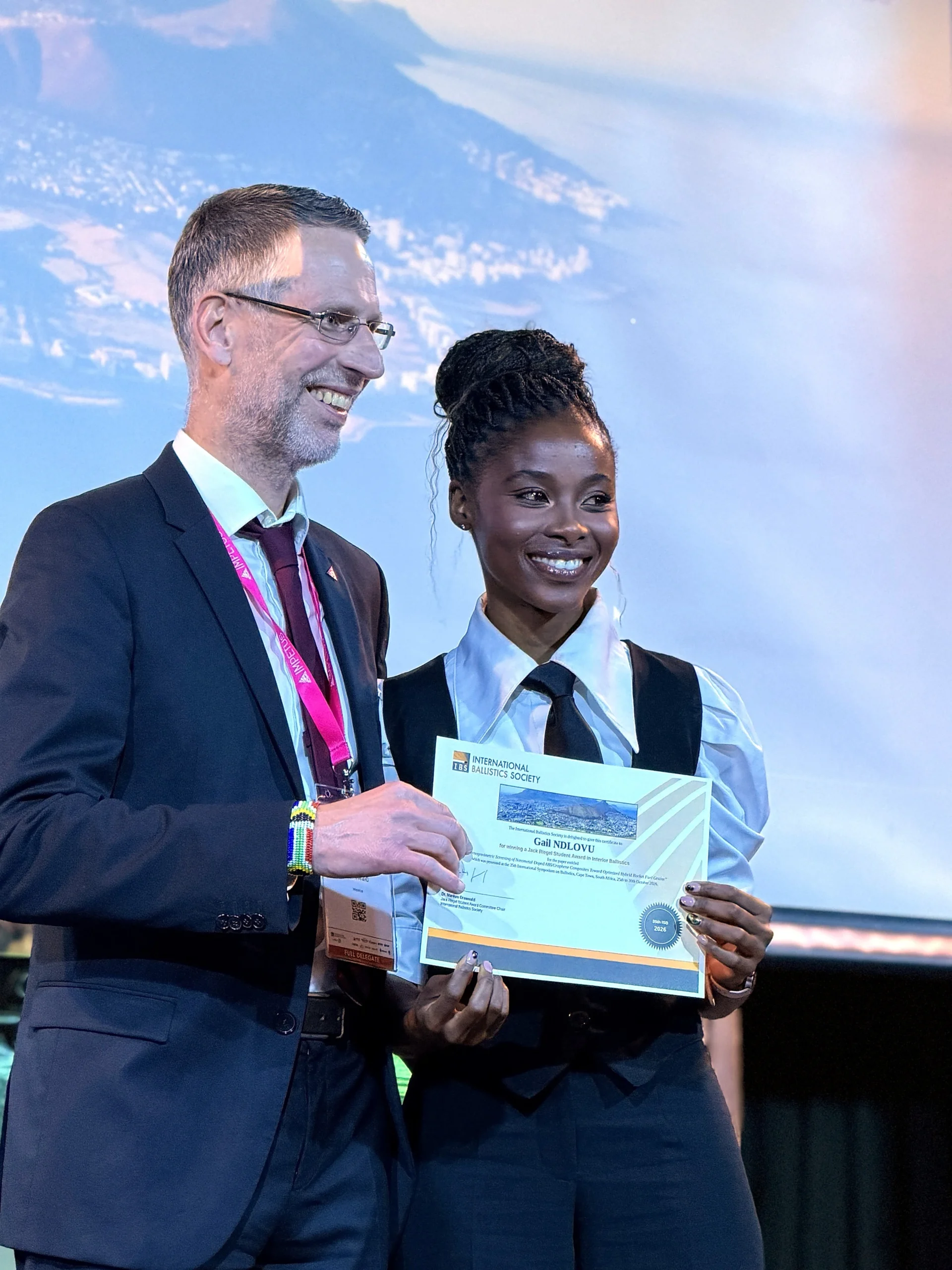
Gail Ndlovu, a researcher at Armscor‘s Flamengro division, has won the International Ballistics Society’s Jack Riegel Student Award for a paper on hybrid rocket fuel grains, presented at the 35th International Symposium on Ballistics (ISB) in Cape Town, South Africa, on 28 October 2026.
Ndlovu received the award for her paper “Thermogravimetric Screening of Nanometal-Doped ABS/Graphene Composites Toward Optimised Hybrid Rocket Fuel Grains”. Armscor’s media statement describes the paper as selected in the “international ballistics” category; the award certificate presented in Cape Town names the category as Interior Ballistics, one of the six technical areas the society recognises. Armscor said the award reflects the quality of her work and its contribution to scientific knowledge in ballistics and innovative materials development.
Flamengro, the Fluid and Mechanical Engineering Group, is one of the defence science and technology institutes within Armscor’s research and development arm. It provides modelling and simulation, failure analysis and engineering support for the design, development and operation of weapon systems used by the South African National Defence Force (SANDF).
Screening Fuels for Hybrid Rockets
A hybrid rocket motor stores its fuel and oxidiser in different states, typically a solid fuel grain inside the combustion chamber and a liquid or gaseous oxidiser such as nitrous oxide fed onto it. The design can be throttled, shut down and restarted, and is safer to handle than a solid motor, but hybrid fuels tend to burn back slowly, which limits thrust. Much hybrid research therefore looks for fuel formulations that release more energy and regress faster.
Ndlovu’s work examines acrylonitrile butadiene styrene (ABS), a thermoplastic that can be 3D-printed into complex grain geometries, reinforced with graphene and doped with nanometal particles. Thermogravimetric analysis measures how a sample loses mass as it is heated, giving a first indication of how each composite decomposes and how energetic additives change its thermal behaviour before full motor firings. The approach allows researchers to screen many candidate formulations cheaply in the laboratory.
The research builds on earlier South African hybrid propulsion work. The University of KwaZulu-Natal’s Phoenix Hybrid Sounding Rocket Programme, started in 2010, has flown paraffin wax and nitrous oxide motors from the Overberg Test Range and studied metallised fuel grains, with the aim of giving the continent its own sounding rocket capability.
From Bursary Student to Award Winner
Reflecting on Armscor’s role in her academic and professional journey, Ndlovu acknowledged the organisation’s investment in her development and the opportunities it has given her to translate academic knowledge into practical research.
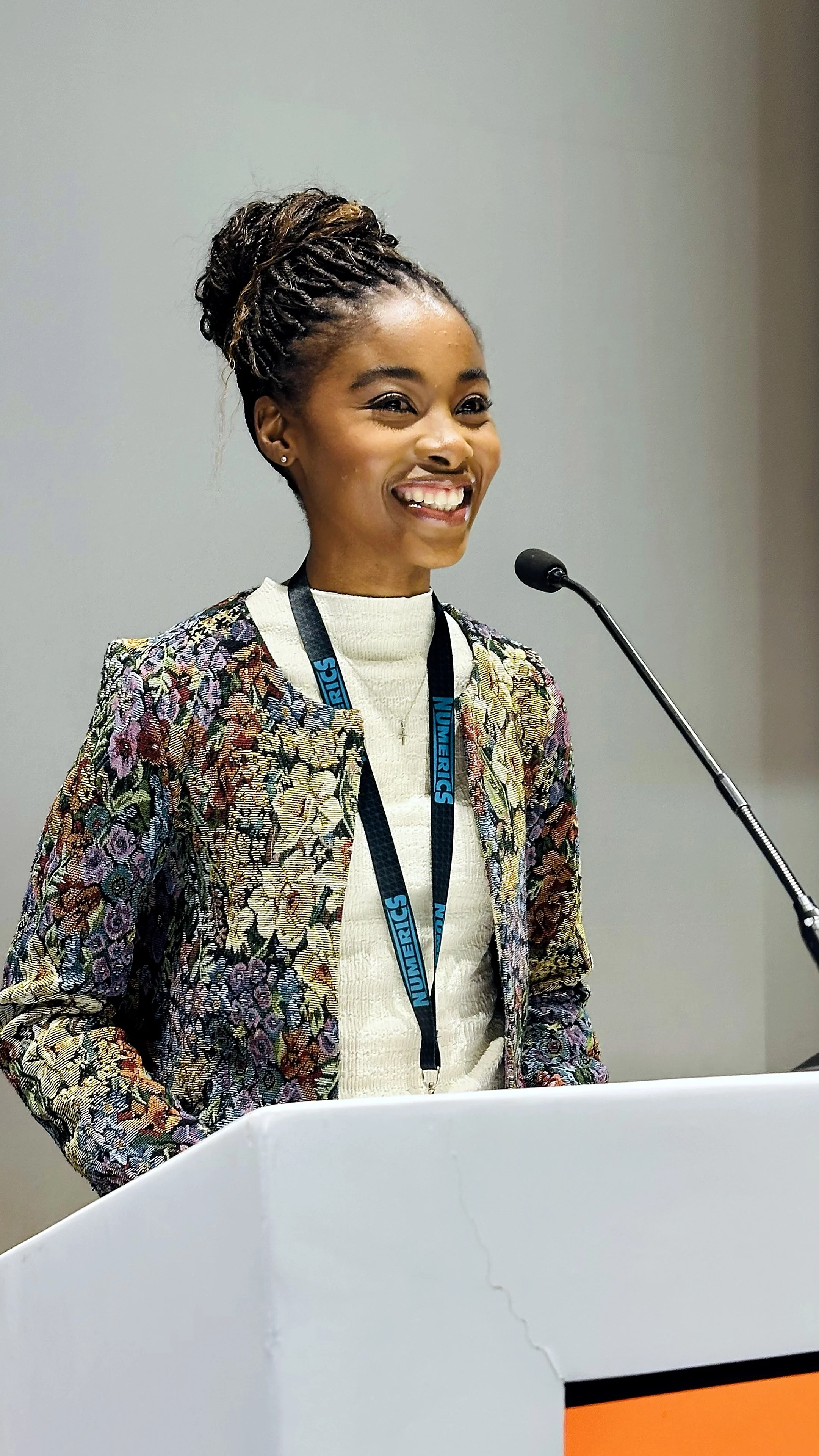
“Armscor has been instrumental in my journey, having supported my studies from undergraduate level through to my master’s and PhD, while also providing me with invaluable industry experience at Flamengro. My research was inspired by the work we do, where I identified an opportunity to build on an existing project and explore further possibilities. My aspiration is to apply the knowledge and expertise I have gained to strengthen Armscor’s research capabilities and contribute to advancing South Africa’s defence technologies,” said Ndlovu.
She becomes the second South African to receive the award. Armscor said the first was a female researcher from the Council for Scientific and Industrial Research (CSIR), who won in 2019. Society records show that South Africa’s Zetu Jiba won in Interior Ballistics at the 31st ISB in Hyderabad, India, that year for work on coating processes for the selective laser sintering of energetic material composites. Tunisia’s Mohamed Dhouibi followed in 2022 at the 32nd ISB in Reno, also in Interior Ballistics, for research on barrel wear in small-calibre guns, making Ndlovu the third African recipient.
The Jack Riegel Student Award
The Jack Riegel Student Award, presented by the International Ballistics Society (IBS), recognises promising student researchers and supports their participation in the symposium. It aims to promote scientific excellence, encourage knowledge-sharing and connect emerging researchers with established experts in the international ballistics community. The society can make up to two awards in each technical area, to a maximum of six per symposium, covering free registration and up to $1,000 in travel and accommodation costs. Nominations come from the student’s academic adviser, and the student must be first author and present the paper.
The award is named after Jack Riegel, the society’s founding president in 2010, and took his name at the 31st ISB in 2019. The 35th ISB ran at the Cape Town International Convention Centre from 25 to 30 October 2026, chaired by Thanyani Pandelani with Tleyane Sono as co-chair, according to the IBS.
Armscor said Ndlovu’s recognition shows the importance of sustained investment in research, skills development and scientific talent, and of an environment in which young researchers can turn academic work into practical solutions for national and defence technology requirements.
More Rocket Launches from South African Soil
Looking ahead, Ndlovu hopes to see more young South Africans in scientific research, closer collaboration between researchers and sustained investment in locally developed technologies.
“I would like to inspire more young South Africans to pursue research that advances our local defence technologies. I hope to see stronger collaboration among researchers, increased investment in local innovation and more rocket launches taking place in South Africa. My research is a small contribution towards achieving this vision, and I welcome opportunities to mentor and collaborate with others in advancing this field,” she added.
Armscor Chief Executive Officer Adv. Solomzi Mbada said research is central to sustaining the defence industry. “At Armscor, we recognise that our greatest strategic asset is the knowledge, expertise and innovative potential of our people. Ndlovu’s achievement demonstrates what can be accomplished when academic excellence is supported by meaningful industry exposure and sustained investment in research and development. Her international recognition is a source of pride for Armscor and South Africa, and reinforces our commitment to nurturing the next generation of scientists and researchers who will contribute to advancing our national defence capabilities.”
The award comes as Armscor widens its skills and research partnerships, from a cyber-defence agreement with the University of South Africa (Unisa) in October to closer collaboration with Denel, while it manages programmes such as the South African Army’s R4/R5 rifle replacement study. Alongside the CSIR’s recent work, including a low-cost target drone under Project Swift and a broadband underwater communication system for Armscor, Ndlovu’s paper points to a local pipeline of propulsion and energetics expertise that South Africa’s defence industry will need if it is to field more of its own rockets and guided weapons.