Nigeria’s Defence Headquarters (DHQ) says plans are underway with the junta-led Sahelian states of the Alliance of Sahel States (AES), known in French as the Alliance des États du Sahel, to reposition the Multinational Joint Task Force (MNJTF), the regional force that coordinates the fight against the Boko Haram insurgency in the Lake Chad Basin. Defence spokesperson Major General Samaila Uba disclosed the plan on Thursday, 5 November 2026, at a joint security briefing at the National Counter Terrorism Centre (NCTC), a unit of the Office of the National Security Adviser (ONSA) in Abuja.
Uba said the repositioning was discussed at a regional forum that brought together former and serving MNJTF force commanders, academics and other experts to examine the future of the regional military coalition. According to him, the forum also examined the implications of the AES states’ withdrawal from the Economic Community of West African States (ECOWAS), including diplomatic alternatives and options for addressing the challenges it has created.
“We also examined the diplomatic alternatives and options available to address issues arising from the withdrawal of those countries from ECOWAS,” he said, Premium Times reported.
“Dividends very soon”
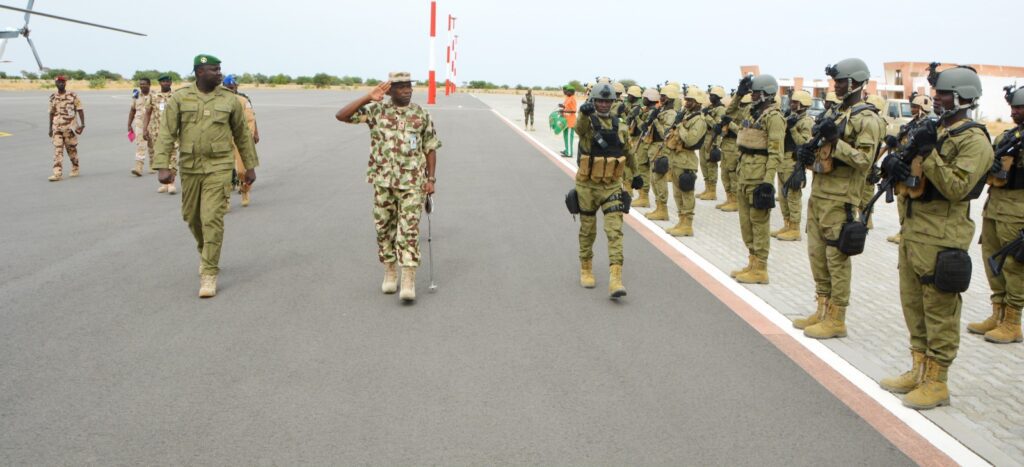
Uba said the forum also discussed prospective developments and measures to improve the task force’s effectiveness while addressing the security implications of shifting political alliances in the region. “I assure you that we will begin to see the dividends of that high-level engagement very soon,” he said. He did not name the forum, say when it was held, or describe what form cooperation with the AES would take.
At the same briefing, Uba denied reports of a secret truce between the government and a Boko Haram faction. “I want to make it clear that there is nothing like a ceasefire,” he said, adding that “we will continue to sustain pressure on these criminal elements.”
A coalition that has lost a member
The MNJTF began as a Nigerian force in 1994, took in Chad and Niger in 1998 and received a counter-terrorism mandate in 2012. It was reconstituted in 2015, after Boko Haram overran its base at Baga in Borno State, with a new headquarters in N’Djamena under the Lake Chad Basin Commission. Its members were Nigeria, Niger, Chad, Cameroon and Benin, with between 7,500 and 10,000 troops operating in sectors at Mora in Cameroon, Baga Sola in Chad, Monguno in Nigeria and, until recently, Diffa in Niger.
Niger stopped taking part after joining the AES and formally withdrew from the MNJTF on 30 March 2025, leaving the force without its Diffa sector on the northern shore of Lake Chad. Chad has also complained in the past that it carries a disproportionate share of the fighting, and has threatened to confine its operations to its own territory.

The AES split from ECOWAS
The withdrawal of three ECOWAS member states, Niger, Mali and Burkina Faso, following military coups, has raised questions about regional cooperation and diplomatic engagement in tackling shared security challenges. The three countries left ECOWAS, formed the AES and have so far rejected overtures to return. They have since built their own military structures, with the AES launching a unified force in December 2025, as Military Africa examined in The Sahel’s emerging “NATO”.
Of the three, only Niger was ever part of the MNJTF; Mali and Burkina Faso lie outside the Lake Chad Basin. Any partnership with the AES on the task force would therefore turn mainly on bringing Niger back into coordination around the lake, where Boko Haram factions and Islamic State West Africa Province (ISWAP) move between Nigerian, Nigerien, Chadian and Cameroonian territory.
Closing the gap on Lake Chad’s northern shore
Without Niger’s Diffa sector, insurgents have a less contested route along the lake’s northern edge. Restoring some form of cooperation with Niamey, whether inside a repositioned MNJTF or through a separate arrangement with the AES unified force, would help close that gap. Abuja has not said what it is offering, and the AES governments, which have kept their distance from ECOWAS-linked structures, have not commented. Uba’s promised “dividends” will be judged by whether Nigerien units return to coordinated operations around Lake Chad.