

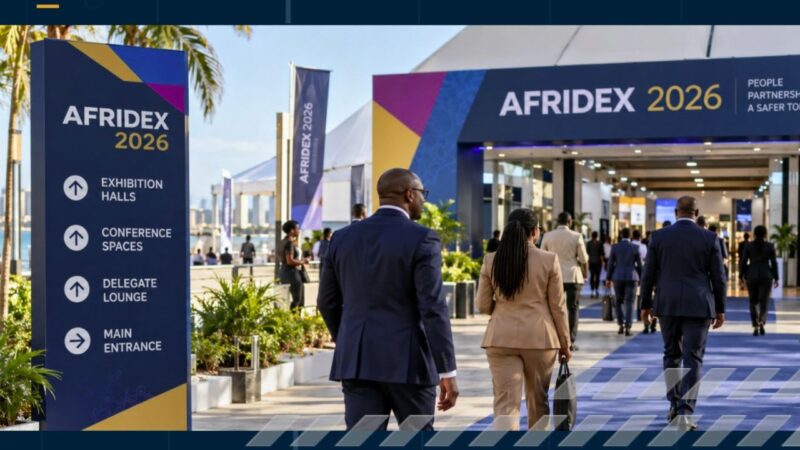
On the reclaimed waterfront of Eko Atlantic, where Lagos meets the Atlantic, the first Africa International Defence Exhibition (AFRIDEX) opens today, Monday 26 October 2026, and runs through Thursday 29 October. The venue is a planned district on Victoria Island that has already hosted a major naval event this year, the Nigerian Navy’s 70th Anniversary International Fleet Review. This time the visitors arrive for industry and procurement and not for warships alone.
On the evening before the opening, Nigeria’s Minister of State for Defence, Dr Bello Matawalle, inspected the venue and commended the Director-General of the Defence Industries Corporation of Nigeria (DICON) and his team for their preparations, according to a statement from his office. DICON hosts the exhibition under the patronage of the Federal Republic of Nigeria, in partnership with the organiser dmg events and the Federal Ministry of Defence.
AFRIDEX is billed as a state-grade, protocol-led event, and its stated purpose is practical: to put African governments, armed forces, and procurement officials in structured contact with manufacturers, and to give Nigeria a stage on which to show its own defence industry.
A First Edition Built Around Nigerian Industry
The exhibition was announced at a press conference in Abuja on 28 November 2025 and formally launched in early 2026. Matawalle described it as a step in advancing defence cooperation and industrial growth across Africa. The organisers had said Nigeria’s President, Bola Ahmed Tinubu, was expected to officiate. At the time of writing, Military Africa had not confirmed who performed the opening or what was said, so this article does not report the ceremony.
The commercial logic is domestic. DICON’s Director-General, Major General Babatunde Ibrahim Alaya, tied the exhibition to the DICON Act of 2023, which directs the corporation to operate as a modern defence manufacturer with wider responsibilities in regulation, research, development, and international cooperation. Ahead of the show he told investors and foreign partners that Nigeria is open for business in the defence and security sector, and invited those ready to partner to bring manufacturing to Nigeria so that DICON and its partners can produce locally. The Minister of Defence, General Christopher Gwabin Musa (retired), who took office in December 2025, said the exhibition gives DICON an international platform to present its work.
That message fits a long Nigerian policy aim. The country is one of Africa’s largest buyers of military equipment, and officials have repeatedly argued that local assembly and production would reduce its reliance on imports. The exhibition is meant to attract the partners who could make that possible.
How the Show Is Laid Out
AFRIDEX covers the land, maritime, air, cyber, and space domains. The organisers describe an event with three layers.
The first is the exhibition floor, with national pavilions and a large outdoor static display. The second is a live demonstration area, which the organisers announced in June. Approved demonstrations are expected to cover vehicle mobility, vertical take-off and landing (VTOL) drones, robotics and uncrewed ground systems, counter-unmanned aircraft system (counter-UAS) simulation, command, control, communications, computers, intelligence, surveillance, and reconnaissance (C4ISR) technologies, communications, surveillance, and emergency response scenarios. The riverbank setting is intended for maritime security demonstrations, including surveillance systems, small craft, and unmanned surface vessels. The organisers say all demonstrations are subject to safety review and host-nation approvals, so the final programme depends on what is cleared on site.
The third layer is the closed-door programme. A Strategic Defence and Security Summit brings together ministers, service chiefs, capability planners, and industry leaders for keynotes, panels, and restricted-access dialogues. Its themes include multi-domain resilience in an era of hybrid and high-technology conflict, covering unmanned systems and counter-UAS, electronic warfare, space-enabled intelligence, surveillance, and reconnaissance (ISR), and long-range fires. A second theme covers human capital, training, readiness, and professional military education. Alongside it, a hosted delegation programme gives official delegations and procurement officials targeted briefings and curated meetings, and an invitation-only Defence Club offers a space for private dialogue between defence leaders, officials, and industry principals.
Who Is in the Room
The organisers’ website lists twelve international pavilions: China, Germany, India, Israel, Italy, Pakistan, Poland, Estonia, Türkiye, the United Arab Emirates, Ukraine, and the United States. Military Africa reported in April that the organisers saw the pavilions as central to the event, and that the participating countries include ten of the world’s top 25 arms exporters, responsible for over 75% of global major-arms exports, along with twelve of the 40 largest arms importers.
The exhibitor list that the organisers had published includes both established prime contractors and smaller specialists. Named companies include Turkey’s Makine ve Kimya Endüstrisi Kurumu (MKE), Turkish Aerospace Industries, and STM, China’s Norinco and Poly Technologies, Italy’s Beretta, Serbia’s Yugoimport, Slovakia’s Letecké Opravovne Trenčín, and Sweden’s MilDef, alongside Nigerian and regional firms such as Terra Industries, Uniccon Group, Vanquish Industries, and Proforce. Italy’s Leonardo is confirmed as an exhibitor and sponsor.
Official delegations confirmed on the organisers’ site include those of Tanzania’s Ministry of Defence and National Service, the Gambia’s Ministry of Defence, and the United States Department of War, as the American defence establishment is now styled, along with Germany’s defence attaché for Nigeria, Benin, Cameroon, and the Central African Republic. The President of the Economic Community of West African States (ECOWAS) Commission, General Birame Diop, a former Senegalese Minister of the Armed Forces, was confirmed as a speaker, and the organisers said they expected defence chiefs from across ECOWAS member states to attend.
The roster is also notable for who does not appear. Russia is not listed among the international pavilions on the organisers’ website, even though it has been an arms supplier to several African states. Whether Russian firms exhibit independently is not clear from the published information.
Confirmed Country Pavilions
According to the AFRIDEX International Pavilions page, the confirmed participating nations include: Azerbaijan, Bulgaria, Canada, China, Cyprus, Czech Republic, Germany, India, Italy, Poland, Türkiye, UAE, Ukraine, USA
The Italian Connection
Italy’s delegation is the most developed of the bilateral stories. Military Africa reported on 22 October that Italy will have an official delegation and a Leonardo presence at the show, coming weeks after the Nigerian Air Force received three Leonardo helicopters and as the first M-346 fighter-attack aircraft move toward delivery. Nigeria’s acquisition of 24 M-346 aircraft is the largest element of that relationship. AFRIDEX’s Portfolio Director, Odiri Umusu, said Italy’s participation comes at a relevant point in the relationship, with Nigeria moving through delivery, training, and sustainment milestones on several Leonardo programmes.
Sustainment is the right word. Delivering an aircraft is one event. Training pilots, supplying spares, and maintaining a fleet for thirty years is another, and it is what African air forces most often struggle with.

Major General Babatunde Ibrahim Alaya, Director General of the Defence Industries Corporation of Nigeria, focused his AFRIDEX 2026 opening address on the work that turns an idea into dependable capability.
He discussed the journey from a clear user requirement through design, realistic testing and consistent production. The message extended beyond handover: spare parts, trained technicians, maintenance procedures and responsive manufacturers remain part of the support users need.
For Nigerian manufacturers, engineering firms, technology companies and research institutions, the address touched on the obligations that accompany participation: quality, safety and reliable delivery.
For international partners, the address pointed to discussion on production processes, technical knowledge, training, testing and lifecycle support, with realistic objectives and a clear account of each party’s contribution.
The Nigerian Backdrop
AFRIDEX opens as Nigeria is in the middle of a modernisation drive. The Nigerian Air Force has announced a planned acquisition of Aksungur drones from Turkey, more T-129 helicopters, and additional Chinese CH-4 drones. It also lists AH-1Z attack helicopters among its expected aircraft, and it reported five helicopter deliveries in September. The Nigerian Navy commissioned three Chinese-built fast patrol vessels at its anniversary fleet review. Many of these programmes are at an early stage, and some have no published contract values, which makes a show where buyers and sellers can meet in person useful to both sides.
Nigeria’s security demands are also plain. The army and air force still fight Boko Haram and the Islamic State West Africa Province (ISWAP) in the North-East, and armed banditry and kidnapping persist in the North-West. The live demonstration programme’s emphasis on uncrewed systems, counter-UAS, surveillance, and mobility corresponds to those problems.
Dr Bello Muhammed Matawalle, MON, Honourable Minister of State for Defence and Chairman of the DICON Board, focused his AFRIDEX 2026 opening address on the industrial work behind dependable capability.
His message connected clear requirements with reliable production, trained people and long-term technical support. He discussed joint development, responsible technology transfer and local manufacturing, with investment matched to the people who will sustain the capability.
The address also highlighted the wider contribution of Nigerian manufacturers, engineering firms, universities and suppliers. Quality assurance, testing and safety were presented as essential to the trust users place in defence equipment.
What Four Days in Lagos Need to Deliver
AFRIDEX will be measured by what it produces, and attendance numbers will be the least informative of the measures.
The first is agreements. Memoranda of understanding are easy to sign at a show and slow to turn into contracts. The ones that name specific products, quantities, and local production sites will matter more than those that do not.
The second is local production. DICON has said it wants partners to manufacture in Nigeria. If a foreign company announces a Nigerian assembly line or a technology transfer arrangement, the terms, including ownership, training, and spare parts supply, will show how real the commitment is.
The third is the African dimension. A “pan-African” label requires African buyers to attend and to hold meetings. Delegations from Tanzania, the Gambia, and ECOWAS are a start, and the hosted programme will show how many others arrive.
The fourth is the outdoor programme. A live demonstration area is only as credible as what is shown in it. If the vehicles, drones, and boats that were promised operate on schedule, the show will have given African buyers something that a static stand cannot.
The last question is whether it returns. The organisers have positioned AFRIDEX as a long-term platform, and whether there is a second edition will depend on whether the first one produces outcomes that companies and governments are willing to pay to repeat.