

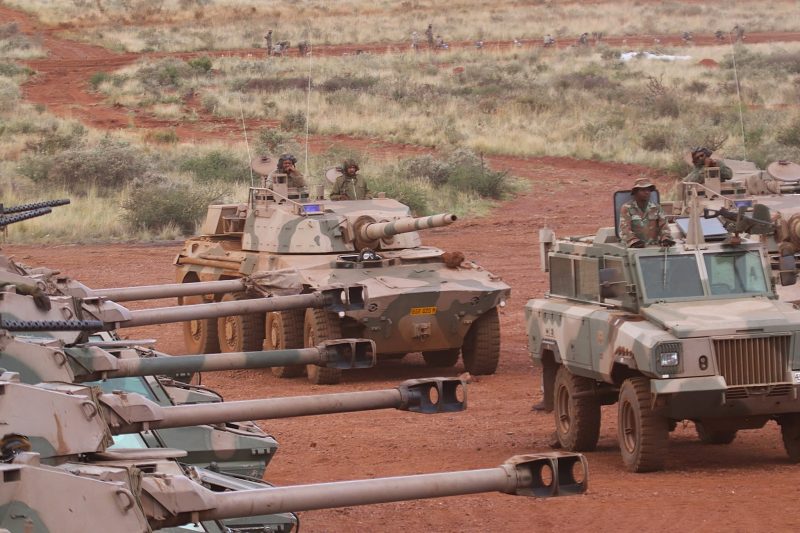
The South African Army is putting its training to the test in the arid Northern Cape, where Exercise Vuk’uhlome V is under way at the Combat Training Centre (CTC) at Lohathla. The exercise began on 19 September and is scheduled to run until 5 December, according to the SA National Defence Force (SANDF) Directorate Corporate Communication (DCC), as reported by DefenceWeb. Lieutenant General Lawrence Mbatha’s Army is the main player, but elements of the SA Air Force (SAAF) and the SA Military Health Service (SAMHS) are also involved, and SA Police Service (SAPS) participation is expected again.
Vuk’uhlome is an isiZulu phrase meaning “arise and arm yourself.” This is the fifth exercise in the series, and the DCC says it will again run at “division minus level.” The directorate gave no personnel numbers and did not say which units are taking part.
Who Is Taking Part
Five of what the Army calls its “modern brigades” (airborne, light, mechanised, motorised and reserve) will take part alongside the specialist medical brigade. They will move across the 158,000-hectare Lohathla CTC, carrying out manoeuvres and tasks with other elements of the force so that combat readiness can be evaluated. As in earlier editions, the exercise also covers continuation training, division-level planning, brigade planning cycles, tactical-level planning, and command and control. Defence Intelligence, the Military Police, Legal Services and Logistics divisions of the Department of Defence (DoD) are contributing as well.
The modern brigade structure was visible when the series began. Military Africa’s coverage of the first exercise in 2022 recorded how the brigades were assembled for the exercise. The motorised brigade was built around Headquarters 46 SA Brigade with 7 and 14 South African Infantry (SAI) battalions and General Botha Regiment. The airborne brigade drew on 6 and 9 SAI, 44 Parachute Brigade and 101 Air Supply Unit. The light brigade included the SA Army Specialist Infantry Capability, the Andrew Mlangeni Regiment and a quick response force. The DCC has not said whether the same allocations apply this year.
Personnel numbers are not normally published. DefenceWeb reported that earlier Vuk’uhlome exercises involved between 7,000 and 9,000 military personnel. That range is not an official figure, and the DCC has not confirmed a number for this year.
What “Division Minus” Means
In standard military usage, a minus sign after a formation’s level means it is operating below its full establishment, for example a division headquarters controlling fewer brigades than a full division would. The DCC did not define the term, and without unit lists it is not possible to say how much of a division is on the ground.
The label marks a change in emphasis. Vuk’uhlome I was billed as the first division-level exercise since the SA Army was formed in 1994. Military Africa reported in December 2025 that the fourth edition concentrated on brigade-level operations, using the Lohathla area to simulate a “hot war” against a fictional destabiliser force. That report described the brigade as the largest independent manoeuvre unit the Army can sustain, and said the exercise was validating its prime mission equipment and its command and control structures.
Soldiers and Police Together
Police are expected to take part again. Earlier Vuk’uhlome scenarios included crowd and riot control, with soldiers and SAPS personnel working in tandem. In 2025, Military Africa’s reporting recorded the Light Modern Brigade training with SAPS mounted units, K9 teams and motorcycles. The SAPS role this year has not been confirmed.
Observers From the Region
The 16-member Southern African Development Community (SADC) has been invited to send observers, which the DCC says adds to the exercise’s “collaborative dimension.” The DCC did not say which member states have accepted.
The invitation comes after the end of the SADC Mission in the Democratic Republic of Congo (SAMIDRC) in mid-March 2025. Military Africa reported that critics called the mission set up for failure because of insufficient troop numbers, poor planning and exposed base locations, while the Chief of the SANDF said it had contributed to peace efforts. The DCC has not linked the two events. Lohathla has hosted regional exercises before. It staged the African Union’s Amani Africa 2 field exercise in 2015 to demonstrate the AU’s rapid deployment capability.
Readiness in Context
The run-up gave some indication of the Army’s condition. On 15 September, Mbatha oversaw a stabling parade of mission equipment at the CTC, including infantry fighting vehicles, an armoured car, tanks, field ambulances and trucks. DefenceWeb reported that he described the parade as part of building a better Army, one capable of working with partners in joint missions. The same report covered preparatory retraining in Limpopo, where 15 SAI catering personnel cooked on firewood and light workshop mechanics returned unserviceable vehicles to service with limited resources.
That points to the logistics and maintenance pressures behind the exercise. Military Africa reported in 2023 that more than R277 million had been spent repairing and preserving military vehicles, with Cuban technicians helping refurbish more than 10,000 Samil and similar vehicles, according to that report.
Vuk’uhlome also serves the defence industry. During preparations for the 2025 exercise, Exercise Chief of Staff Brigadier General Leon Puckree called it a chance to showcase capabilities and market modernised equipment, and for the South African defence industry to network with the DoD. In 2023, Military Africa reported that companies bidding for army armoured vehicle tenders would be invited to display at the exercise. No industry component has been announced for this year.
What Has Not Been Announced
Several details are still unavailable: the numbers and units involved, the scenario, which SADC states will observe, the SAPS role, and the date of any distinguished visitors’ day. Last year’s was expected in late November. Until the DCC releases more, Vuk’uhlome V can be described only by its dates, its structure and its stated purpose: a test of whether the SA Army’s planning, command and logistics hold up when its brigades work together.