

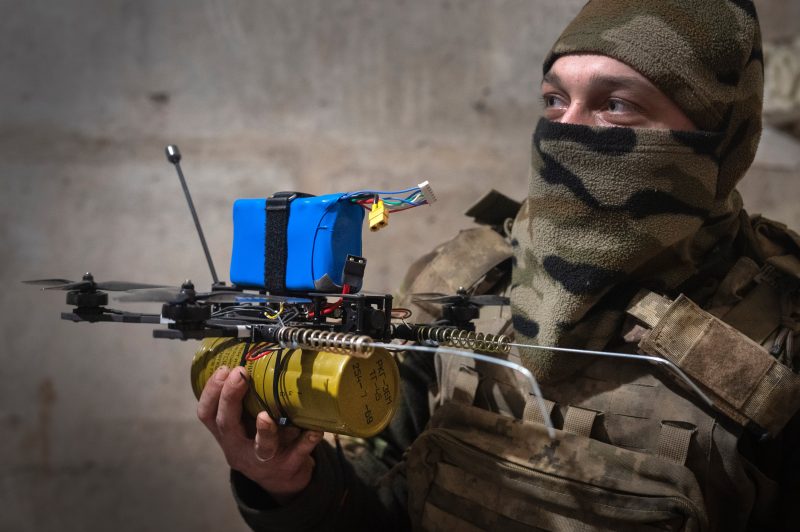
Ukrainian military intelligence has sent drone specialists to Mali, Libya and Sudan to help local forces fight Russian troops and their proxies. The report draws on interviews with Ukrainian soldiers and officers involved in the missions. It places about 15 operators in northern Mali, a naval drone effort in Libya, and several specialists in Sudan.
The Mali contingent works with the Azawad Liberation Front (FLA), a Tuareg-led separatist coalition that fights Mali’s military government and Russia’s Africa Corps, the state-run successor to the Wagner Group. One operator told CNN he receives a drone’s video feed over the internet and radios back where to fly.
A Ukrainian Defence Intelligence source said troops from Chad, Niger, and Burkina Faso earlier travelled to Mali for drone training. The reporting reviewed shows no confirmation from those governments. The FLA and Jama’at Nusrat al-Islam wal-Muslimin (JNIM), an al-Qaeda affiliate, launched coordinated attacks on 25 April 2026. A car bomb killed Mali’s defence minister, General Sadio Camara, at his home in Kati, about 15 kilometers north of Bamako. The FLA then took Kidal in the north and said it had agreed terms letting Africa Corps fighters leave a camp outside the city. Mali’s army said at the time that operations there were continuing.
A Ukrainian operator revealed that his unit assisted the rebels during the Kidal fight. Ukraine’s link to the Tuareg dates to at least July 2024, when rebels ambushed Wagner and Malian troops near Tinzaouaten; Kyiv later denied giving substantial help.
The Libyan operation adds a maritime element. A Ukrainian naval drone operator also said his unit has used the international military base in Misrata since late 2025 to attack Russia’s “shadow fleet”, the ageing tankers Moscow uses to move sanctioned oil. In return, the Ukrainians train Libyan forces. French public broadcaster, Radio France Internationale (RFI), reported that more than 200 Ukrainian officers and technical specialists work at 3 sites in western Libya with the approval of the Tripoli government. RFI said some are based at the Air Force Academy in Misrata. It also linked the group to the March strike on the Russian gas carrier Arctic Metagaz east of Malta.
If both counts hold, the Libya footprint is roughly 13 times the size of the Mali team. The craft involved are uncrewed surface vessels, small boats packed with explosives and steered remotely. They are cheap next to the tankers and gas carriers they target, which is why Kyiv has invested in them. Their range and reliability depend on the launch point, and a base in western Libya puts the central Mediterranean within reach.
Fishermen found an armed naval drone, about six meters long, off the Greek island of Lefkada on 7 May. The island lies more than 1,000 kilometers from the Ukrainian coast. Greek authorities destroyed a 100-kilogram explosive charge on board. Greece lodged a formal protest on 3 June, and Kyiv apologized on 6 June, citing circumstances created by Russia’s aggression. Ukraine’s Foreign Ministry had earlier said it had no evidence the vessel belonged to Ukrainian operators. Media reports tie the craft to Libya-based launches.
CNN first reported Ukrainian-linked drone activity in Sudan in 2023, when strikes near Khartoum hit a Wagner-backed militia. The footage showed 2 commercial drone types widely used by Ukrainian forces, with Ukrainian text on a controller. A Ukrainian source then told CNN that Ukrainian special services were likely responsible.
A Ukrainian source also said the missions let units test equipment in extreme heat, dust and long supply lines that the war in Ukraine has not imposed. Ukrainian teams have also visited at least 5 Middle Eastern countries this year to train local forces against Shahed drones, the Iranian-designed type Russia fires at Ukrainian cities.
Kyiv is turning battlefield experience into a foreign policy tool. “It puts pressure on them. This whole story has both psychological and real results”. Remote coordination keeps operators out of harm’s way but depends on stable data links and on partners who can fly the drones. A Libyan base gives Ukrainian naval drones access to the central Mediterranean, far beyond the reach of launches from Ukraine’s own coast, where Russian tankers and gas carriers pass. The Lefkada incident shows the risk: a craft that drifts loose becomes a diplomatic problem for Kyiv.
Moscow is already answering in public. Dmitry Polyansky, Russia’s deputy representative at the United Nations, and others accused Ukrainian pilots in late August of aiding terrorist-designated groups in Mali, Sudan, the Central African Republic, Chad and the Democratic Republic of Congo.
Tripoli and the FLA have yet to acknowledge Ukrainian help on the record, and any Russian retaliation against those hosts would test how far the arrangements hold. Further scrutiny from Greece and other Mediterranean states is likely if another naval drone goes astray.