

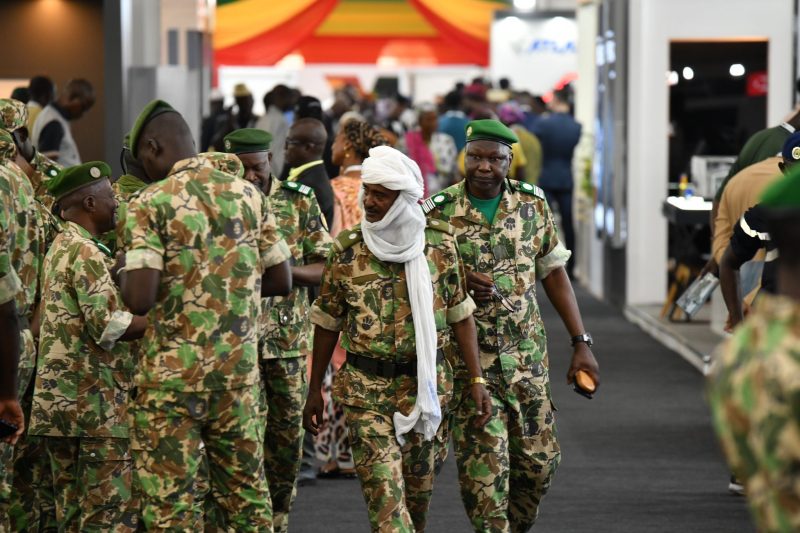
When the Bamako International Defence and Security Exhibition (BAMEX) opens its doors from 9 to 13 November 2026, it will do so as an event still finding its footing but already carrying real weight in a region most Western defence exhibitions have quietly written off. Ahead of the show, Military Africa spoke with Harun Saraç, Chairman of BAMEX, about what the organisers are building in Mali’s capital and why they believe the Sahel, despite the security challenges that have made it a byword for instability, represents one of the more consequential emerging markets in global defence.
A Platform, Not Just an Exhibition
Saraç is careful to distinguish between what BAMEX looks like on paper and what he says it is actually trying to become. “Our vision for BAMEX 2026 is to establish Bamako as one of the key meeting points for the defense and security industry in the Sahel and West Africa,” he said. “We want BAMEX to be more than an exhibition. Our goal is to create a platform where international companies can meet directly with military delegations, government representatives, leading industry distributors and key decision makers from the region.”
For 2026, Saraç is promising “stronger international participation, high level official delegations, direct engagement with regional stakeholders and, most importantly, a very business focused environment.” That framing matters because it marks a deliberate shift from where BAMEX started. Military Africa’s coverage of the inaugural edition in November 2025 described an event that, despite being billed as a pan-African platform, “functioned largely as a showcase for the Turkish defence industry’s deep integration into the security architecture of the Alliance of Sahel States.” That first BAMEX drew around 30 Turkish exhibitors, including ASELSAN, Baykar, Makine ve Kimya Endüstrisi (MKE), Roketsan, STM and Otokar, organised under the auspices of Mali’s presidency and its Ministry of Security and Civil Protection. Widening that base beyond a single national industry is, on Saraç’s own account, one of the central goals for this year’s edition.
Why the Sahel, and Why Now
Saraç’s case for the region rests on a straightforward observation about how defence markets actually work outside the major established buyers. “The Sahel is going through an important transformation in defense and security,” he said. “Countries across the region are strengthening their capabilities, investing in new technologies and looking for reliable long term partners.” But he was equally direct about what makes the region difficult for companies that try to approach it the way they might approach a European or Gulf procurement process. “This is a region where business cannot be developed only from a distance,” he said. “Relationships, trust, local understanding and direct access are extremely important.”
That argument is not merely a sales pitch. Mali, Burkina Faso and Niger, the three founding members of the Alliance of Sahel States (AES), have spent the past several years pulling away from their traditional Western security partners and rebuilding defence relationships from scratch, with Turkey moving fastest to fill the gap. Military Africa’s reporting on Turkey’s regional posture has traced how Bayraktar TB2 drones, first supplied to Niger in 2022, became central to Malian government forces’ ability to track and strike rebel groups across the country’s vast desert terrain, including during the recapture of Kidal. That track record is precisely the kind of on-the-ground credibility Saraç argues a company cannot build by exhibiting only at exhibitions in Paris, London or Abu Dhabi.
What Will Actually Be on the Floor
Asked which sectors would have the strongest presence, Saraç listed a genuinely broad sweep of the defence and security industry: land systems, unmanned aerial vehicle (UAV) and counter-UAV technologies, weapons and ammunition, electro-optics, communications, surveillance and reconnaissance, armoured vehicles, tactical equipment, border security, cybersecurity, and training and logistics. But he pushed back against the idea that BAMEX is chasing scale for its own sake. “It is not only about the size of the company or the stand,” he said. “We particularly want to welcome companies that are ready to understand the operational requirements of the region. This includes major international defense companies but also specialized and innovative companies offering technologies and solutions that respond to real needs on the ground.”
The emphasis on operational relevance over brand recognition echoes what set the first BAMEX apart from more conventional airshows. Military Africa’s coverage of the 2025 edition highlighted its “Demo Days,” a 48-hour window in which international delegations could watch equipment operate under real Sahelian conditions rather than in a climate-controlled hall, testing heat tolerance and dust ingress resistance, two factors that routinely degrade sophisticated equipment not designed for the region. Saraç referenced the same concept for 2026, noting that “delegations and the visitors will have the opportunity to test all the products live in Demo Day,” suggesting the format will continue as a defining feature of the exhibition rather than a one-off experiment.
Engineering the Meetings That Matter
Saraç described BAMEX’s core function less as an exhibition and more as a matchmaking operation between buyers and sellers who might otherwise struggle to find each other. “We do not want exhibitors simply sitting at their stands and waiting for visitors,” he said. “Our objective is to bring military leadership, government representatives, procurement authorities, security institutions and official delegations together with participating companies.” The organisers, he said, will facilitate targeted business-to-business, business-to-government and government-to-government meetings based on matching specific company capabilities to specific regional requirements, “rather than simply arranging meetings for the sake of numbers.”
He was candid that the real measure of the exhibition’s success will not be visible during the five days it runs. “For us, the real success of BAMEX is what happens after the exhibition,” he said, pointing to procurement decisions, local partnerships, training arrangements, technology cooperation, and maintenance and support agreements as the outcomes that actually matter. On the scale of participation expected this year, Saraç again resisted framing the event purely in terms of numbers: “Our priority is not simply to increase the numbers. We want the right companies and the right delegations in Bamako.” He described that combination, serious international companies meeting regional stakeholders with genuine decision-making authority, as what ultimately makes participation worthwhile.
An Invitation Built on Ground-Level Experience
Saraç’s closing message to prospective exhibitors drew directly on his own background working in Mali and the wider region. “I have been doing business in Mali and this region for years, and one thing I can say with confidence is that the Sahel cannot be understood from a distance,” he said. “This is a region where trust, relationships and being present on the ground really matter. You need to meet the people, listen to their requirements and understand how the market actually works.”
He was explicit that BAMEX is not designed as a low-commitment showcase. “We are not inviting companies to Bamako simply to rent a stand, display their products for a few days and go home,” he said. “We want them to meet the people who matter, understand the real needs of the region, develop relationships and hopefully leave Bamako with opportunities that can turn into long term business and cooperation.” Looking further ahead, Saraç framed early movers as securing a lasting advantage. “I also believe the Sahel will become an increasingly important market for the global defense and security industry in the coming years,” he said. “The companies that come here today, understand the region and build the right relationships will naturally be in a much stronger position tomorrow.”
His invitation to the industry was unambiguous. “If Mali, the Sahel or West Africa are part of your future strategy, my invitation is simple: come to BAMEX 2026,” he said. “Come with an open mind, meet the region for yourself and let us show you what BAMEX and Bamako can offer. We will be very happy to welcome you here.”
The Wider Context Behind the Invitation
Saraç’s pitch lands at a moment when Military Africa’s own analysis has raised harder questions about what, exactly, the Turkish-led model dominating BAMEX’s first edition leaves behind for host nations once the exhibition halls close, noting that Turkey’s Presidency of Defence Industries oversees a portfolio reported at more than 76 billion US dollars and describing BAMEX as “the Turkey pitch made visible.” Whether BAMEX 2026 succeeds in genuinely broadening its exhibitor base beyond that Turkish core, as Saraç says is now the goal, or continues to function primarily as a showcase for one country’s defence-industrial ambitions in the Sahel, is a question this year’s edition will begin to answer. What is not in question is the scale of the opportunity Saraç is describing: a landlocked capital of more than four million people, at the centre of a region actively rearming amid an ongoing jihadist insurgency, where governments have shown they are willing to make major, fast-moving procurement decisions once a supplier proves it can operate on the ground rather than simply from a catalogue.