

On 5 August 2026, South Africa’s state-owned defence group, Denel, informed Parliament’s Standing Committee on Appropriations (SCOA) that it secured its second consecutive profitable year, closing the 2025/26 financial year with a net profit of R156 million despite a decline from the R193 million recorded in 2024/25. Revenue rose 15% over the same period, from R1.2 billion to R1.4 billion, driven mainly by maintenance work in the Aeronautics, Landward, and Pretoria Metal Pressings (PMP) divisions. Denel’s chief financial officer told SCOA the profit decline stemmed from “cost control, guarantee fees and so on”, without detailing a single dominant cause.
The company’s income from associate businesses, among them Rheinmetall Denel Munition, climbed to R716 million from R411 million the year before. Denel also cut its borrowings sharply, from R183 million in 2024/25 to R58 million in 2025/26, and trimmed operating costs from R1.3 billion in 2023 to R694 million in 2025. That cost line is now projected to rise again, to R912 million, as the group works to retain staff. Denel told the committee it needs R4 billion in annual revenue to sustain that cost base on a lasting footing, a figure more than double what it currently earns.
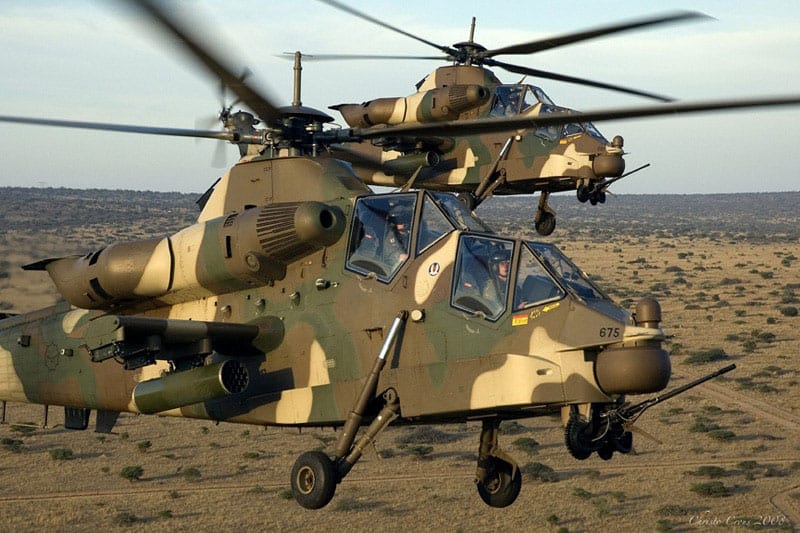
On operations, Denel reported it supported 8 Oryx transport helicopters, 5 Rooivalk attack helicopters, and 2 C-130 Hercules aircraft for the South African Air Force (SAAF) over the year, and delivered four operational A-Darter air-to-air missiles to the service. The results arrive five months after Defence and Military Veterans Minister Angie Motshekga installed a new Denel board on 12 February 2026, a step taken amid union pressure and a confidential forensic report alleging corruption and maladministration inside the group. The board, chaired on an interim basis by Tshidi Mokgabudi, will serve until 2029. Group Chief Executive Officer Tsepo Monaheng and Group Chief Financial Officer Matodzi Mukwevho kept their posts despite calls from the trade union Solidarity for their suspension pending investigation.
Denel’s shareholder oversight itself changed hands over the past two years, moving from the Department of Public Enterprises to the Department of Defence, a transition the company says was finalized in April 2025. The shift places the group’s commercial performance and its role as the South African National Defence Force’s (SANDF) primary equipment supplier under a single ministry for the first time in years.
To understand the scale of Denel’s decline, compare it to 2015/16, when the group generated a record-breaking revenue of approximately R8.2 billion. A board change that year, followed by governance failures tied to state capture and a Gupta-linked joint venture called Denel Asia, triggered a collapse. Revenue dropped to R5 billion in 2017/18 alongside a net loss of R1.76 billion, and losses peaked at R1.96 billion in 2019/20. Headcount fell from 4,950 in 2016 to about 1,600 by 2024. In May 2020, the group ran out of working capital and could not pay staff in full, a low point that pushed it into the turnaround programme still underway today. That programme drew on a R5.2 billion state support package, including a R3.4 billion Treasury guarantee and R992 million released from the Denel Medical Benefit Trust.
A planned R1.8 billion in proceeds from selling non-core assets never materialized because the Department of Defence declined to support the disposals, leaving Denel to service legacy debt out of operating cash flow, which the company itself has called unsustainable. The Auditor-General’s 2024/25 audit found that Denel could not fully account for how some of the bailout funds were spent and reported that only R277 million of the R3.4 billion guarantee remained unused by March 2025.
In January 2026, Denel faced extreme liquidity constraints that left the company on the brink of failing to pay employee salaries, an outcome averted only through intervention by Solidarity. On 19 August 2025, Draken International, a United States-based adversary-air training provider, filed a civil complaint in Florida’s Middle District Court over a $35.2 million contract for 12 Cheetah fighter jets, alleging Denel failed to deliver despite repeated extensions and seeking a $7.1 million refund plus damages.
Denel is nonetheless pursuing an order pipeline it values at roughly R53 billion, with about R41 billion in top-priority opportunities spanning missiles, unmanned aerial vehicles, and artillery systems, including Umkhonto-IR air defence missiles, the Ingwe anti-tank guided weapon, the Seeker 400 unmanned aircraft system, and T5 155mm artillery packages. More than R4 billion in contracts are already in execution, among them SAAF sustainment work, A-Darter missile support, and an unmanned aircraft support contract for the United Arab Emirates. The company has also signed cooperation agreements with Embraer, Airbus, and Safran aimed at African markets, and in January 2026 it formalized a memorandum of understanding with the Council for Scientific and Industrial Research covering cybersecurity, maritime technology, and aerospace research.
Work continues with Turkish firm Aselsan on the MEROPS targeting and surveillance sight intended for the Rooivalk helicopter. Denel projects a return to breakeven by 2027/28, with revenue climbing toward R3 billion, though it expects further losses before then.