
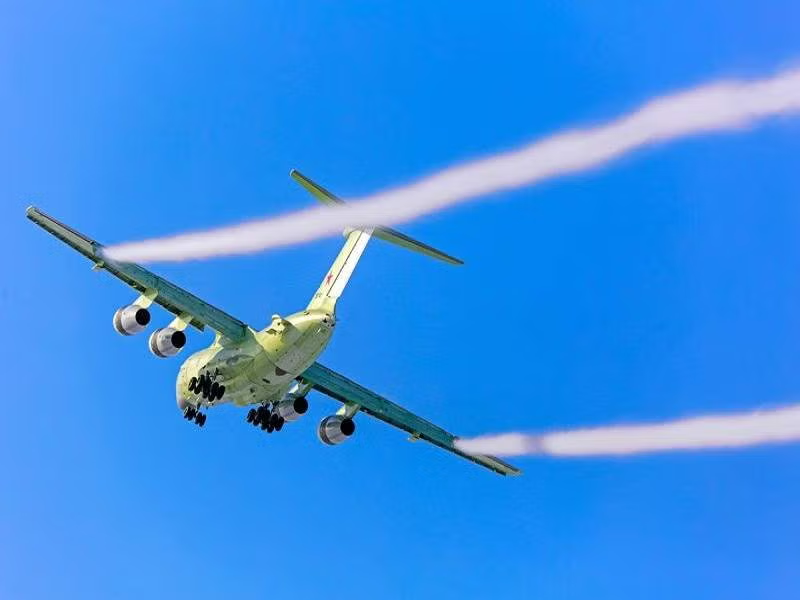
New footage of a rolled-out Il-78MK-90A aerial refueling tanker, built in export configuration, points to Algeria as the aircraft’s most likely buyer, adding a refueling arm to a Russian-supplied fighter fleet that already includes the export version of the Su-57 stealth jet.
The video began circulating on Russian social media and aviation channels, showing the tanker in what analysts describe as export trim. Some posts claimed the aircraft was built under a deal to supply 20 Il-78 tankers to China, but that claim could not be independently verified, and aviation analysts and insider sources have disputed it. Neither Rosoboronexport, Russia’s state arms exporter, nor Russian state media has confirmed the customer or contract tied to the newly shown aircraft.
Several of the same sources instead point to Algeria, which has signed a contract for three new Il-78 tankers with an option for three more. That deal sits inside a wider modernization package for the Algerian air force that also covers Su-34 strike aircraft and Su-35 and Su-57 fighter jets, according to Russian aviation reporting. in 2023, Algeria and Russia strengthened military ties.
Algeria became the first foreign operator of the Su-57E, the export version of Russia’s fifth-generation fighter. The state-run United Aircraft Corporation (UAC) confirmed in November 2025 that it had delivered the first two aircraft to the customer, a milestone that came during the Dubai Airshow. UAC chief executive Vadim Badekha told Russian television at the time, “Our foreign customer and our foreign partner have already received the first two aircraft. Algerian Su-35s have since been photographed in service, and the country has separately taken delivery of Su-34ME strike aircraft under contracts first reported in 2019.
The Il-78MK-90A is the export variant of the Il-78M-90A, itself built on the airframe of the Il-76MD-90A military transport produced by UAC. It runs on four PS-90A-76 turbofan engines, has a maximum takeoff weight of roughly 210 tons, and can transfer up to 78 tons of fuel depending on the mission. Total fuel capacity reaches 138 tons, and the aircraft can deliver that 78-ton figure to a receiving aircraft at a range of 1,000 kilometers from base, or 62 tons at 2,000 kilometers.
Three UPAZ-1M hose-and-drogue refueling pods, two under the wings and one on the rear fuselage, let the tanker refuel two tactical fighters at once or a single heavy aircraft such as a bomber or large transport. On the ground it can act as a fuel hub for up to four aircraft simultaneously, and it can handle two different fuel types at once without cross-contamination risk. Navigation and optical systems allow rendezvous and refueling at ranges up to 300 kilometers by day or night and in moderately poor weather.
Compared with older Il-78 variants running D-30KP engines, the newer PS-90A-76 powerplants give roughly a 10 percent gain in fuel transfer flow along with better efficiency and less noise. The tanker cruises at up to 850 kilometers an hour and refuels at altitudes between 2,000 and 9,150 meters, at speeds of 450 to 650 kilometers an hour. Its airframe can also operate from unpaved or dispersed airfields, not just concrete runways, which matters for forward-deployed or disaster-relief use. Rosoboronexport has also described convertible variants for cargo, firefighting and medical transport roles built on the same airframe.
Assembly happens at the Aviastar-SP plant in Ulyanovsk, the same facility that builds the Il-76MD-90A transport. The type first flew in January 2018, and Russia’s Ministry of Defense signed its first serial production contract for ten Il-78M-90A tankers for domestic use in 2020. Indonesia has separately submitted a formal request covering 2025-2030 that includes the Il-78MK-90A, though that remains an acquisition inquiry rather than a signed contract.
For Algeria, a tanker fleet would close a capability gap that has grown more visible as the air force is set to take in faster, longer-range aircraft. A future fighter force built around the Su-57 and Su-35 gains little from its speed and sensors if missions are capped by fuel load; aerial refueling lets those aircraft patrol further from base and loiter longer once there, whether over the western border with Morocco or the southern approaches toward the Sahel.
The tanker purchase also fits a broader Russian sales pitch. In June 2025, Rosoboronexport director general Alexander Mikheev outlined a defence package for African and Middle Eastern buyers spanning the Su-57E, Su-35, Il-78MK-90A tanker, Ka-52E attack helicopters, Mi-17 transport helicopters, drones and associated missile systems, along with armoured vehicles, naval platforms and air defence and counter-drone systems. Algeria’s growing shopping list tracks closely with that pitch.
Algeria’s spending underwrites all of it. The country logged $25.4 billion in military expenditure in 2025, the highest total in Africa and equal to roughly a quarter of public spending, according to the Stockholm International Peace Research Institute. That budget has funded a run of Russian deliveries stretching from Su-34 strike jets to the Su-57E, and now, most likely, a dedicated tanker fleet to support them.
Rosoboronexport has yet to confirm Algeria by name as the buyer of the newly rolled-out aircraft, and the first Il-78MK-90A delivery date has not been made public. With the contract for three tankers already reported and an option for three more on the table, the next marker to watch is whether Moscow or Algiers puts a name and a date to the airframe shown this week.