

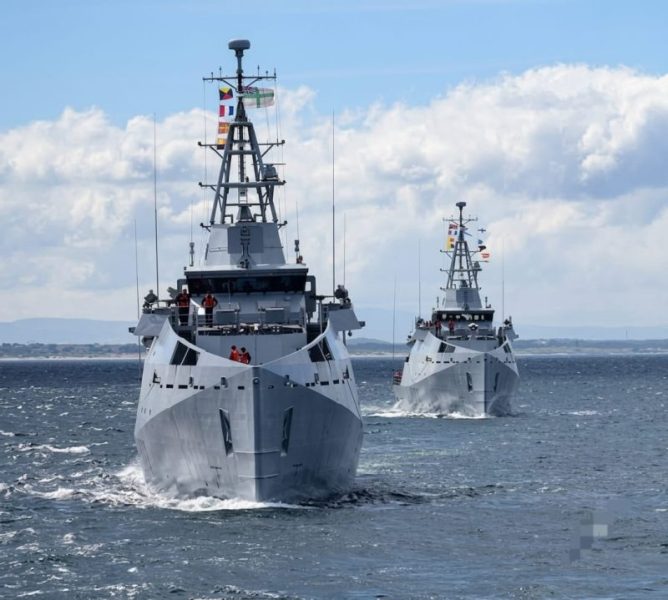
The South African Navy (SAN) opened its annual force preparation exercise, Red Lion 2026 (ERL 26), with a ceremonial colours parade on Monday 27 July at Simon’s Town naval base. It is scheduled to run until 28 August 2026, under the theme “capacity in preparedness”. Flag Officer Fleet, Rear Admiral Handsome Thamsanqa Matsane, addressed personnel on parade and said the exercise reflects the values the navy says it is built on: discipline, courage, integrity and service before self. “It is our annual opportunity to put the Fleet through its paces and determine if any course corrections are required”, he told the assembled crews. “Training under realistic conditions ensures that when the nation calls, our Navy is ready”.
ERL 26 is designed to build capacity across the fleet, test current doctrine and close training gaps identified in earlier exercises. It is not a navy-only affair. The South African Air Force and 4 Special Forces Regiment are both taking part, alongside civilian agencies including the Maritime Rescue Coordination Centre, the Aeronautical Rescue Coordination Centre, the National System for Incident Reporting, Cape Town Radio, the City of Cape Town, Cape Town Law Enforcement, the South African Police Service, the traffic department and South African National Parks. A Final Planning Conference held in mid-July at the Maritime Warfare Training Centre in Simon’s Town locked in the arrangements.
As reported by DefenceWeb, the exercise runs through three broad stages: combat readiness training, mission readiness training and mobilization, and a final field training exercise. Activity is spread across Simon’s Town, Silvermine, Wingfield, Gordon’s Bay, Saldanha, Durban, Gqeberha and Pretoria, reflecting the geographic spread of SAN units and headquarters staff. On day two, 28 July, building managers across the navy’s shore establishments attended a briefing on fire and evacuation procedures at the SA Navy Fire Department. Petty Officer David Donavan Saayman used the session to press the case for regular fire drills, routine checks of detection and extinguishing equipment and better hazard reporting from unit managers, a reminder that force preparation covers base safety as much as sea time.
ERL 26 will close with a 2-week field training exercise in which planners inject unscripted scenarios, forcing crews and shore units to react in real time rather than follow a fixed script. That format mirrors how the Navy has run Red Lion in recent years and is meant to test decision-making under pressure rather than rehearse set-piece drills.
The SAN’s blue-water core is four Valour-class frigates, built to the MEKO A-200SAN design under the 1999 Strategic Defence Package: SAS Amatola, SAS Isandlwana, SAS Spioenkop and SAS Mendi. Each displaces around 3,700 tonnes and carries a mix of surface-to-air and anti-ship missiles alongside a 76mm main gun. Budget pressure and deferred maintenance left much of the class sidelined for years, and refit costs have run to roughly R600 million per ship, with work on SAS Isandlwana targeted for completion around March 2026. SAS Amatola returned to sea duty in January 2025 after its own refit and picked up the navy’s Best Sailing Ship award for 2024/25.
The navy’s three Heroine-class (Type 209) submarines add an underwater deterrent element, though open-source reporting suggests only one has been consistently serviceable amid ongoing refit work. The more visible growth area has been inshore patrol capability. Three Warrior-class Multi-Mission Inshore Patrol Vessels: SAS King Sekhukhune I entered service in 2022, SAS King Shaka Zulu followed in 2023, and SAS Adam Kok III was officially received, named, and commissioned in 2025, built by Damen at its Cape Town yard under Project Biro. At roughly 1,000 tonnes, with a cruising speed of 20 knots and a range near 4,000 nautical miles, the class is intended to handle exclusive economic zone patrol, anti-poaching and border enforcement work that does not need a frigate’s firepower. That mix of an under-resourced blue-water force and a modernizing inshore fleet is the backdrop against which Red Lion is run each year.
The exercise gives the SAN a structured window to test whatever is actually seaworthy at the time, work through mobilization procedures with sister services, and rehearse the civil-military coordination that would matter in a real search-and-rescue or disaster-response scenario off the Cape coast. Red Lion 2025 covered similar ground over 3 weeks. It included a port visit from a French vessel plus a Visit, Board, Search and Seizure demonstration by the Maritime Reaction Squadron. Earlier iterations, including exercises in 2015 and 2016, followed a similar late-winter timing in the Western Cape, suggesting Red Lion has settled into a fairly consistent annual rhythm even as the ships available to it have changed.
ERL 26 will show planners which units and crews are ready to deploy on missions such as Operation Corona, the SAN’s EEZ patrol tasking, and which need further work before the next exercise cycle. It also gives newer platforms like the MMIPVs more time operating alongside the frigates and submarines in a coordinated task-group setting, which matters for a navy trying to rebuild readiness across a fleet that has spent much of the past decade short of serviceable hulls.