

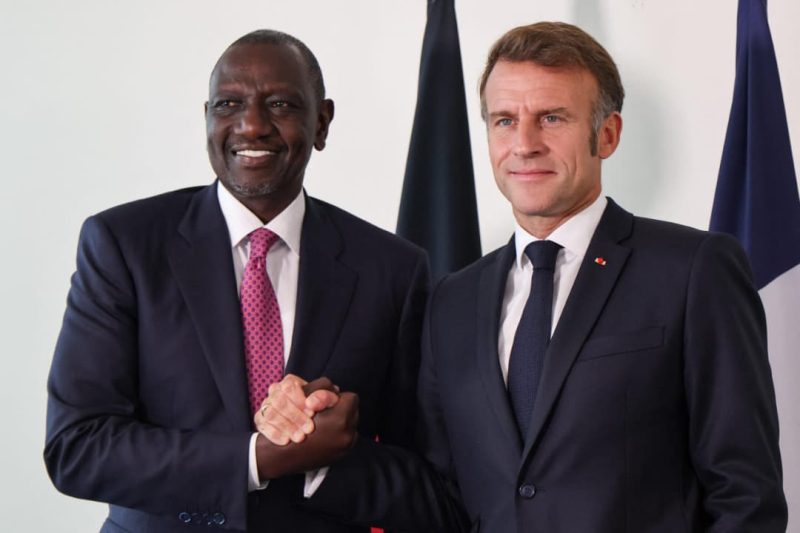
Kenyan President William Ruto joined the Group of Seven (G7) summit (The 52nd G7 Summit) in Évian-les-Bains, France, from 15 to 17 June 2026, capping eight months of accelerating military and commercial engagement between Nairobi and Paris.
The Evian trip followed the Africa Forward summit held in Nairobi on 11 and 12 May, where French President Emmanuel Macron and Ruto signed 11 bilateral agreements at State House. Both events built on a defence cooperation agreement (DCA) that Kenya’s Defence Cabinet Secretary, Soipan Tuya, and French Ambassador Arnaud Suquet signed at Nairobi’s Defence Headquarters on 29 October 2025. Kenya’s National Assembly ratified the pact on 9 April 2026, clearing the way for it to take effect as a five-year framework that renews automatically. The DCA sets rules for intelligence sharing, maritime security, peacekeeping, training and humanitarian assistance. It also grants visiting French forces certain privileges and immunities, a provision that drew objections from opposition lawmakers and prompted a public consultation period before ratification. Parliament tabled the agreement on 27 November 2025 and invited public submissions through the end of that year.
Three French warships, the frigate Aconit and the amphibious assault ship Dixmude, along with the offshore patrol vessel Finch, docked at Mombasa from 13 to 16 March 2026, carrying more than 800 personnel. The task group, sailing under the Jeanne d’Arc 2026 mission, was on a five-month deployment through the Indian and Pacific Oceans and used the stopover for resupply, crew rest and joint drills with the Kenya Navy. During the visit, Kenya’s Chief of the Defence Forces, General Charles Kahariri, received France’s Legion of Honour aboard the Dixmude in recognition of his role in building the bilateral relationship.
Kenyan forces bought SA-313 Alouette II helicopters in the 1960s, followed by SA-330 Puma and SA-342 Gazelle airframes, more than 80 AML armoured vehicles, and Milan anti-tank guided missiles during the Cold War. In 2011, Kenya acquired the P400-class offshore patrol vessel later commissioned as KNS Harambee II for anti-piracy work, and received a donation of a dozen French-designed Bastion armoured personnel carriers from the United States in 2018 for counterterrorism operations. Kenyan special forces, including the 40th Ranger Regiment, have trained with the French-made PGM 338 sniper rifle since at least 2021.
Mombasa sits on shipping lanes into the Indian Ocean that carry a large share of East African trade, and Somalia-based piracy and smuggling networks remain an active concern for regional navies. A French naval presence, even a rotating one built around port calls rather than a permanent base, gives Nairobi extra surveillance and training capacity without the political cost of hosting foreign troops long-term. France, for its part, gains a foothold near the Horn of Africa as it draws down its footprint in West and Central Africa, where Macron has pushed to cut troop numbers to around 600 amid a string of military expulsions from Sahel states since 2023. Analysts and Kenyan officials have pushed back on claims that the DCA creates a permanent French base, noting the agreement is a legal framework for cooperation rather than authorization for any specific deployment.
As reported by DefenceWeb, France ranks as Kenya’s fourth-largest trading partner in the East African Indian Ocean area, with 2-way trade between €288.5 million and €348 million in 2024 and a clear surplus in France’s favour. Kenya’s exports to France lean heavily on agriculture: processed vegetables worth about $26 million, tropical fruit at $18.9 million, legumes at $14.4 million, along with flowers and coffee. French exports run the other way, led by pharmaceutical products at roughly $47 million, anti-knock additives at $19 million and aircraft at $17.2 million, with pesticides, alcohol and metal containers filling out the list.
French firms operating in Kenya, more than 150 of them by Business France’s count, support roughly 36,000 direct jobs. TotalEnergies alone runs about 200 fuel stations, 2 depots, a lubricant blending plant, 2 LPG facilities and 3 aviation depots. France sits among Kenya’s top 5 foreign investors, accounting for more than 6.7% of foreign direct investment; Al Jazeera has separately reported French investment in Kenya at €1.8 billion over the past decade.
The 11 May agreements added fresh commitments in infrastructure and energy. They cover the modernization of Nairobi Central Station to the Embakasi rail corridor, a civil nuclear energy cooperation framework, the Masinga Dam project, meteorological service upgrades, sustainable aviation fuel production and expanded port capacity. Shipping group CMA CGM has separately pledged over $820 million for Mombasa port investment, while French investor Meridiam has committed more than €200 million to a Kenyan wind farm as Nairobi works toward a fully renewable power mix by 2030; The country’s grid already draws more than 90% of its electricity from hydro and geothermal sources.
For Kenya Defence Forces planners, the practical near-term effect is more joint training slots, deeper intelligence exchange and continued access to French equipment and doctrine, rather than any new basing arrangement. For France, the relationship offers a maritime security partner and a diplomatic showcase, since May’s Nairobi summit marked the first time the Africa-France gathering was held outside a Francophone country.