

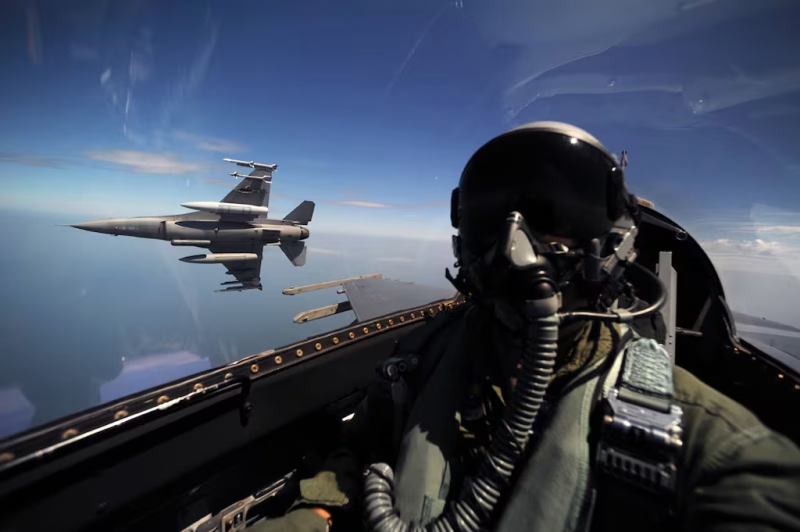
On July 22, 2026, the Washington Post reported that the U.S. was considering airstrikes in Mali, with National Security Council Senior Director for Counterterrorism Sebastian Gorka emerging as a vocal advocate. The airstrikes, thus far hypothetical, would either target the al-Qa’ida affiliate Jama’at Nusrat al-Islam wal-Muslimeen (JNIM) or the Islamic State (IS) affiliate Islamic State Sahel Province (ISSP). Despite interest from at least one voice in the administration, higher global military priorities, logistical constraints, and operational challenges make strikes both unlikely and strategically limited.
The administration’s consideration is part of a broader U.S. attempt at rapprochement with Mali and coup-led governments in the region, undoing efforts to distance the U.S. under the Biden administration. Within the past year, U.S. President Donald Trump’s team has attempted to warm relations with Mali, as evidenced by several high-level delegations, including visits by U.S. Africa Command (AFRICOM), the acting head of the U.S. State Department’s Bureau of African Affairs, and the U.S. Assistant Secretary of State for African Affairs. This re-engagement has not occurred in isolation, with the U.S. gradually re-engaging with key regional actors such as Cameroon, Niger, Burkina Faso, Benin, and Togo.
Notable among the U.S. military’s efforts is its cooperation with Nigeria. Starting in 2025, the U.S. and Nigeria exchanged several delegations focused on the growing threat of non-state actors and attacks on Nigerian Christians. The dialogue eventually led to the 2026 deployment of several hundred U.S. military personnel and the reported elimination of Abu Bilal al-Minuki, one of the senior-most Islamic State officials in the country.
The Unlikely, Likely Scenario.
The possibility of U.S. kinetic action in Mali, though unlikely, reflects a continuation of the administration’s efforts to reestablish a regional foothold and employ airstrike campaigns to constrain African terrorism, the epicenter of global terrorism. This same calculus has helped drive U.S regional efforts, all of which have occurred at the intersection of the administration’s transactional America First Foreign policy.
U.S. operations would likely aim to target ISSP, as it has shown a greater interest than JNIM in targeting the U.S. and its allies, though the latter still possesses the capability to do so. Since January 2025, ISSP has kidnapped an American citizen in Niger and, likely under the direction of global IS, pursued European operations. Moroccan and Spanish authorities have dismantled four IS cells involving dozens of operatives within this time frame, with at least one cell in direct communication with a senior ISSP leader. The threat ISSP poses as an enabler of external operations indicates that the U.S. would likely target senior ISSP officials to degrade this capability. Decapitation strikes are particularly effective in curtailing external capabilities due to the outsized role one individual can play in the logistical coordination of cells.[MP1]
Political and Logistical Constraints
Any action, if taken, likely won’t extend beyond intelligence, surveillance, reconnaissance (ISR), and airstrikes due to the political and logistical constraints the administration faces. Foremost, the U.S. likely does not have the political will to pursue a comprehensive counterinsurgency strategy. Unlike Nigeria, Mali lacks a significant U.S.-based lobbying base and the will to rouse domestic U.S. support as Nigeria did. Furthermore, Mali does not currently hold the geopolitical importance or pre-existing infrastructure, as seen in other causes of U.S. sustained action such as Somalia, to push the administration into action.
Beyond the administration’s political will, aerial operations face several logistical constraints. U.S. airstrikes or surveillance in Mali would require both parties to agree on a clear military objective, however as it stands, both actors likely have diverging interests. Similar to its efforts in Nigeria, the U.S. is likely more interested in targeting ISSP in a series of targeted strikes to decapitate senior leadership and degrade the group’s transnational capabilities. Conversely, the Malian junta likely prioritizes JNIM as it poses the greatest threat to its regime. These diverging priorities could limit if not entirely prevent U.S. action.
Any U.S. action would also require the U.S. military to deconflict or directly cooperate with the estimated 2,000 Africa Corps troops, a subsidiary of the Russian Ministry of Defense, stationed in Mali. The U.S. listed the Africa Corps’ predecessor, the Wagner Group, as a Transnational Criminal Organization in 2023. This, when considered along the Russo-Ukrainian war, makes cooperation infeasible.
The operational basing of aerial operations also poses a significant logistical challenge. Prior to the U.S.’s 2024 expulsion from Niger, strikes and surveillance could have launched[MP2] from the Agadez drone base, which the U.S. military spent over $100 million constructing[MP3] . However, at present, the U.S. military has no existing drone or strike capabilities stationed in the Sahel.[MP4] Thus, several unfavorable options exist. The U.S. could, as it did in Nigeria, launch Tomahawk missiles from the Gulf of Guinea. Modern conventional U.S. Tomahawk variants typically launch from either Arleigh Burke-class destroyers or Virginia-class attack submarines and can travel approximately 1,600 kilometers, placing the tri-border region and northern Mali at the edge of Tomahawks’ operational range[MP5] . However, this would require the U.S. to reposition existing assets, likely from the Persian Gulf, which would then risk weakening U.S. force projection around Iran.
The U.S. could alternatively base surveillance and strikes from Nigeria or elsewhere in coastal West Africa. In March 2026, the U.S. had an estimated 200 personnel and several MQ-9 Reaper drones stationed at Nigeria’s Bauchi base, roughly 1,300 kilometers from Mali. Although as of July 2026, the contingent has undergone a partial withdrawal. To effectively operate in Mali, the U.S. would need to significantly expand upon and reposition assets closer to Mali as MQ-9 Reaper drones only have a flight range and endurance of 1,850 kilometers and 27 hours, respectively. The U.S. separately used Accra, Ghana, to launch ISR flights over Nigeria in 2025, however, these never included kinetic strikes. Deploying U.S. assets to Mali is likely not an option due to the general insecurity, vulnerability of airbases, and overall resource constraints.
AFRICOM remains a posture-limited theater, meaning the combatant command has to compete for resources against other, higher-priority missions. Matt Petit, a nonresident senior fellow at the Atlantic Council and former NSC Director for the Sahel, noted: “ISR and strike assets have significant basing, operation, and maintenance footprints. Deterrence missions in the South China Sea and Taiwan Strait, CENTCOM activities in the Persian Gulf, and missions along the U.S. southern border and the Caribbean are much higher priorities for the Joint Force. AFRICOM would need to win trade-off battles against those missions to create even temporary infrastructure, task personnel, and then support assets in and around the Sahel. Given Pentagon budget outlays and requests for more funding from Congress, that’s very unlikely to happen at an effective scale.”
The Potential Impact
In the mid- to long-term, one-off airstrikes in Mali will do little to address the insecurity or alleviate pressure on the junta.[MP6] One-off airstrikes without coordinated ground incursions enable insurgents to reconstitute in targeted areas, limiting any strategic benefits. This is a strategy that the Sahelian juntas have pursued, but that has left them worse off than when they first seized power. Furthermore, while the elimination of senior leadership holds short-term benefit, al-Qaeda and the Islamic State have proven to be resilient to the loss of leadership.
Airstrikes may ultimately work against both the junta and the U.S. Though JNIM has lacked the intent to target the U.S, airstrikes could push it to retaliate and shift its posture. The group’s size and operational capabilities indicate that if it chose to, it could pose an equally, if not more dangerous threat to U.S. interests. U.S. airstrikes also challenge the junta’s sovereigntist rhetoric, rooted in disdain of Western actors, that served as a core justification for the putsch. This risks [MP7] degrading support for the junta in key urban centers, a constituency the junta cannot afford to lose. U.S. strikes or surveillance without clear messaging could also spread confusion and fear, as seen in the early sentiment of Nigerian communities reacting to the U.S.’s Christmas Day strikes in northwestern Nigeria. [MC8] [MP9]
In the short-term, U.S. airstrikes, specifically those targeting senior JNIM and ISSP officials, could have significant strategic benefits for the Malian junta and the U.S. [MP10] The elimination of senior JNIM and ISSP leaders and resulting disruption of the groups’ regional and external capabilities hold dual value, alleviating pressure from the junta and limiting the threat of attacks on the U.S. and its allies. Despite the possibility of marginal gains, the strategic reality remains. As West African security expert Aneliese Bernard observes, “airstrikes, in the absence of a clear strategy for a ground offensive, give the U.S. military little advantage in reducing the insurgency in the Sahel. Airstrikes serve to augment and support the security apparatus on the ground, and if we are not on the same page with the Malians and the Africa Corps about what our goals are in Mali, then one would have to question what the objective of U.S. airstrikes could be, and who stands to gain from them.