

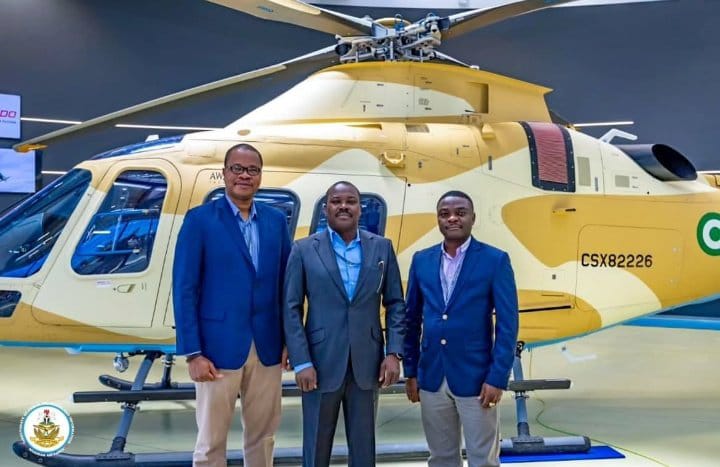
The Nigerian Air Force (NAF) completed factory acceptance testing on three additional AgustaWestland AW109 Trekker Type B helicopters between June 29 and July 3, 2026, at the Leonardo Helicopters facility in Vergiate, Italy, bringing its Trekker fleet to six of ten units ready for delivery, moving the aircraft one step closer to service in Nigeria’s counter-terrorism and internal security operations.
A joint delegation from the NAF and Nigeria’s Ministry of Defence carried out the acceptance exercise, according to a statement from Air Commodore Ehimen Ejodame, Director of Public Relations and Information at NAF headquarters. The team ran technical inspections and flight evaluations to confirm the aircraft met contractual specifications before shipment. The Chief of the Air Staff, Air Marshal Sunday Kelvin Aneke, framed the milestone as part of a broader readiness push. “The dynamic nature of contemporary security threats demands agile, technologically advanced and mission-ready air capabilities”, he said in the statement carried by NAF’s public affairs office.
The Trekker’s path into NAF service goes back several years. The service inducted its first two AW109 Power variants on 29 April 2019, then a second pair on 15 January 2020, building on a 2018 order for 6 A109-family helicopters placed under then-Chief of the Air Staff, Air Marshal Sadique Abubakar. In October 2024, NAF officials led by then-Chief of the Air Staff, Air Marshal Hasan Abubakar, met Leonardo executives in Rome to finalize a deal for 10 additional AW109 Trekkers, on top of two units NAF had already procured, as part of a wider package that also included 24 M-346 Fighter Ground Attack jets. That would put the NAF’s planned Trekkers holdings at 12 airframes once deliveries are complete.
President Bola Ahmed Tinubu inducted two Trekkers into service on 16 May 2025. The Nigerian Navy separately received 3 Trekkers from the Ministry of Defence in November 2024, for maritime security duties. This is a reminder that Leonardo’s light twin has found more than one customer within Nigeria’s armed forces. Between 12 January and 20 February 2026, a group of NAF technicians completed a six-week maintenance and systems diagnostics course on the Trekker at Leonardo’s Sesto Calende facility before returning to support fleet upkeep at home.
The AW109 Trekker is a light, twin-engine helicopter that Leonardo introduced in 2014 as a skid-equipped variant of the long-running AW109 family, the first twin-engine design from the manufacturer to trade wheeled landing gear for fixed skids. The change simplifies operations on unprepared strips and reduces the mechanical upkeep tied to retractable gear, a practical advantage for units operating from forward sites in Nigeria’s North and Niger Delta theatres.
Power comes from 2 Pratt & Whitney Canada PW207C turboshaft engines with full-authority digital engine control (FADEC), giving the aircraft a cruise speed of 285 km/h and a maximum takeoff weight near 3,175 kg. The cockpit uses Genesys Aerosystems glass avionics designed around single-pilot operation, which cuts crew workload during high-tempo missions.

The Trekker Type B can carry electro-optical and infrared sensor turrets and searchlights for night reconnaissance, and its airframe supports external mounts for rocket and machine-gun pods when configured for close air support or armed escort work. NAF has said the type will also serve combat search-and-rescue and joint operations alongside ground forces, a multi-role profile common to light military helicopters filling gaps between attack platforms and pure transport types.
Air Marshal Sunday Kelvin Aneke has reportedly opened discussions with Leonardo about establishing a dedicated support office in Nigeria to keep spare parts closer to operating units and cut downtime.
By standardizing more of its light helicopter fleet on the Trekker variant, NAF also simplifies logistics. The service already operates roughly 15 older A109E and LUH (Light Utility Helicopter) airframes, and folding newer Trekkers into that same family line reduces the number of distinct parts catalogs and maintenance courses its technicians need to master, even as the fleet grows in absolute size.