

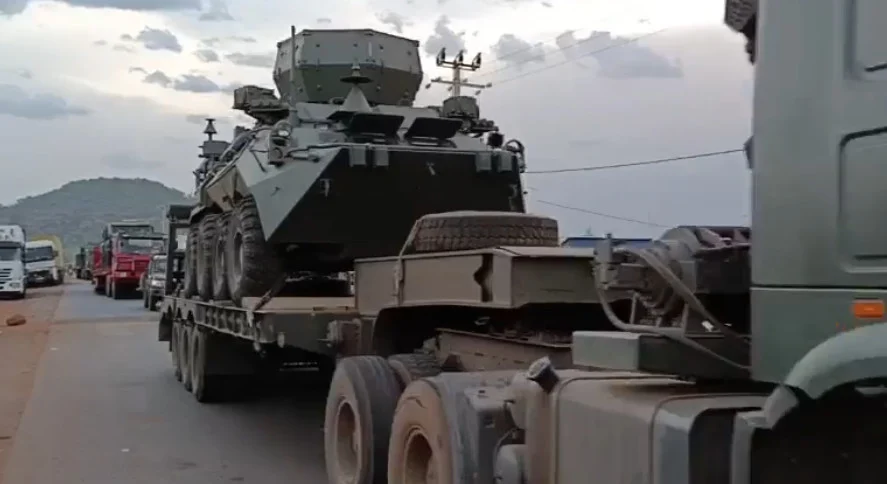
A Russian RB-531B Infauna electronic warfare (EW) vehicle has been photographed with Russia’s Africa Corps in Mali, according to images shared on social media by the open-source account Hammer Of War. The vehicle, built to jam radio communications and the signals used to set off roadside bombs, would be one of the more specialised pieces of Russian equipment seen with the Russian Ministry of Defence-controlled force in the Sahel.
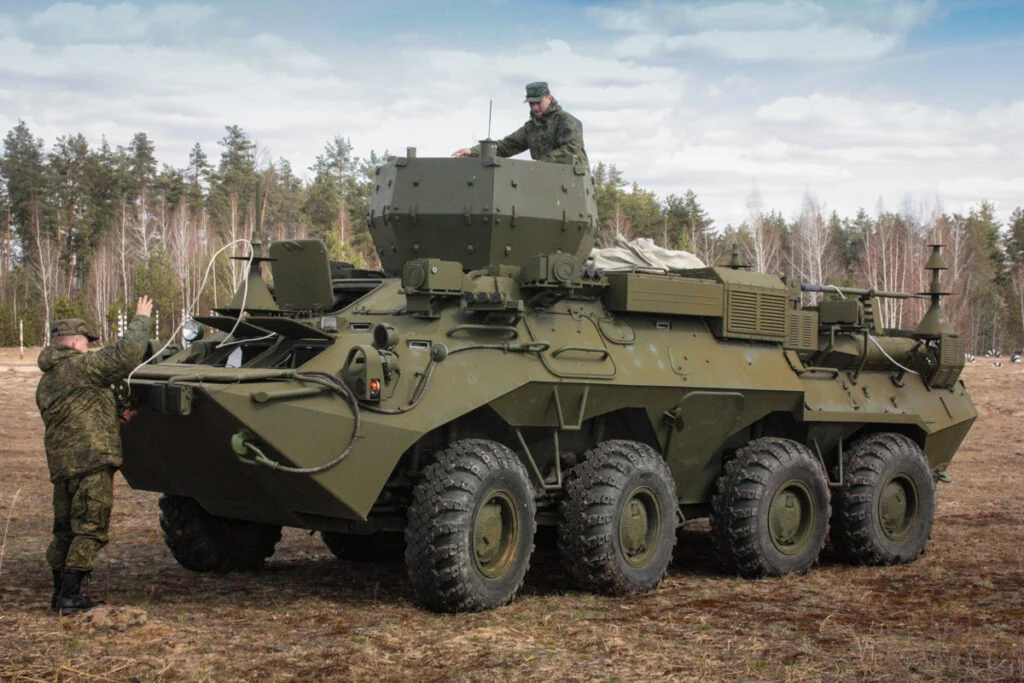
The account first posted a photo on 31 October 2026 identifying the vehicle as an Infauna, citing the account Casus Belli. The image shows the eight-wheeled vehicle carried on a low-loader truck in a road convoy, and Ukrainian outlet Militarnyi, which republished it, dated it to autumn 2026. In a follow-up post on 1 November, Hammer Of War shared a second image, taken in June 2025, showing a similar Russian-made EW vehicle with the Africa Corps, which it said could be either an Infauna or an R-934BMV Borisoglebsk-2. Neither Russia nor Mali has commented on the photos, and the date and location of the newer image have not been independently confirmed.
Jamming radios and roadside bombs
The Infauna sits on the K1Sh1 (GAZ-59039) armoured chassis, a variant of the BTR-80 wheeled armoured personnel carrier with an enlarged hull, and carries a telescopic roof mast with protected antennas. Rosoboronexport, Russia’s state arms exporter, markets an export version, the RB-531BE, as a system that searches for, locates and jams very high frequency (VHF) radio communications, blocks radio-controlled mines and improvised explosive devices (IEDs) whether moving or stopped, and fires aerosol screens to hide nearby vehicles from aimed small-arms fire.
The vehicle has a crew of three: a commander, a driver and an EW operator. A laser warning receiver automatically fires smoke grenades to screen the vehicle and the convoy it protects when it detects laser targeting. Development ran from 2005 to 2009 under the Russian Sozvezdie concern, and the first production systems entered service with the Russian Airborne Forces in 2012, according to Militarnyi.
That mix of tasks fits the threat Russian and Malian forces face in Mali, where jihadist groups and separatist fighters regularly ambush convoys and use roadside bombs on the routes between bases. The Borisoglebsk-2, the other possible identification, is a larger system aimed mainly at jamming enemy radio networks and has been used heavily by Russia in Ukraine.
Heavier Russian equipment for Mali
Russia has been sending heavier equipment to Mali since the Africa Corps took over from the Wagner Group in 2025. The Defence Blog previously reported on Russian tanks and armoured vehicles spotted in Mali, Military Africa reported in January 2025 that Russia was supplying heavy armoured vehicles, and the Africa Corps has since fielded a range of armoured vehicles across the country. Its arsenal has also grown in the air and in unmanned systems: Russia set up a combined aviation grouping in Mali, an Orion drone was sighted over Bamako, and the Africa Corps has deployed first-person-view (FPV) kamikaze drones.
Electronic warfare is spreading on both sides of Africa’s wars. In Sudan, the Rapid Support Forces have fielded the Belarusian Groza-S EW system, and armed groups in the Sahel increasingly use commercial drones and radios that an Infauna is designed to locate and disrupt.
Losses at Kidal and beyond
The force has also taken losses. On 25 April 2026, coordinated attacks by the al-Qaeda-linked Jama’at Nusrat al-Islam wal-Muslimin (JNIM) and the Tuareg separatist Azawad Liberation Front (FLA) hit Kidal, Gao, Sévaré, Mopti, Kati and Bamako, and killed Defence Minister Sadio Camara. The Africa Corps confirmed its withdrawal from the northern city of Kidal two days later, and The Moscow Times geolocated videos showing a convoy leaving the city and destroyed armoured vehicles that analysts said had been delivered to Russian forces in Mali in 2025.
Convoys have remained the weak point since. An FLA ambush on a convoy returning from Anéfis in July killed about 50 soldiers, and rebels and jihadists have continued to degrade Mali’s air capabilities, while Ukrainian drone teams have been reported operating in Africa alongside Russia’s opponents.
Protecting convoys on Mali’s supply roads
If the identification is correct, the Infauna’s job in Mali would be less about fighting rival armies and more about escorting supply columns through ambush country, jamming the radio links that trigger IEDs and the handsets that insurgents use to coordinate attacks. A single vehicle can protect only one convoy at a time, and jamming does nothing against command-wire or pressure-plate bombs, so its arrival points to Russia adapting equipment from the Ukrainian front to the Sahel’s road war rather than to a change in the balance of forces.