

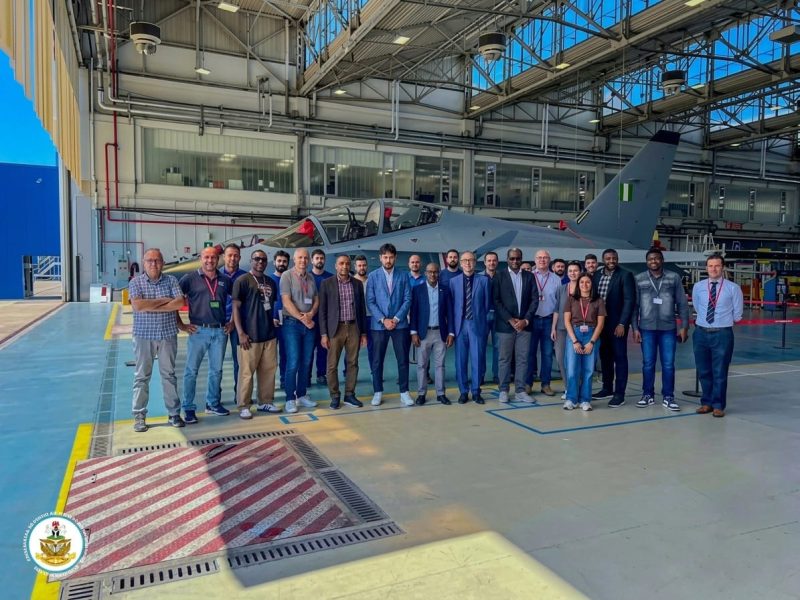
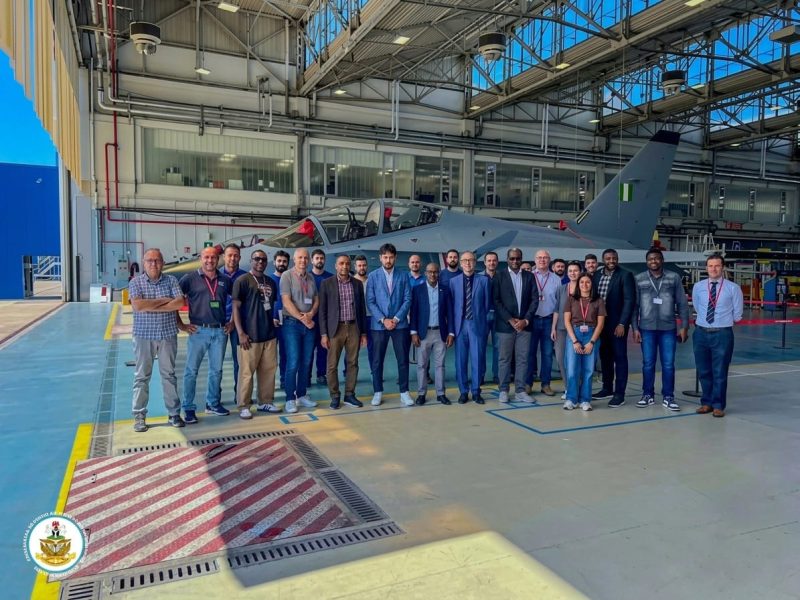
Thirteen Nigerian Air Force (NAF) personnel are completing a maintenance training programme in Italy to build the technical skills needed to keep the service’s new Leonardo M-346FA jets flying, with a final phase on engine run procedures due to end on 25 October 2026.
The training began on 13 July 2026 and involves four officers and nine airmen and airwomen. The group started with classroom instruction in Turin on airframe and propulsion systems, then moved to hands-on sessions at Leonardo’s M-346 production site at Venegono Superiore, in the Varese area of northern Italy. That practical phase ended on 25 September. The closing segment, on engine run procedures, involves a smaller group of two officers and four airmen and airwomen.
The NAF says the course is meant to raise aircraft serviceability and sustain operational readiness as the service builds a domestic maintenance workforce rather than relying on contractor support alone. Chief of the Air Staff Air Marshal Sunday Kelvin Aneke has presented the effort as part of a wider push for professionalism and standardised training across the force.
First Jets Cleared for Delivery
The course comes at a key moment for the programme. In late July 2026 the NAF announced that its first three M-346FA aircraft had passed factory acceptance testing (FAT), the formal inspection and sign-off confirming that an aircraft meets contractual and airworthiness standards. A joint NAF and Ministry of Defence delegation carried out the testing at Venegono Superiore between 29 June and 9 July 2026. Aneke called the milestone “another strategic step in strengthening the Nigerian Air Force’s operational capability,” according to the News Agency of Nigeria.
The three jets lead a much larger order. Nigeria has committed to 24 M-346FA aircraft under a contract valued at about €1.2 billion (roughly $1.4 billion), structured in four tranches of six aircraft, each package including armament, support equipment, spares, training and logistics support. The aircraft will equip two NAF squadrons. Nigeria’s interest in the type was first reported in 2021, the deal was finalised with Leonardo in 2023, and Aneke met company executives in Milan in January 2026 to review progress. Timelines have slipped before: a previous air chief said in October 2024 that the first three aircraft would arrive in early 2025, with deliveries running through 2026. Completion of FAT suggests the schedule is now firmer.
A Trainer That Can Fight
The M-346FA is the fighter-attack derivative of the M-346 Master, an Italian advanced jet trainer flown by air forces including those of Italy, Israel, Poland, Greece, Singapore and Qatar. Leonardo markets the twin-engine jet as a platform that can move between training and light combat roles. Nigeria’s version is fitted with the Leonardo Grifo-346 multimode fire-control radar, a defensive aids suite, a tactical datalink and a helmet-mounted display. Seven hardpoints, three under each wing and one on the centreline for an optional cannon pod, allow it to carry more than 2,000 kilograms of guided and unguided bombs, air-to-surface missiles, air-to-air missiles and targeting pods. Several defence companies have competed to supply weapons for Nigeria’s jets.

For Nigeria, that dual role matters. The aircraft is meant both to produce combat-ready pilots faster and to reinforce the NAF’s strike fleet. It will replace three ageing types still in front-line service: the Dassault/Dornier Alpha Jet, the Aero L-39ZA Albatros and the Aermacchi MB-339AN. Those aircraft have flown alongside the JF-17 Thunder and the A-29 Super Tucano in Nigeria’s long campaign against Boko Haram and Islamic State West Africa Province (ISWAP), and in operations against armed groups in the north-west. Replacing three legacy types with one common airframe should simplify spares, pilot conversion and ground support, which matters more to a sustainment-constrained air force than headline performance.
Keeping the Fleet Serviceable at Home
Sustainment is exactly what the Italian training is meant to address. Leonardo has said its support package covers the fleet for at least 25 years, and NAF leaders have floated the idea of a Leonardo maintenance hub inside Nigeria to keep more of that work, and the jobs that come with it, at home. Sending technicians through theory and practical instruction at the factory where the aircraft is built is a conventional way to seed that capability, giving Nigerian personnel direct exposure to the production line and engineering standards before the jets reach squadron service in numbers. Italy has also been raising its defence profile in Nigeria, with an official delegation and Leonardo at the AFRIDEX 2026 exhibition in Lagos.
Nigeria’s Italian Pipeline
The M-346 is not the NAF’s only Italian programme. The service is also receiving Leonardo AW109 Trekker light helicopters, three of which it accepted in Lagos on 6 October, and a separate group of technicians completed a six-week Trekker maintenance course in Italy earlier in 2026. Together, the 24 M-346FAs and ten Trekkers on order account for 34 aircraft in Nigeria’s Italian supply pipeline, a large share of the fleet renewal the air force has pursued over the past three years.