

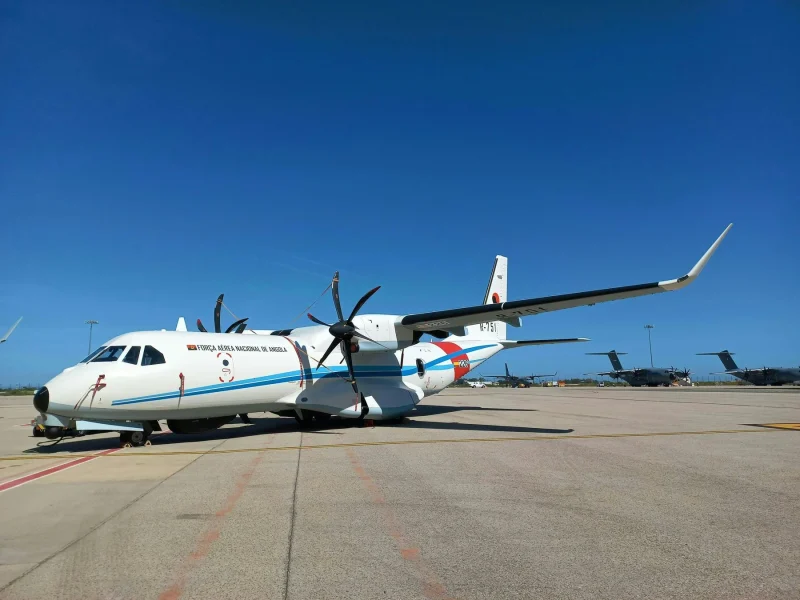
Airbus used a newly delivered Angolan C295 maritime surveillance aircraft at Africa Aerospace and Defence (AAD) 2026 to pitch the type to African air forces, including as a possible replacement for South Africa’s ageing maritime patrol fleet. The show ran from 16 to 20 September at Air Force Base Waterkloof, near Pretoria.
The aircraft belongs to the Força Aérea Nacional de Angola (FANA), the Angolan Air Force, and sat on the static display for the full show. It is one of two C295 maritime surveillance aircraft (MSA) in Angolan service, alongside a transport-configured example.
Angola placed a firm order for three C295s, two for maritime surveillance and one for transport, which made FANA the 38th operator of the type. The transport aircraft arrived in July 2024. Airbus handed over the two MSA aircraft on 7 November 2025. Both stopped at Gando air base in Gran Canaria on 4 November during the ferry flight.
Fernando Ciria, product marketing at Airbus Defence and Space, made the sales case at AAD, when speaking with DefenceWeb. He said the C295 suits smaller air forces because one airframe type can cover several jobs. Those forces often cannot afford separate fleets for transport, surveillance and medical evacuation. He called the aircraft part of the “skeleton” of an air force, next to larger tactical airlifters and dedicated surveillance types.

What the aircraft carries
The keeps most of the cabin free. Radar and sensor operator workstations and electronic racks sit toward the front, which leaves roughly two-thirds of the cabin for troops, cargo or stretchers. Airbus also sells palletised kits that roll on and off, so an operator can return the aircraft to transport duty.
Both MSAs use Airbus’s Fully Integrated Tactical System (FITS), which fuses sensor data into a single maritime picture on touchscreen displays. The Angolan suite centres on a multi-mission radar, an electro-optical camera system and an automatic identification system (AIS) receiver, which reads the position broadcasts that ships transmit. That mix covers maritime watch and some overland surveillance.
Heavier patrol versions add a magnetic anomaly detector, which senses a submarine’s distortion of the earth’s magnetic field. They can also carry torpedoes, missiles, mines and depth charges. Angola did not buy that end of the range.
The C295 is a twin-turboprop powered by Pratt & Whitney Canada PW127G engines. Its maximum cruise speed is about 260 knots, slower than a jet patrol aircraft. In exchange, it can stay on task for more than 11 hours. That endurance matters when a crew searches a large ocean area for small vessels that do not want to be found.
The aircraft also operates from short and unpaved strips, which helps on coastal deployments far from main bases. All three Angolan aircraft carry the Collins Aerospace Pro Line Fusion avionics suite, a glass cockpit with electronic checklists and approach data that cuts crew workload.
The market and the South African opening
Ciria said more than 337 C-295s are on order worldwide with 46 operators in 40 countries, and that 54 have gone to African customers. Airbus’s own November 2025 statement also put the African total at 54, spread across 11 air forces. Egypt is the largest African operator with 24 aircraft. Other buyers operate only a handful, which supports Airbus’s argument that small fleets can pay their way.
Interest is still growing. A Nigerian Air Force delegation led by Air Marshal Sunday Kelvin Aneke visited Spain from 14 to 18 March 2026 to study the C295 ahead of a possible purchase. South Africa is the harder target. The SA Air Force’s 35 Squadron at Ysterplaat in Cape Town flies the C-47TP, a turboprop-converted Dakota, for maritime patrol. The service received its first Dakotas in 1943. In September 2024, defenceWeb reported that the type was being withdrawn, that Project Pelican (the planned light transport and maritime replacement) had command approval, and that it could not proceed without funding.
Airbus has chased this requirement for years. It offered both the CN235 and the C295 when the SAAF first sought a Dakota successor under Project Saucepan. The AAD pitch is therefore marketing, not a live tender.
What comes next
For African buyers, the commonality argument is practical. One type, with shared pilot and technician training and a single spares chain, costs less to run than separate transport and patrol fleets. Angola’s two MSAs will show how well that works in service, particularly over its offshore energy zone. South Africa will decide on money before it decides on airframes. If Pelican gets funded, the C295 will meet competition, and the SAAF will need to choose between a cheap shared airframe and a more capable patrol aircraft. Nigeria’s talks with Airbus are the nearer test of whether the AAD pitch turns into orders.