

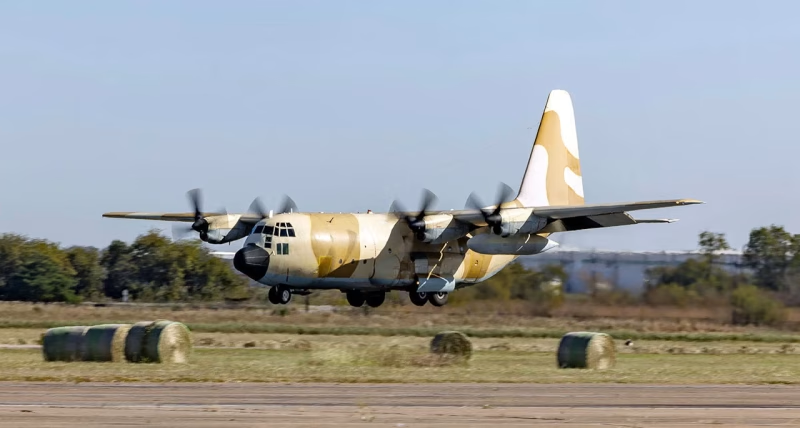
The first aircraft is already in Texas. A Royal Moroccan Air Force (RMAF) C-130H Hercules sits inside L3Harris Technologies’ maintenance and modification facility in Waco, undergoing the inspections, repairs, and system upgrades that mark the opening phase of a modernization programme expected to run through 2029. A second airframe has since joined it on the ramp. A third is due before the end of the year, and that one will leave Waco with a fully digital cockpit in place of the analogue instrumentation its crews have flown for decades.
This is the practical, visible start of a contract that L3Harris and the RMAF signed in the summer of 2025. It marks the point where the programme stops being a signature on paper and becomes work on a hangar floor.
From Contract Signature to Hangar Floor
Morocco’s Administration of National Defense formalised the agreement with L3Harris on 3 July 2025. L3Harris made the partnership public eleven days later, on 14 July, at an award ceremony in Rabat attended by the company’s President of Intelligence, Surveillance, and Reconnaissance (ISR), Jason Lambert, and the General Manager of the Waco facility, Sean Ling. The US Embassy’s Chargée d’Affaires at the time, Aimee Cutrona, marked the occasion publicly, describing it as a milestone moment in the ongoing US-Morocco partnership in defense and aerospace, language that reflects how closely Washington tracks the defence relationship it maintains with Rabat.
Lambert framed the agreement as the start of a long-term relationship rather than a one-off transaction, saying L3Harris would draw on its avionics expertise to deliver scalable modifications to enhance C-130 performance and fleet longevity. Military Africa reported on the contract when it was first signed, noting even then that the RMAF’s C-130H fleet, alongside its two KC-130H tankers, would be the direct beneficiary of the work.
Fifteen months on, that agreement has moved into its execution phase. L3Harris confirmed in late August 2026 that it had completed inspections on the first RMAF aircraft inducted into the programme, calling it evidence that the effort was moving from contract award into delivered work. The RMAF announced the arrival of a second C-130H at Waco that same month, describing the effort as a technology partnership carried out to the highest international quality and maintenance standards. A third aircraft is scheduled to enter the programme before the end of 2026 and will receive the most extensive package of the three: a full avionics upgrade built around a complete digital cockpit.
What Actually Happens in Waco
The work at Waco is not cosmetic. L3Harris’s contract covers aircraft modifications, programme depot maintenance (PDM), engine overhauls, and logistics support: the full slate of heavy structural and systems work that keeps an ageing airframe airworthy long after its original service projections have expired. The first aircraft through the line received a new standby instrument and a digital engine display, an incremental but meaningful step that replaces failure-prone analogue gauges with digital readouts crews can trust in poor visibility or at night. The third aircraft’s complete digital cockpit represents the deeper end of the same philosophy: replacing the entire instrument panel with the kind of glass-cockpit displays now standard on modern transport aircraft, while leaving the airframe, engines, and mission systems largely untouched.
That distinction, upgrading the aircraft rather than replacing it, sits at the centre of L3Harris’s pitch to Morocco and to every other C-130 operator it works with. Modernising an existing airframe costs a fraction of buying a new one, and it can be done far faster, since the alternative for most C-130H operators is a wait of years for a new-build C-130J Super Hercules to reach the front of Lockheed Martin’s production queue.
A Company That Has Done This Before
L3Harris did not arrive at this contract without a record to point to. The company brings more than four decades of experience modernising C-130 aircraft for the US Air Force, the US Coast Guard, and a range of international customers, and it currently serves as the prime contractor for the US Air Force’s C-130 Avionics Modernization Program (AMP) Increment 2, one of the largest fleet-wide avionics upgrade efforts the service runs. Its record includes delivering ten aircraft ahead of schedule to the US Coast Guard and developing an integrated data package for the type. L3Harris also states that it was the first company to successfully integrate the Collins APS-7000 digital autopilot onto a C-130H, a credential that speaks directly to the glass-cockpit work now underway on Morocco’s third aircraft.
That institutional depth matters more in this line of work than it might elsewhere. Modernising an aircraft that first flew half a century ago is not simply a matter of swapping old displays for new touchscreens. Engineers must integrate new digital systems into wiring, structures, and mission software that were never designed with them in mind, without disturbing flight-critical systems that have flown safely for decades. Get it wrong, and an operator loses an aircraft to grounding for months. Get it right, and a Hercules built during the Cold War can keep flying credibly into the 2040s.
The Fleet Being Rebuilt
The aircraft at the centre of this programme form the backbone of Moroccan military airlift. The RMAF currently operates 14 C-130H Hercules aircraft alongside two KC-130H tanker variants, supported by a smaller transport fleet of four C-27J Spartans, six CN-235 twin-turboprops, and several older Do 28 light utility aircraft. The Lockheed Martin-built C-130H models feature Allison T56-A-15 turboprop engines, a redesigned outer wing, and avionics that were considered current when they were installed decades ago. The aircraft themselves, however, are old: RMAF airframes range between 43 and more than 50 years in service, placing them well into the years most transport fleets are retired or replaced.
Morocco has kept them flying because the C-130H remains genuinely useful and because replacing fourteen tactical airlifters outright would represent a capital outlay competing against every other line item in the defence budget. The RMAF depends on these aircraft for tactical airlift of troops and equipment, humanitarian relief delivery, and support to special operations, missions that require an airframe that starts every morning, flies reliably, and can be trusted by the crews inside it. That reliability is exactly what programme depot maintenance and a digital cockpit are meant to restore and extend.
Some reporting around the contract has noted that Moroccan pilots have reportedly tested Embraer’s C-390 Millennium as a possible future addition to the transport fleet, and that the RMAF may eventually explore newer C-130J Super Hercules airframes as well. Nothing in the public record suggests either interest has progressed to a funded requirement. For now, the L3Harris contract represents Morocco’s actual, funded path for sustaining its Hercules capability rather than a stopgap ahead of a different aircraft purchase.
Part of a Much Larger Defence Build-Out
The C-130 modernization contract does not exist in isolation. It sits inside a Moroccan defence build-out that has accelerated over the past several years, backed by a defence budget estimated at $6.5 billion in 2024, with projections pointing to further annual growth through the remainder of the decade. Independent trackers vary in how they calculate that figure, since Morocco does not publish a single, uniform line item for total military spending, and estimates from other sources for the same year range considerably depending on what is counted as defence versus wider security spending. The direction of travel, however, is not in dispute.
As a major non-NATO ally of the United States, Morocco has built up $8.545 billion in active government-to-government sales cases through the Foreign Military Sales (FMS) programme, according to US State Department data. That total covers a wide range of hardware beyond the C-130 fleet: 25 F-16C/D Block 72 fighters, 36 AH-64E Apache attack helicopters, three CH-47D Chinook helicopters, HIMARS rocket artillery, Harpoon anti-ship missiles, and Sidewinder air-to-air missiles, among other systems. Military Africa has previously examined how the F-16 Block 72 and Apache programmes are reshaping Morocco’s ability to project precision airpower and mobile firepower across its own territory and the wider Maghreb. The C-130 contract is a quieter piece of that same build-out, but arguably just as consequential for day-to-day readiness: fighters and attack helicopters draw the headlines, but it is airlift that moves the troops, fuel, and equipment those fighters and helicopters depend on.
Meanwhile, Maintenance Aero Maroc (MAM) has officially broken ground on a new, state-of-the-art maintenance hangar at Benslimane airport, launching a strategic project to provide in-country heavy maintenance for the Royal Moroccan Air Force (RMAF) fleet. The ceremony, held on October 15, 2025, marks a milestone in a venture that brings together Moroccan, Belgian, and American industrial partners.
The facility is a joint venture between Lockheed Martin, the original equipment manufacturer (OEM) of the F-16 and C-130, and Sabena Engineering, a Belgian MRO specialist under the Orizio Group. They are partnered with Morocco’s MEDZ, the infrastructure development subsidiary of the state’s Caisse de Dépôt et de Gestion (CDG) investment fund.
Scheduled to be operational in the second half of 2026, the new centre is poised to become a regional hub for Maintenance, Repair, and Overhaul (MRO) services, starting with Morocco’s most critical air assets: the F-16 Fighting Falcon and the C-130 Hercules.
A Fleet with a Long Institutional Memory
Morocco’s relationship with the C-130 goes back further than this contract and further than the aircraft currently in RMAF service. On 18 July 2019, Morocco formally requested two additional C-130H aircraft from the United States under the Excess Defense Articles (EDA) programme, which allows Washington to transfer surplus military equipment to allied nations at reduced or no cost. The US government approved that transfer in June 2020, providing the two aircraft along with six C-130H pylons and fuel tanks for a package valued at approximately $60.8 million, a fraction of what two new-build tactical airlifters would have cost on the open market.
That history illustrates a consistent pattern in how Morocco has grown and sustained its Hercules fleet: opportunistic, cost-conscious acquisition of available airframes, followed by sustained investment in keeping them flying well past the point most air forces would consider retirement. The current L3Harris contract is simply the latest and most comprehensive chapter of that same approach, applied at a scale and depth the fleet has not seen before.
A Global Workhorse, Still Earning Its Keep
The C-130 Hercules remains among the most widely used military transport aircraft in the world. Lockheed Martin has delivered more than 2,700 C-130s since production began in the 1950s, with the type currently flown by more than 70 nations, a reach matched by very few other military aircraft of any type. Its reputation rests on genuine versatility: the same basic airframe handles routine tactical airlift, Antarctic ice resupply, aeromedical evacuation, weather reconnaissance, aerial firefighting, and crop spraying, often within the same air force’s fleet and sometimes across the same aircraft’s flying career.
For Morocco, that versatility has proven exactly as valuable as it has for every other operator of the type. A C-130H that moves troops one week, delivers earthquake relief supplies to a mountain community the next, and supports a counter-narcotics operation the week after is worth more to the RMAF’s daily operations than almost any other single aircraft type in its inventory. That utility is precisely why Morocco is spending money to extend these airframes’ lives rather than retiring them as they pass the half-century mark.
The next visible marker in the programme will likely arrive at the Marrakech Air Show, scheduled for 7 to 10 October 2026, where L3Harris is listed among the event’s main sponsors and where the modernization programme’s progress is expected to feature in the company’s public presentation. By then, if the current schedule holds, Morocco should have one modernised Hercules back in RMAF service, a second deep in the maintenance line at Waco, and a third about to begin the most extensive rebuild of the three.
Whatever else changes in Morocco’s air force in the coming years, whether that means new fighters, new attack helicopters, or eventually new-build transports, the fourteen ageing C-130Hs now filing through Waco will likely remain the aircraft actually moving people and cargo across Moroccan territory for a long time yet.